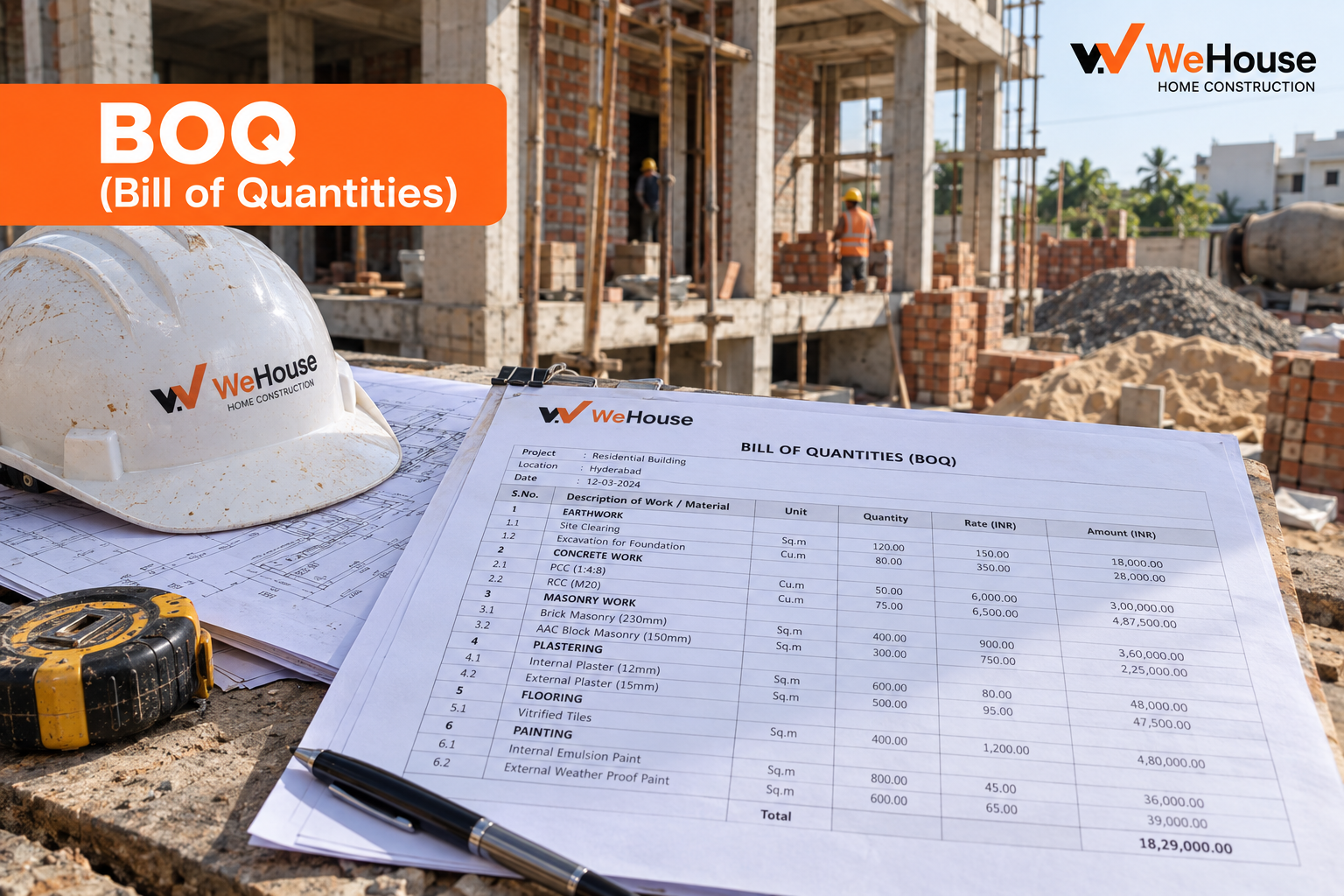
 What is a BOQ in construction?
A Bill of Quantities is an itemised list of everything that has to be built, measured from the drawings, with a unit, a quantity, a rate and an amount against each line. It turns a set of drawings into a number, and more importantly, into a number that can be audited line by line.
The core purpose is comparison. If three contractors each quote a lump sum for a house, you are comparing three different assumptions about specification, quantity and inclusion. If all three price the same BOQ, you are comparing rates for identical work. That is the entire value proposition.
What does a BOQ line item look like?
| Item | Description | Unit | Qty | Rate | Amount |
|---|---|---|---|---|---|
| 3.02 | Providing and laying M25 design mix concrete in columns, including formwork, vibrating, curing, excluding reinforcement | cum | 48.60 | 7,850 | 3,81,510 |
| 4.01 | Supplying, cutting, bending and fixing Fe 500D TMT reinforcement bars as per bar bending schedule | MT | 9.24 | 82,000 | 7,57,680 |
Notice the description does the heavy lifting. It states what is included and, critically, what is excluded. The words excluding reinforcement in the first item are why the second item exists. Vague descriptions are where disputes are born.
What are the main sections of a BOQ?
- Preliminaries: site setup, temporary works, water and power, site office, safety provisions.
- Earthwork: excavation, backfilling, disposal, compaction.
- Concrete: PCC, RCC split by member type, with formwork either bundled or billed separately.
- Reinforcement: TMT bars by weight, taken from the bar bending schedule.
- Masonry: brick or block walling, by thickness.
- Finishes: plastering, flooring, vitrified tile, painting, false ceiling.
- Doors and windows: flush doors, UPVC windows, hardware.
- MEP: plumbing, sanitary fittings, electrical points, earthing.
- External works: compound wall, gate, drainage, paving.
Which units are used in a BOQ?
Units follow IS 1200, the code for method of measurement of building and civil engineering works. Getting units right is not pedantry, it is what makes quantities checkable.
| Work | Unit |
|---|---|
| Excavation, concrete, backfill | Cubic metre (cum) |
| Plaster, flooring, painting, formwork | Square metre (sqm) |
| Reinforcement steel | Metric tonne (MT) or kg |
| Skirting, piping, railing | Running metre (rm) |
| Doors, fittings, fixtures | Number (nos) |
| Waterproofing | Square metre |
What is the difference between a BOQ and an estimate?
An estimate is an approximate cost, often derived from a rate per square foot, used for early budgeting and loan applications. A BOQ is a measured, itemised document derived from actual drawings, used for tendering and payment.
An estimate answers: roughly what will this cost? A BOQ answers: exactly what am I buying, at what rate, and how will I verify it was delivered? The estimate comes first, at concept stage; the BOQ comes once drawings are frozen. Do not treat a per-square-foot estimate as a contract basis.
How is a BOQ used during construction?
The document is live, not archival. Three ongoing uses:
- Running bills. The contractor claims for work done; the site engineer measures actual quantity executed and certifies payment against BOQ rates. This is far more defensible than a percentage-of-completion guess.
- Variations. When the owner changes a specification, the new work is priced using existing BOQ rates where the item exists, or by rate analysis derived from them where it does not. Without a BOQ, every change is a fresh negotiation from a weak position.
- Milestone billing. Payment stages can be tied to BOQ sections completed rather than vague descriptions like slab done.
How does the BOQ relate to the type of contract?
The BOQ is most powerful under an item-rate contract, and progressively less relevant as you move away from one.
| Contract type | Role of the BOQ |
|---|---|
| Item rate | Central. Contractor quotes a rate per item; payment follows measured quantities. Changes are valued at agreed rates. |
| Lump sum | Supporting. A fixed total is agreed, but the BOQ defines what that total includes, which is what protects you in a dispute. |
| Cost plus | Limited. The contractor is reimbursed actual cost plus a fee, so the BOQ serves mainly as a budget and audit reference. |
| Labour rate | Partial. Owner supplies material; the BOQ covers labour items only. |
Most Indian residential projects run as either item rate or labour rate contracts. In both cases the item descriptions carry the weight, because they define the boundary between what is included and what will later be claimed as extra.
How much does a BOQ cost to prepare?
A quantity surveyor typically charges Rs 5 to Rs 15 per sq ft for preparation, or 0.3 to 1 percent of project value. Engaging one through the full project for BOQ, bill certification and variation control runs 0.5 to 1.5 percent.
Against a typical Rs 1 crore house, that is Rs 50,000 to Rs 1.5 lakh. The comparison worth making is not against zero, but against the cost of discovering mid-project that the quoted rate excluded waterproofing and that the sanitary allowance was set at a third of what you intended to buy.
Common BOQ problems to watch for
- Provisional sums hiding real cost. A line reading sanitaryware, provisional sum Rs 2 lakh is not a priced item, it is a placeholder. Fix specifications early.
- Quantities supplied by the bidding contractor. Whoever measures controls the comparison. Have quantities prepared independently.
- Missing exclusions. Every item description should state what is not included.
- No wastage allowance stated. Clarify whether rates are inclusive of wastage, because 5 percent on steel is real money.
- Front-loaded rates. A contractor may price early items high and later items low to improve cash flow. Compare rates item by item across bidders, not just bottom lines.
- Taxes and cess unstated. Confirm whether GST and labour cess are inside or outside the quoted amounts.
Who prepares the BOQ?
A quantity surveyor or cost consultant, working from the architect's and structural engineer's frozen drawings. The architect confirms specifications that feed item descriptions. The owner approves before tendering. It should not be written by the contractor who will price it, for the same reason you would not let one bidder set the rules for the others. On smaller projects where hiring a dedicated QS is not viable, ask the architect to prepare at least an itemised quantity statement, and insist that all bidders price that same sheet.