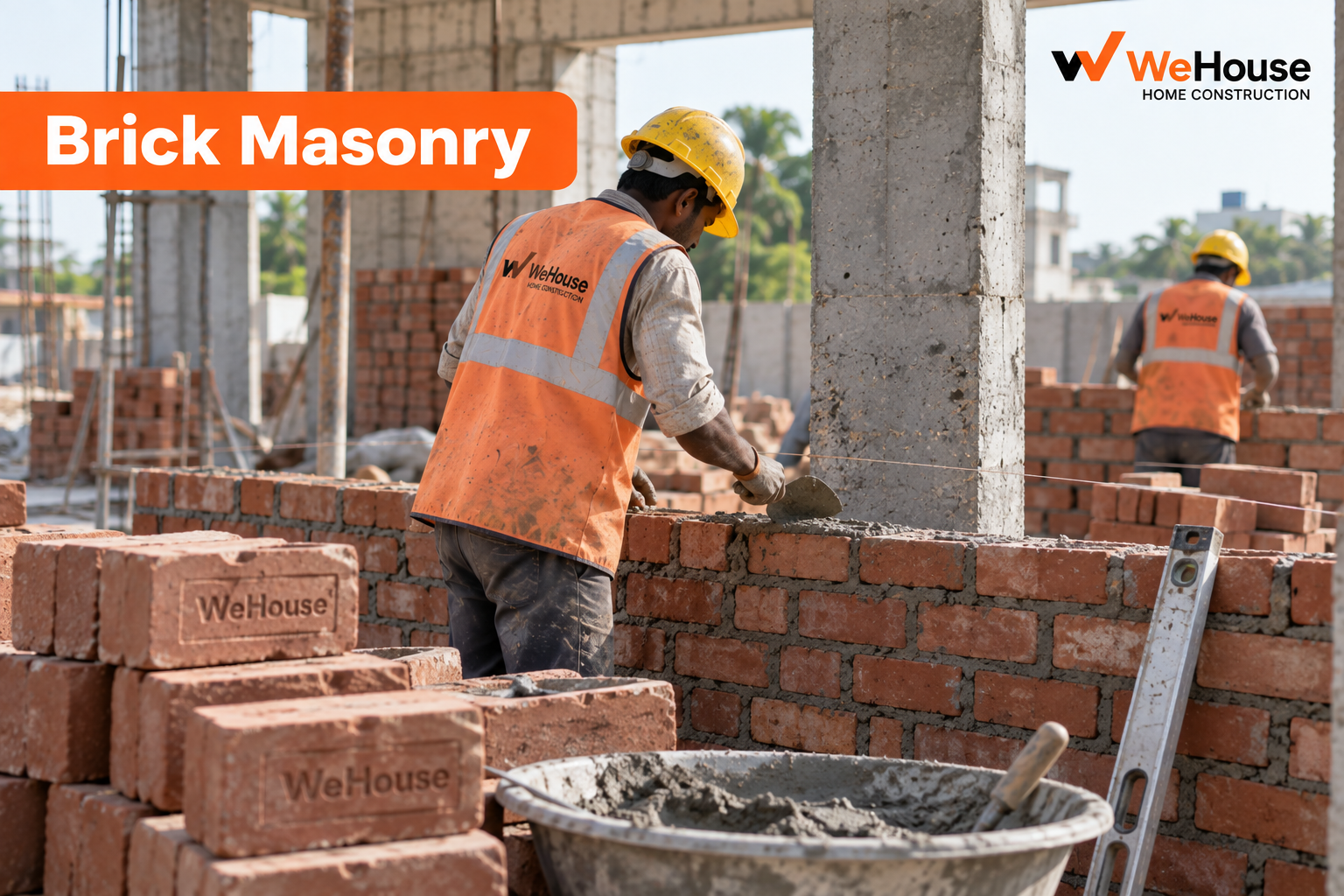
 What is brick masonry?
Brick masonry is a wall or structural element built by laying bricks in courses, bound together with mortar, in a pattern called a bond. In Indian residential construction it is almost always non-structural infill within an RCC frame of columns and beams, filling the gaps between the structural skeleton to form rooms. In older or low-rise construction, brick masonry can itself be a load-bearing wall carrying the roof and floor loads directly to the foundation.
The two variables that define a piece of brickwork are the brick itself and the mortar joint. A standard modular brick measures 190x90x90 mm; with a 10 mm mortar joint on each face it occupies a nominal 200x100x100 mm space, which is why brick counts and rate calculations use the round 200 mm figure even though the fired brick is smaller.
What wall thicknesses are used in brick masonry?
| Thickness | Common name | Typical use |
|---|---|---|
| 115 mm | 4.5 inch / half-brick | Internal partitions, non-load-bearing walls |
| 230 mm | 9 inch / one-brick | External walls, some internal walls needing sound insulation |
| 345 mm | 13.5 inch / one-and-half brick | Load-bearing walls in older low-rise buildings, boundary walls |
A 4.5 inch wall is cheaper and saves floor area but transmits more sound and heat; many owners now use it only for internal partitions and keep external walls at 9 inch, sometimes adding external insulation or a cavity for thermal performance in hot climates.
What mortar ratio is used for brick masonry?
Cement-sand mortar ratio depends on the wall's role. A 1:6 mix (1 part cement to 6 parts sand) is standard for ordinary internal and external brickwork. A richer 1:4 or 1:5 mix is used where the wall carries load, is exposed to dampness, or sits below plinth level. IS 2212, the code of practice for brickwork, and IS 1905, the structural design code for unreinforced masonry, set out the mortar grade required for a given wall's structural role. Joint thickness should be kept to 10 mm; thicker joints weaken the wall because mortar is less strong than the brick itself.
What bonds are used in brick masonry?
- Stretcher bond. All bricks laid lengthwise (stretcher face showing). Used for half-brick (115 mm) partition walls, the most common bond in Indian residential work.
- English bond. Alternating courses of stretchers and headers (brick end showing). Strong, used for one-brick and thicker load-bearing walls.
- Flemish bond. Alternating stretcher and header within the same course. Slightly weaker than English bond but considered more decorative for exposed brick facades.
Whichever bond is used, vertical joints in successive courses must never align (no two vertical joints directly above one another), since aligned joints create a continuous weak line through the wall, a defect called a ""straight joint.""
What quality checks matter in brick masonry?
Bricks conforming to IS 1077 should have a minimum compressive strength of 3.5 N/mm2 for the lowest class used in general work, rising to 10 N/mm2 and above for load-bearing use, and water absorption should not exceed 20 percent by weight after 24-hour immersion. On site, a good brick should give a clear metallic ring when struck, should not break when dropped from about a metre, and should show a uniform, non-crumbly fracture when broken in half. Bricks should be soaked in water for at least 2 hours (until air bubbles stop) before laying, so they do not draw water out of the fresh mortar and weaken the bond, a defect that shows up later as hairline cracking and poor plaster adhesion.
How much does brick masonry cost in India?
As of September 2026, a 9 inch (230 mm) red clay brick wall costs roughly Rs 75-95 per sq ft and a 4.5 inch (115 mm) wall costs roughly Rs 55-70 per sq ft, materials and labour included; these are indicative all-India figures and vary sharply by state, since brick, sand and mason labour rates differ regionally. Fly ash bricks, where locally available, typically run 10-20 percent cheaper and are more dimensionally uniform, which reduces mortar consumption and plaster thickness. Red clay brick remains the default in much of India despite fly ash and AAC block alternatives, mainly on account of established mason familiarity and local supply.
What goes wrong with brick masonry on site?
- Dry bricks laid without soaking. Weak, brittle joints and later cracking.
- Excess mortar joint thickness. Joints thicker than 10-12 mm reduce wall strength and increase shrinkage cracking.
- Aligned vertical joints (straight joints). Creates a structural weak line.
- Racking up too fast. Raising more than about 1-1.2 m of wall height per day risks the fresh mortar below being crushed or bulging out of plumb.
- No curing. Brickwork needs curing for at least 7 days like any cement-based work; skipping it weakens the mortar joints.
- Chasing for electrical/plumbing conduit cut too deep or too soon. Cutting more than one-third of wall thickness for a chase, or cutting before the wall has gained strength, can destabilise the wall locally.
Which IS codes govern brick masonry?
IS 1077 specifies common burnt clay building bricks and their classes by strength. IS 2212 is the code of practice for execution of brickwork. IS 1905 covers structural design of unreinforced masonry, relevant where brickwork is actually load-bearing. See IS Code for how these references work together. On a typical residential job the useful question to ask a contractor is simply which brick class is being used, what mortar ratio, and whether bricks are soaked before laying — these three answers tell you most of what you need to know about the quality of the brickwork.