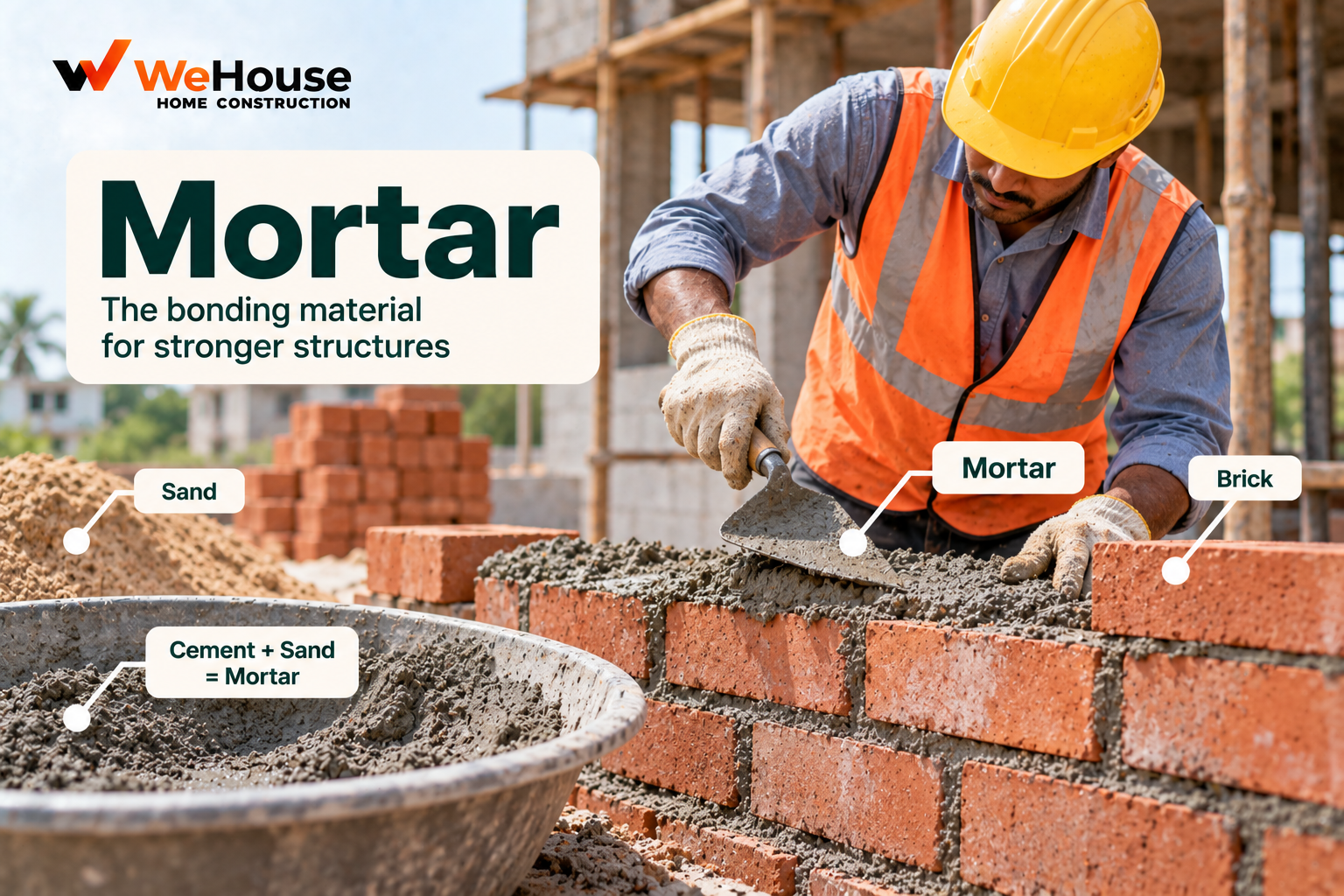
 What is mortar?
Mortar is a workable, paste-like building material made by mixing cement, sand and water in a specific proportion, used primarily to bind masonry units (bricks or blocks) together in masonry construction, and as the base coat material in plastering. Once mixed with water, the cement component undergoes hydration — the same chemical hardening reaction that gives concrete its strength — binding the sand particles together into a hard, durable matrix that fills and seals the joints between masonry units or coats a wall surface.
What mortar ratios are used for different applications?
| Application | Typical ratio (cement:sand) | Why |
|---|---|---|
| Ordinary brickwork (partition walls) | 1:6 | Adequate strength for non-structural infill, economical |
| Load-bearing or external brickwork | 1:4 to 1:5 | Higher strength and water resistance needed |
| Plastering (general) | 1:4 to 1:6 | Balances workability, crack resistance and cost |
| DPC and waterproofing-critical work | 1:1.5 to 1:3, often with waterproofing compound | Maximum density and water resistance |
A richer mix (more cement relative to sand) generally gives higher strength and better water resistance but costs more and is more prone to shrinkage cracking if used indiscriminately; a leaner mix is more economical and has lower shrinkage but correspondingly lower strength, which is why the correct ratio is matched to each specific application rather than using one uniform mix throughout a project.
How is mortar workability managed on site?
Fresh mortar needs adequate workability — enough fluidity to spread and bed properly, without being so wet that it loses strength or runs excessively. Mortar should generally be used within 30-45 minutes of mixing with water, after which it begins to stiffen as hydration proceeds, losing workability and bonding effectiveness; mortar that has begun to set should never be re-tempered by simply adding more water and reusing it, a common but quality-compromising shortcut, since this disrupts the proper water-cement ratio and weakens the final hardened mortar.
What types of mortar are used in Indian construction?
- Cement mortar. The standard mortar type in contemporary Indian construction, a simple cement-sand-water mix, used for the great majority of brickwork and plastering.
- Cement-lime mortar. Lime added to improve workability and reduce shrinkage cracking, somewhat more common in older or heritage construction and specialist restoration work than in ordinary contemporary residential building.
- Ready-mix mortar. Factory-proportioned dry mortar mix, supplied in bags and mixed with water on site, increasingly used on larger projects for consistent quality and reduced on-site measurement error compared to manually proportioning cement and sand.
- Waterproof / polymer-modified mortar. Mortar with added waterproofing compound or polymer, used for DPC, bathroom and other water-exposure-critical applications.
What goes wrong with mortar on site?
- Incorrect proportioning. Mixing by loose volumetric estimation rather than careful measurement, leading to inconsistent mortar strength across a project.
- Using stale, re-tempered mortar that has already begun to set, weakening the final bond.
- Wrong ratio for the application, such as using an overly lean mix for load-bearing or water-exposed work, or an unnecessarily rich mix for ordinary partition work.
- Poor sand quality. Sand with excessive silt or clay content weakens mortar significantly even if the cement ratio itself is correct; IS 2116 sets quality limits for sand used in mortar.
- Inadequate curing of finished brickwork or plaster, since mortar, like any cement-based material, needs sustained moisture to develop its full strength.