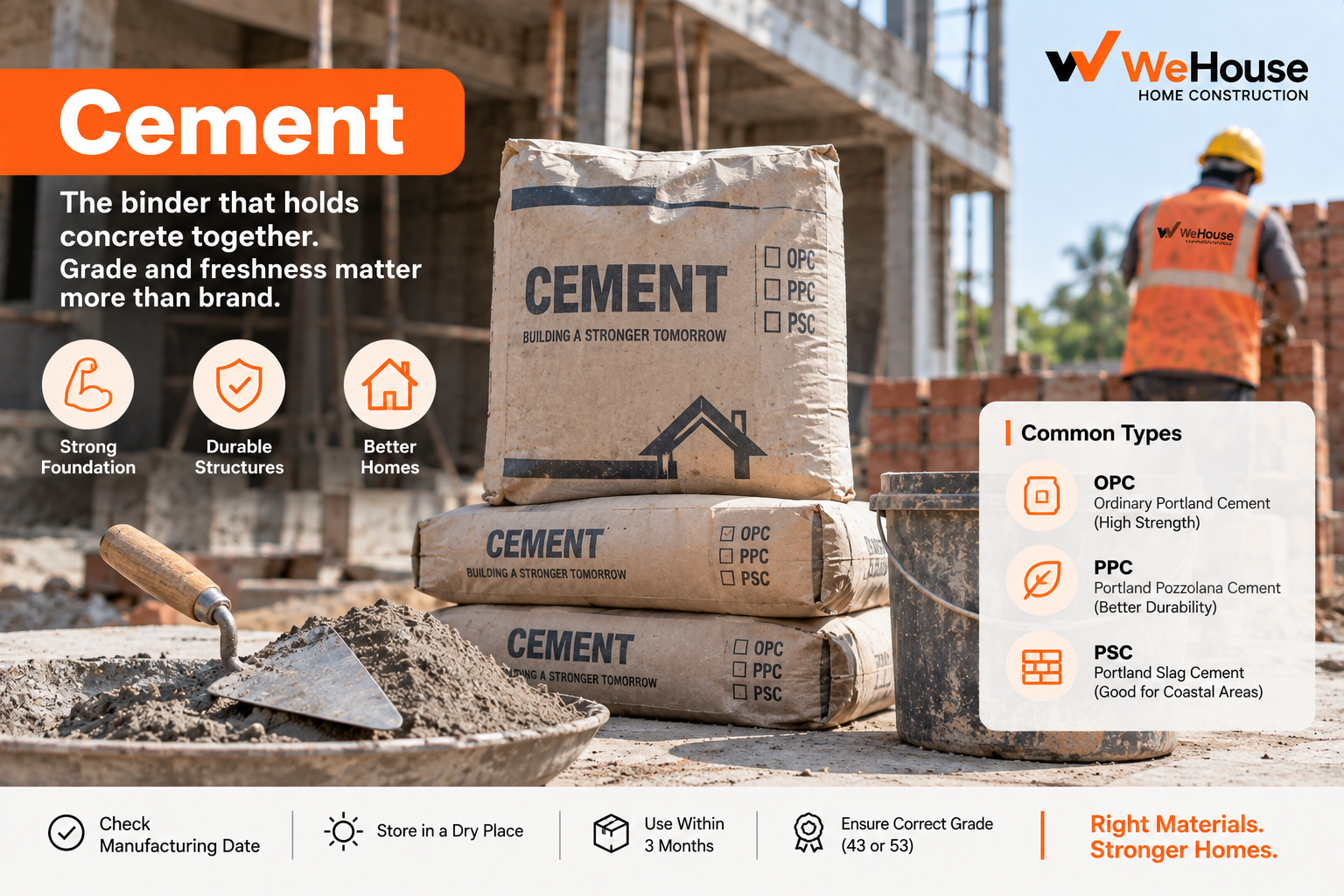
 What is cement?
Cement is a fine grey powder that acts as the binding agent in concrete and mortar. It is manufactured by heating limestone and clay in a kiln to around 1450 degrees Celsius to form clinker, which is then ground with a small amount of gypsum, and in the case of blended cements, additional materials like fly ash or slag. When mixed with water, cement undergoes hydration — a chemical reaction, not simple drying — that forms interlocking crystalline compounds binding the sand and aggregate around it into a hard, load-bearing mass.
What types of cement are used in India?
| Type | IS Code | Key feature | Typical use |
|---|---|---|---|
| OPC (Ordinary Portland Cement) | IS 269 | Higher early strength, higher heat of hydration | Precast, RCC needing fast strength gain |
| PPC (Portland Pozzolana Cement) | IS 1489 | Fly ash blended, lower heat, better long-term durability | General RCC, mass concrete, most residential work |
| PSC (Portland Slag Cement) | IS 455 | Slag blended, good sulphate/chloride resistance | Marine and industrial structures |
OPC is further graded 33, 43 and 53, the number denoting minimum 28-day compressive strength in N/mm2 (megapascals) on a standard mortar cube. Grade 53 gains strength fastest and is favoured for precast and high-strength work; Grade 43 remains the most common general-purpose OPC grade. PPC has largely displaced OPC 33 for everyday residential concrete and mortar because it produces less heat during hydration (reducing early-age cracking risk in mass pours), resists sulphate attack better, and is generally the cheaper, more widely stocked option.
How much cement is used in concrete and mortar?
Cement content in concrete depends on the grade of concrete specified. An M20 mix typically uses around 300-320 kg of cement per cubic metre, while an M25 mix uses roughly 320-360 kg per cubic metre; higher grades require correspondingly more cement or a lower water-cement ratio. For brickwork mortar, a 1:6 mix uses roughly 5-6 bags of cement per cubic metre of mortar, while plaster mortar at 1:4 or 1:6 uses a broadly similar range depending on thickness and coat.
What is the correct setting time for cement?
Per IS 269 and IS 4031 (the testing methods code), initial setting time for OPC must be no less than 30 minutes — giving enough working time to place and finish the mix — and final setting time must be no more than 600 minutes (10 hours). Cement that sets too fast on site (well under 30 minutes) or shows lumps that do not break apart under light finger pressure usually indicates it has absorbed moisture and partially hydrated in storage, and should not be used for structural work.
How should cement be stored on site?
- Off the ground. Store bags on a raised wooden platform at least 150-200 mm above floor level to prevent ground moisture uptake.
- Stack height. No more than 10-12 bags high, to avoid the lower bags compacting and partially setting under weight.
- Away from walls. Keep a gap of at least 300 mm from external walls, which can carry dampness inward.
- First in, first out. Use older stock first; cement loses roughly 20 percent of its strength after 3 months of storage even in ideal dry conditions, and considerably faster in humid conditions or once a bag is opened.
- Covered storage. A dry, covered godown is essential, especially during monsoon; even a short exposure to rain can ruin an entire stack of bags.
How much does cement cost in India?
As of September 2026, a 50 kg bag of OPC or PPC from a major national brand costs roughly Rs 350-420, with regional variation driven by freight distance from the nearest plant, local taxes and seasonal demand (prices typically firm up just before and during the pre-monsoon construction push). Bulk orders for large projects generally attract a 5-10 percent discount over retail single-bag pricing. Cement is usually the second-largest material cost after steel in an RCC-framed residential build, commonly 12-16 percent of total material cost.
Which IS codes govern cement in India?
IS 269 covers OPC, IS 1489 covers PPC (in two parts, for fly ash and calcined clay based pozzolana respectively), and IS 455 covers PSC. IS 4031 sets out the standard test methods for setting time, fineness, soundness and strength. IS 456, the master code for plain and reinforced concrete, references these material standards and sets minimum cement content requirements for different exposure conditions. See IS Code for how to read these references together on a drawing or specification.