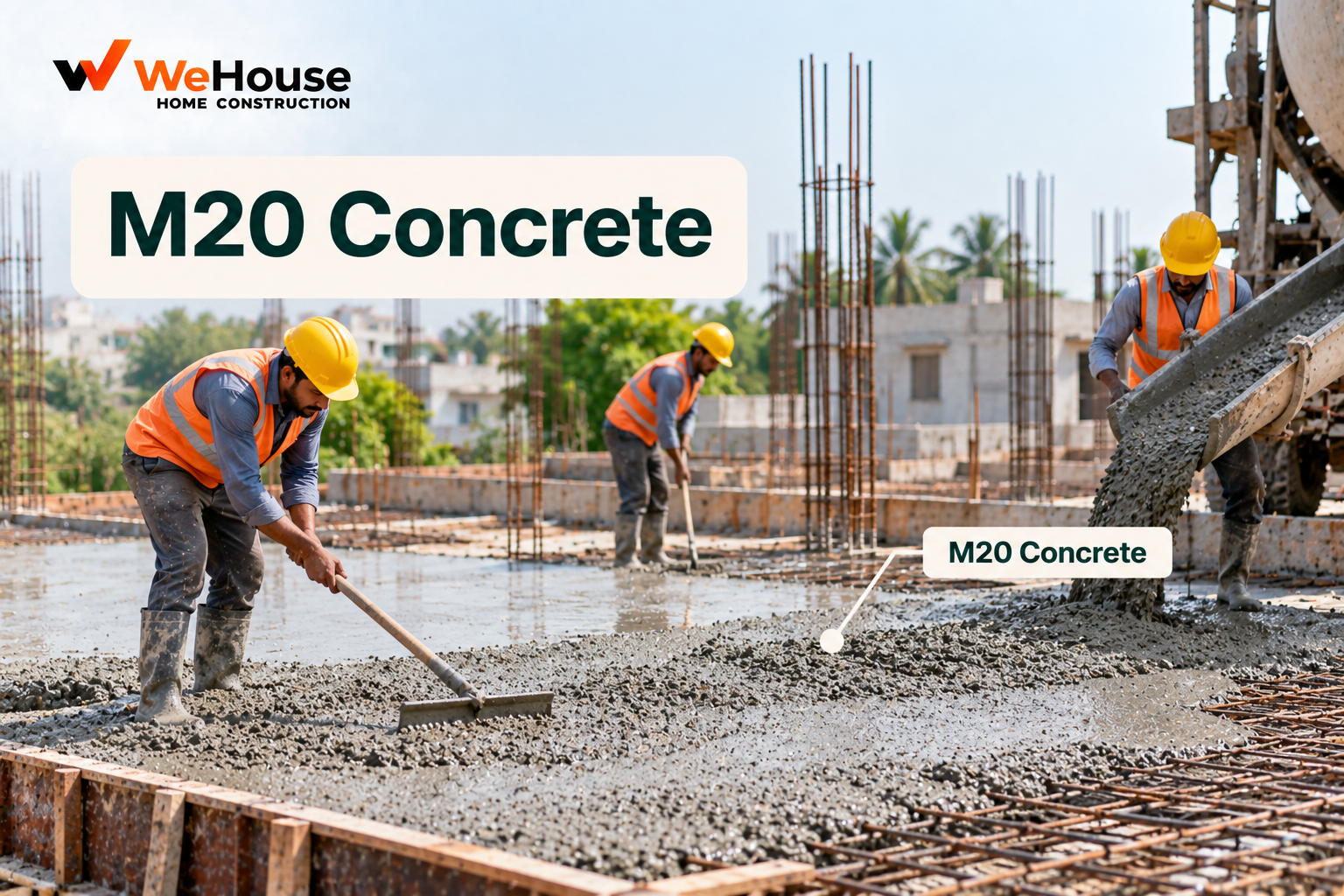
 What is M20 concrete?
M20 concrete is a specific concrete grade, meaning it is designed and expected to achieve a characteristic compressive strength of 20 N/mm2 (megapascals) when tested on a standard 150 mm cube at 28 days after casting, under the testing methodology set out in IS 516 and the acceptance criteria in IS 456. It is significant specifically because IS 456 sets M20 as the minimum grade permitted for any reinforced concrete construction in India — no structural RCC element, regardless of how lightly loaded, can legally use a weaker concrete mix than this.
Where is M20 concrete typically used?
- Lighter residential structural elements. Where the structural engineer's design confirms M20 is adequate for the specific load, such as lightly loaded slabs, beams or columns in a smaller, lower-rise building.
- Non-structural but higher-strength applications. Certain PCC applications where a plain concrete element needs more strength than a basic lean concrete or M5-M10 mix would provide, but does not require reinforced structural design.
- General flooring and paving applications, where M20's strength is more than adequate for the load involved and its relative economy (being the minimum permitted structural grade) makes it a sensible choice.
That said, M25 has become the more common default grade for general residential columns, beams and slabs in contemporary Indian construction, chosen for the additional margin it provides above the code minimum; M20 remains in active use specifically where the structural engineer's calculation confirms it is genuinely sufficient for a given, typically lighter-loaded element, rather than being used indiscriminately as a blanket default.
What is the nominal mix ratio for M20 concrete?
A nominal mix historically associated with M20 concrete is roughly 1:1.5:3 (cement:sand:coarse aggregate) by volume, a ratio sometimes quoted informally on site. However, IS 456 requires that any concrete of grade M20 or above used for actual structural work be produced as a design mix, engineered and verified through trial batches for the specific materials being used, following IS 10262, rather than relying on this traditional nominal ratio as a substitute for proper mix design and testing. The nominal ratio is a useful conceptual reference but should not be treated as an acceptable shortcut for genuine structural concrete production without accompanying mix design verification and cube testing.
How is M20 concrete verified on site?
Like any structural concrete grade, M20 must be verified through cube testing: samples taken during the actual pour, cast into standard cube moulds, cured under controlled conditions, and tested in compression at 7 and 28 days to confirm the delivered concrete actually achieves its specified 20 N/mm2 characteristic strength, following IS 456's specified sampling frequency and statistical acceptance criteria for that quantity of concrete poured. Simply ordering ""M20"" from a ready mix supplier or mixing to an assumed nominal ratio on site, without this verification, provides no actual evidence the concrete met its specified grade.
Is M20 always the right choice because it is cheaper than higher grades?
No. While M20's lower cement content generally makes it somewhat cheaper per cubic metre than higher grades like M25 or M30, the correct grade for any given structural element is determined entirely by the structural engineer's design calculation for that element's load and durability requirement, not by seeking the cheapest permissible option. Using M20 where the structural design actually calls for a higher grade is a serious safety compromise, not a legitimate cost-saving measure, and any substitution of specified concrete grade should never be made unilaterally on site without the structural engineer's explicit approval.