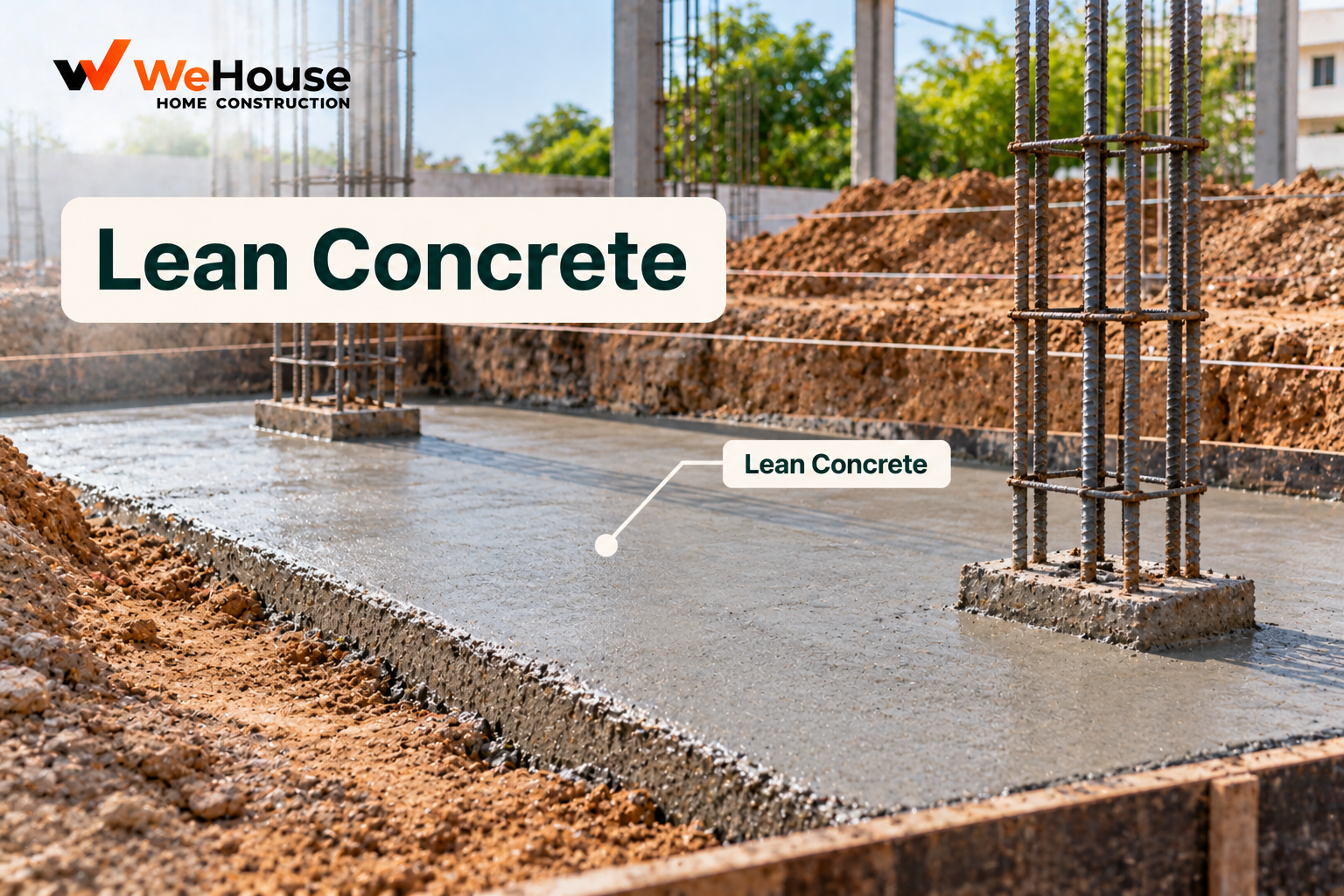
 What is lean concrete?
Lean concrete is a low-strength concrete mix, typically graded M5 to M10 — well below the M20 minimum required for structural reinforced concrete under IS 456 — laid as a thin, unreinforced layer directly on excavated and levelled soil, immediately beneath a footing or other foundation element. It is called ""lean"" specifically because it uses considerably less cement relative to aggregate than a structural mix, reflecting its non-structural role: it exists purely to prepare the ground for the structural concrete that follows, not to carry any significant load itself.
Why is a lean concrete layer needed before footing concrete?
- Clean, flat working surface. Excavated soil, even when carefully levelled, is never as flat, clean or dimensionally accurate as a cast concrete surface, and a lean concrete layer provides exactly that surface for the footing work to proceed on.
- Preventing soil contamination. Structural footing concrete poured directly onto bare soil risks absorbing moisture from the soil (affecting its water-cement ratio and strength development) and picking up soil particles into the mix at its lower face, both of which compromise the structural concrete's quality precisely where it is least visible and hardest to inspect afterward.
- Accurate reinforcement placement. The lean concrete surface gives a firm, stable, precisely level base on which footing reinforcement can be set out, tied and supported at the correct height using cover blocks, something that is far more difficult to achieve accurately on loose or uneven excavated soil.
- Protecting the excavated base from disturbance. Once laid, the lean concrete layer protects the exposed, carefully checked soil beneath it from rain, foot traffic and general site disturbance while the footing work above proceeds.
What thickness and grade is typically used?
| Application | Typical thickness | Typical grade |
|---|---|---|
| Ordinary residential footing | 50-75 mm | M7.5-M10 |
| Larger foundations, raft foundations | 75-100 mm | M10 |
| Poor or variable soil conditions | 75-100 mm or more, sometimes with a nominal steel mesh for additional integrity | M10 |
These figures are typical rather than universal; the specific thickness and grade for a given project should follow the structural engineer's foundation detail, since soil conditions, foundation type and the specific structural design all influence what lean concrete specification is appropriate.
What is the difference between lean concrete and structural PCC?
Both lean concrete and structural PCC (Plain Cement Concrete) are unreinforced concrete, but they serve different purposes and are specified at different strength grades accordingly. Lean concrete, as discussed here, is specifically the thin, low-grade levelling and blinding layer beneath a footing, playing a purely preparatory role. PCC more broadly refers to any plain, unreinforced concrete element, which can include structural applications — such as a plain concrete floor slab, a PCC bed under a driveway, or mass concrete fill — designed and specified at whatever grade its actual load-bearing or performance role requires, sometimes considerably higher than the M5-M10 range typical of a lean concrete blinding layer.
What goes wrong when lean concrete is skipped or done poorly?
- Footing concrete poured directly onto soil, risking moisture absorption, soil contamination of the mix, and an uneven, poorly defined base level.
- Reinforcement resting directly on soil rather than on a firm, level surface, making it far harder to maintain correct cover and position during the subsequent structural concrete pour.
- Inadequate thickness, leaving an uneven or insufficiently protective layer that does not fully achieve its intended preparatory function.
- Lean concrete not adequately cured before footing reinforcement work proceeds on top of it, though this is a lower-consequence issue than the equivalent lapse in structural concrete, given lean concrete's non-structural role.
Because lean concrete is a low-cost, low-complexity step, skipping it is rarely a deliberate cost-cutting decision on a well-run project, but it is occasionally shortcut on very budget-constrained or poorly supervised sites, an avoidable risk given how little the layer itself typically costs relative to the protection it provides the much more expensive and consequential structural footing above it.