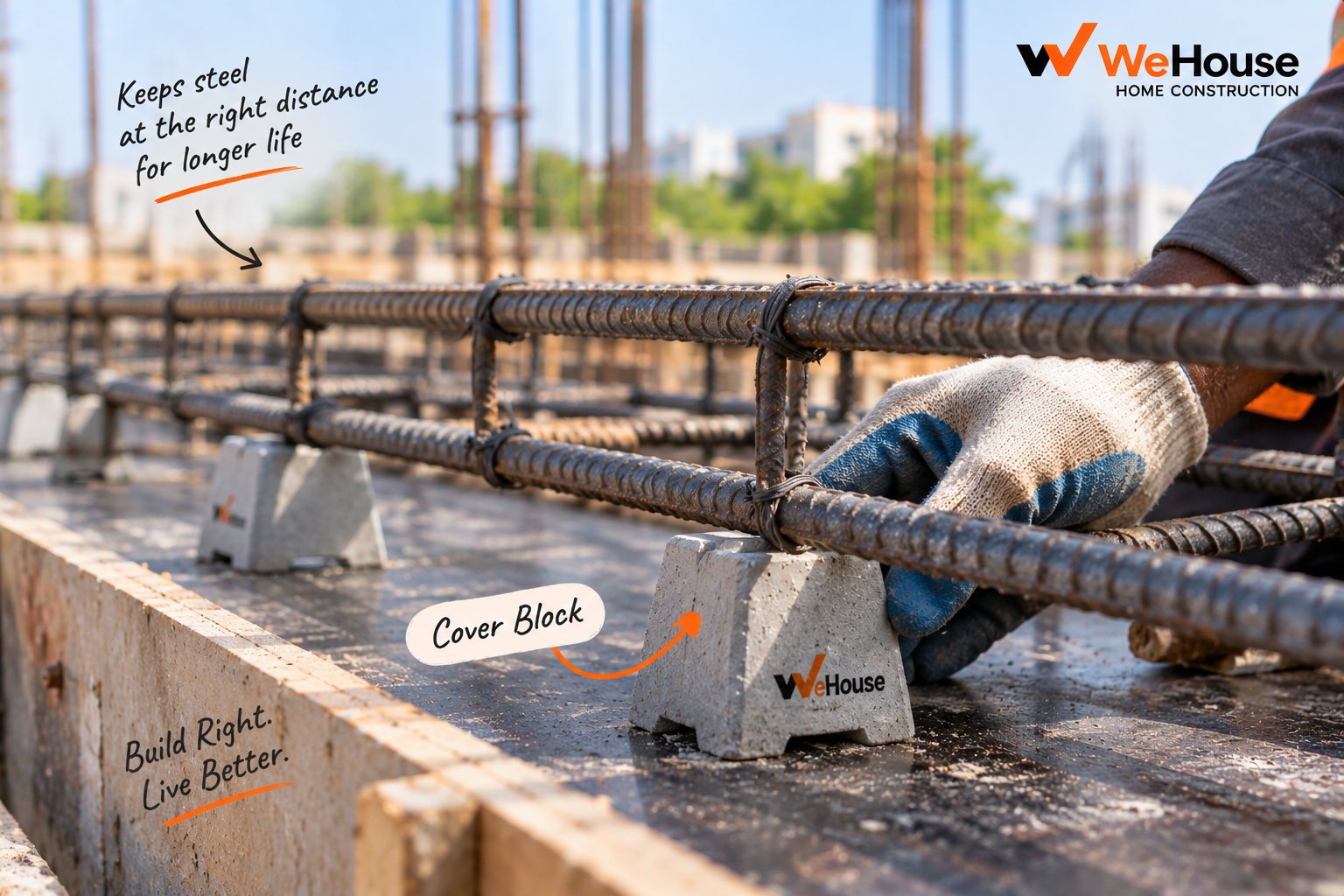
 What is a cover block?
A cover block is a small spacer placed between reinforcement bars and the inside face of formwork, holding the steel at the correct distance from the formwork so that, once concrete is poured, the bars end up embedded at the specified clear cover depth rather than resting directly against the surface. It is one of the smallest, cheapest components on a construction site, and also one of the most consequential for the long-term durability of the finished structure.
Why does concrete cover matter?
Reinforcement steel is protected from corrosion by two things: the alkaline environment inside concrete, which keeps steel passive and non-corroding, and the physical barrier the concrete itself provides against moisture, oxygen and carbon dioxide reaching the steel. Cover is the thickness of that barrier. Too little cover, and moisture and carbonation reach the steel far sooner than the structure's design life assumes, leading to rust, expansion of the corroding bar, and eventually cracking and spalling of the surrounding concrete — a very common, highly visible defect in older Indian buildings, especially near coastlines or in humid regions, where inadequate cover was common practice.
What cover does IS 456 require?
| Element | Minimum clear cover (normal exposure) |
|---|---|
| Slab | 15-20 mm |
| Beam | 25-30 mm |
| Column | 40 mm |
| Footing | 50 mm |
These are typical figures for mild to moderate exposure conditions; IS 456 sets higher minimum cover for more severe exposure (coastal, industrial, or elements in direct contact with soil or water), since the durability risk from inadequate cover is greater in aggressive environments. See column and footing for the specific cover figures typically used for those elements.
What types of cover blocks are used?
- Precast mortar cover blocks. Small cubes cast on site from a cement-sand mortar mix matching the main concrete's strength, with a tying wire embedded in each block. Cheap and widely used, but quality depends entirely on how carefully they were cast and cured, and poorly made blocks can themselves become a weak point.
- Plastic cover blocks (chairs and circular spacers). Moulded plastic spacers, often colour-coded by size, that clip or tie onto the bars. More dimensionally consistent than site-cast mortar blocks and increasingly preferred on better-supervised sites, though marginally more expensive per piece.
Whichever type is used, cover blocks should be placed at intervals of roughly 600-1000 mm across a reinforcement mat or cage, and at every direction change or bend, so the bars cannot sag or shift toward the formwork face between spacer points during concreting and vibration.
What goes wrong with cover blocks on site?
- Wrong size used. A 25 mm block used where 40 mm cover is specified, common when blocks are not clearly sorted or labelled by size on site.
- Too few blocks. Wide spacing lets the reinforcement cage sag between spacer points, especially in horizontal elements like slabs and beam soffits.
- Blocks dislodged during concreting or vibration. Reinforcement should be checked again just before the pour starts, since foot traffic and material handling between the initial check and the actual pour often shifts spacers.
- Improvised substitutes. Using stone chips, brick pieces or wood scraps instead of proper cover blocks — these are inconsistent in size and, in the case of wood, can decay and leave a void.
- Poorly cast mortar blocks. Site-cast blocks made with a weak mix or not cured properly can crumble under the load of the reinforcement and formwork, defeating their purpose.
Checking cover block size, spacing and placement is one of the quickest and most useful things a site visit before a pour can verify, since it is fully visible before concreting and essentially impossible to correct afterward.