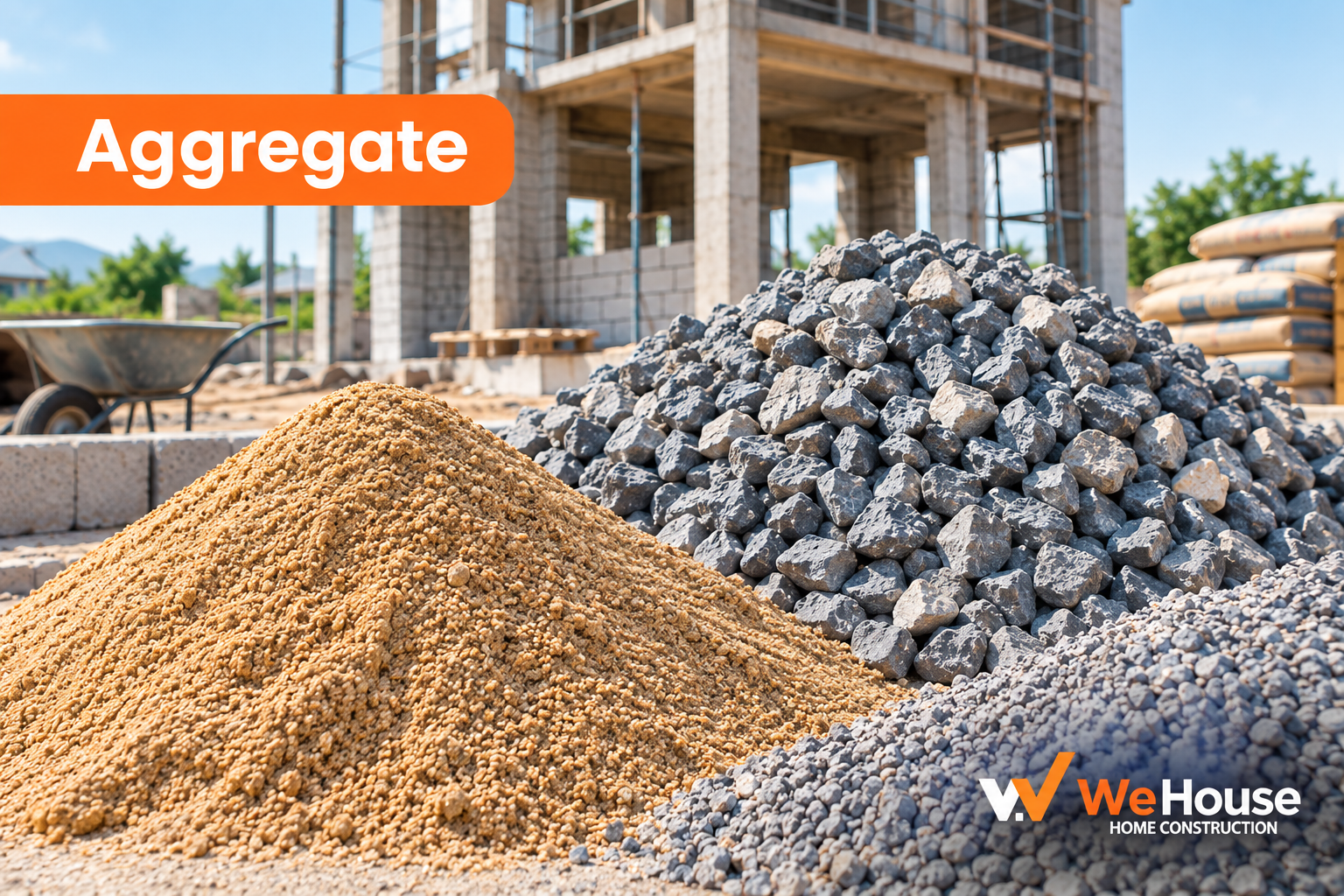
 What is aggregate in construction?
Aggregate is the granular material that fills the bulk of concrete and mortar. It is sand, gravel, crushed stone and similar inert material. In a typical concrete mix, aggregate occupies 60 to 80 percent of the volume, while cement paste is only the glue holding it together.
This proportion matters for a reason people often miss: aggregate is not a cheap filler diluting the good stuff. Concrete gets much of its stiffness, dimensional stability and resistance to shrinkage from the aggregate skeleton. Cement paste alone shrinks and cracks badly. The aggregate restrains it. A mix with poor aggregate cannot be rescued by adding more cement.
What is the difference between fine and coarse aggregate?
The dividing line is the 4.75 mm sieve. Material passing through it is fine aggregate, which in practice means sand. Material retained on it is coarse aggregate, which means gravel or crushed stone.
| Fine aggregate | Coarse aggregate | |
|---|---|---|
| Size range | 0 to 4.75 mm | 4.75 mm to 40 mm |
| Common site names | Sand, baalu, M-sand | Jelly, gitti, metal, kapchi |
| Role in mix | Fills voids between coarse aggregate | Forms the load-carrying skeleton |
| Quantity in 1 m3 of M20 | Approx 0.45 m3 | Approx 0.90 m3 |
| Used alone in | Plaster, mortar, bedding | Never used alone |
What size of coarse aggregate should be used?
The standard for ordinary RCC work in India is 20 mm nominal size. Larger aggregate reduces the cement needed but will not pass through closely spaced reinforcement, causing honeycombing. Smaller aggregate flows better but demands more paste.
- 40 mm: mass concrete, lean concrete, large raft foundations, and PCC levelling courses.
- 20 mm: the default for footings, columns, beams and slabs.
- 12.5 mm or 10 mm: thin slabs, chajjas, heavily congested reinforcement, and pumped concrete in narrow sections.
IS 456 sets the practical limits: the maximum nominal aggregate size should not exceed one quarter of the minimum section thickness, and must be at least 5 mm less than the clear spacing between bars. It should also clear the cover comfortably. In a 150 mm slab with 100 mm bar spacing, 20 mm aggregate is right; 40 mm is not.
River sand or M-sand: which should you use?
River sand extraction is now restricted or banned across large parts of India, so manufactured sand, produced by crushing hard rock in a vertical shaft impactor, has become the default in most cities. It is a legitimate substitute, not a compromise, provided it is properly processed.
M-sand particles are angular rather than rounded, so a mix using it needs slightly more water or an admixture for the same workability. In return it is consistently graded, free of silt and clay, and available year-round at a stable price. Poorly made M-sand carries excess micro-fines and stone dust, which raises water demand and weakens the mix. Ask for a sieve analysis report; do not judge it by colour.
How do you check aggregate quality on site?
Three field checks, all of which a homeowner can do:
- Silt content test for sand. Fill a transparent bottle to 50 ml with sand, add water to 100 ml, add a pinch of salt, shake, and let it stand for three hours. A silt layer above 6 percent of the sand height means the sand should be washed or rejected. IS 383 limits silt and clay in fine aggregate to 3 percent by mass.
- Squeeze test. Grip a handful of sand. If it stains your palm brown and holds its shape, clay content is too high.
- Visual check on coarse aggregate. Look for angular, clean, well-graded stone. Reject flaky or elongated pieces, which break under load, and reject dusty stone that has not been washed.
For laboratory confirmation, ask for sieve analysis, flakiness and elongation index, water absorption (should be under 2 percent for most stone), and impact value. Do this alongside the soil test at project start so both reports land before the first pour.
How much aggregate is needed and what does it cost?
For one cubic metre of M20 concrete at a 1:1.5:3 nominal mix, the approximate requirement is 8 bags of cement, 0.45 m3 of sand and 0.90 m3 of coarse aggregate. Multiply by the concrete volume in your structural drawings and add 3 to 5 percent for handling loss.
Coarse aggregate typically costs Rs 900 to Rs 1,800 per tonne, or Rs 45 to Rs 80 per cubic foot delivered. Sand varies far more: river sand can hit Rs 3,500 per tonne in states with active mining bans, while M-sand usually stays in the Rs 1,200 to Rs 2,200 range. Quarry distance is the biggest single variable, since freight can exceed material cost beyond 60 to 80 km. Build a regional rate into your estimate rather than using a national average.
How should aggregate be stored on site?
Stack fine and coarse aggregate in separate heaps with a clear gap between them, on a hard, clean platform. Aggregate dumped straight onto soil picks up clay at the base, and the last two feet of the heap frequently end up contaminating a pour. Cover sand during monsoon, because surface moisture changes the effective water-cement ratio unless the batching allows for it. Wet sand also bulks: it can occupy 20 to 30 percent more volume than dry sand, which is why volume batching by box is unreliable in the rains and weight batching is preferred.
Which IS code covers aggregates?
IS 383 is the specification for coarse and fine aggregate for concrete. It sets grading limits, defines fine aggregate Zones I to IV, and caps deleterious material. IS 2386 covers the test methods, including sieve analysis, specific gravity, flakiness and impact value. IS 456 governs how aggregate size is chosen for a given section. IS 1542 covers sand for plaster. See IS Code for how to cite these in a specification.
Who decides the aggregate specification?
The structural engineer fixes the maximum nominal size and grading requirement as part of the mix design. The contractor chooses the quarry and negotiates rates. The site engineer inspects and accepts each load. Where the homeowner buys material directly, which is common in individual house construction, the acceptance decision falls to them, and a Rs 500 sieve test on the first load is cheap insurance against a slab that never reaches its design grade.