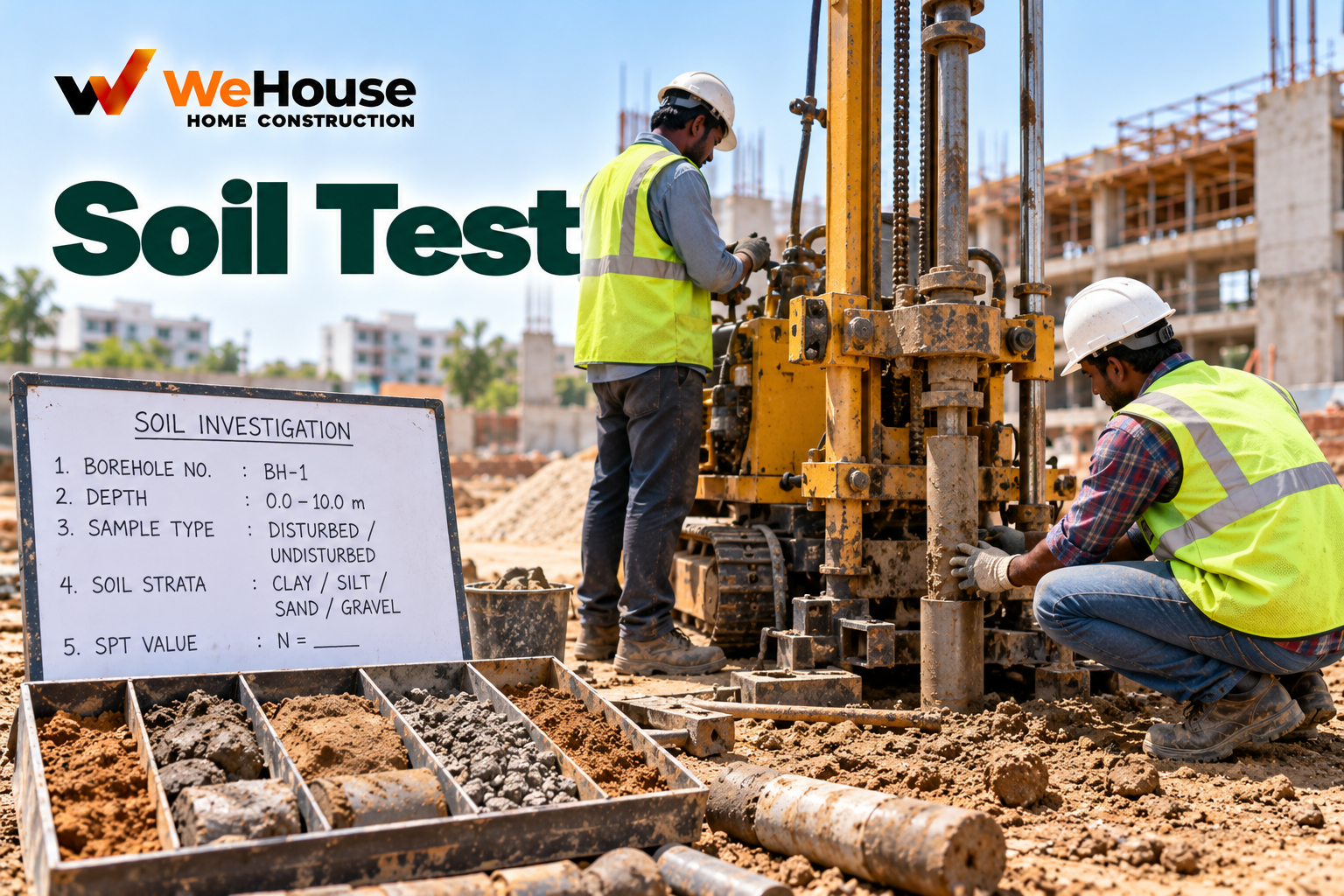
 What is a soil test?
A soil test, more formally called a geotechnical investigation, is a systematic study of a construction site's actual soil conditions, carried out specifically to give the structural engineer the information needed to design an appropriate foundation for that specific site — rather than designing a foundation based on general assumption, a neighbouring site's foundation, or a generic ""standard"" depth that may or may not actually suit the site in question.
How is a soil test actually carried out?
A geotechnical engineer or soil testing laboratory digs trial pits, or more commonly for deeper investigation, drills boreholes at several points across the site, typically 2-6 points for an ordinary residential plot, to a depth sufficient to characterise soil conditions below the anticipated foundation level. Soil samples are collected at different depths within each pit or borehole, along with observations of the soil's visual condition and any groundwater encountered, and these samples are then tested in a laboratory for properties including grain size distribution, moisture content, and, critically, bearing capacity — the soil's ability to safely carry load without excessive settlement — often supplemented by in-situ field tests like the Standard Penetration Test (SPT), which measures soil resistance directly at depth during the drilling process itself.
What does a soil test report actually tell the structural engineer?
| Finding | How it affects foundation design |
|---|---|
| Safe bearing capacity at various depths | Determines required footing size (see bearing capacity) and whether a shallow or deep foundation is appropriate |
| Soil classification and type | Affects foundation type choice and specific design parameters, including susceptibility to settlement or expansion/shrinkage with moisture change |
| Groundwater table level | Affects excavation and construction methodology, dewatering needs, and waterproofing requirements for below-ground elements |
| Soil variability across the site | Identifies whether soil conditions are consistent, informing whether isolated footings, a combined footing, or a raft foundation bridging variable conditions is most appropriate |
Why does soil condition vary even between neighbouring plots?
Soil conditions can genuinely vary meaningfully over surprisingly short distances, due to factors like historical land use (a plot that was once filled, excavated, or used for a different purpose than its neighbour), natural variation in underlying geology, local groundwater patterns, and even relatively localised features like old tree roots, buried debris, or previous construction remnants that are not visible from the surface. This is precisely why relying on a neighbouring plot's foundation depth or a generic ""standard"" assumption, rather than conducting a site-specific soil test, is a genuine and avoidable risk — the soil beneath a given plot cannot be reliably assumed from what was found or used next door, however reasonable that assumption might seem.
What are the consequences of inadequate foundation design from a skipped or poor soil test?
A foundation designed without reliable, site-specific soil data risks being undersized relative to the soil's actual bearing capacity, leading to excessive or uneven settlement over the building's life — a defect that typically manifests gradually, as cracking in walls, doors and windows that stick or misalign, or visibly uneven floor levels, often not becoming apparent until well after construction is complete and the building is occupied, by which point correction is considerably more disruptive and expensive than the soil test itself would ever have cost. This asymmetry between the soil test's modest upfront cost and the potentially severe, hard-to-reverse consequences of getting foundation design wrong is the core reason a proper soil test is considered a non-negotiable first step for any significant construction project.
Which IS codes govern soil testing and foundation design?
IS 1904 covers the general design and construction requirements for foundations, IS 6403 provides the methodology for determining bearing capacity, and IS 2131 covers the Standard Penetration Test procedure specifically; these codes, discussed in more detail under IS Code, together form the technical framework a geotechnical and structural engineer apply when conducting a soil investigation and translating its findings into a specific, appropriate foundation design.