 What is bearing capacity?
Bearing capacity is how much load the soil under your building can carry without failing. Every footing spreads the load from a column over an area of soil. The question bearing capacity answers is how large that area needs to be.
Two distinct failures are being guarded against. The first is shear failure, where the soil actually gives way and the foundation punches into it. The second, far more common in practice, is excessive settlement, where the soil holds but compresses enough to crack the structure above. Safe bearing capacity accounts for both, and settlement usually governs.
What is the difference between ultimate and safe bearing capacity?
| Term | Meaning |
|---|---|
| Ultimate bearing capacity | The pressure at which the soil fails in shear |
| Net ultimate bearing capacity | Ultimate value less the pressure the removed soil was already applying |
| Safe bearing capacity (SBC) | Net ultimate divided by a factor of safety, usually 2.5 to 3 |
| Allowable bearing pressure | The lower of SBC and the pressure limited by permissible settlement |
The number quoted on site and used in design is the safe bearing capacity, or SBC. When someone says the SBC here is 180, they mean 180 kN per square metre, roughly 18 tonnes per square metre.
What are typical bearing capacity values in India?
These are indicative ranges only. They are useful for sanity-checking a report, never for designing against.
| Soil type | Indicative SBC (kN/m2) |
|---|---|
| Soft clay | 50-100 |
| Stiff clay | 100-180 |
| Loose sand | 100-150 |
| Medium dense sand | 150-250 |
| Dense sand and gravel | 250-450 |
| Weathered / soft rock | 400-900 |
| Hard rock | 1,500 and above |
| Black cotton soil | Highly variable; usually requires special treatment |
| Filled or made-up ground | Unreliable; treat as unknown until tested |
Black cotton soil deserves its own note. Its problem is not low strength but volume change: it swells when wet and shrinks when dry, lifting and dropping foundations seasonally. The remedy is founding below the active zone, replacing the soil under footings with granular fill, or using an under-reamed pile foundation.
How is bearing capacity determined?
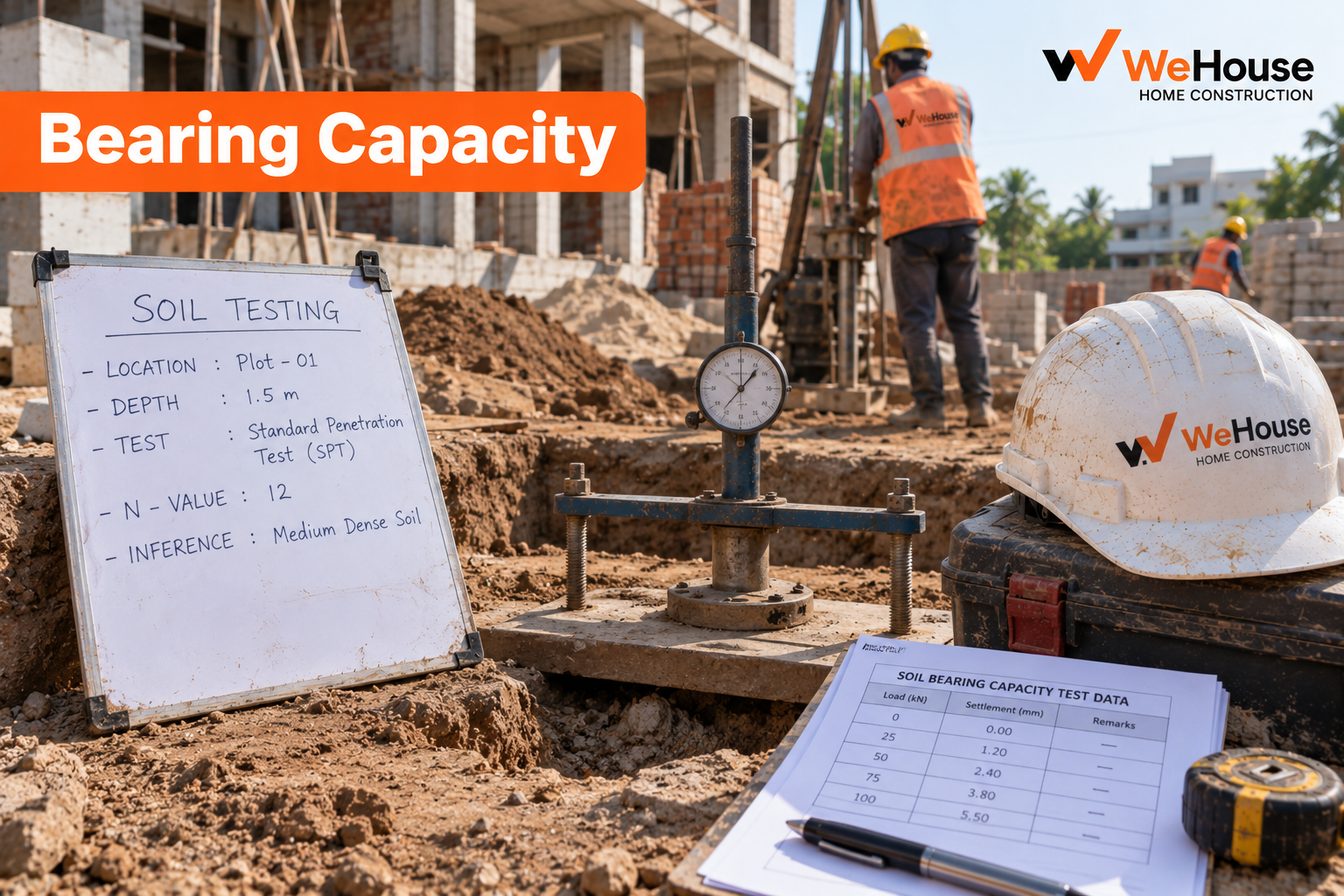
- Borehole investigation with SPT. The standard method. A split spoon sampler is driven into the soil and the blows needed for 300 mm of penetration give the N-value, from which bearing capacity is correlated. Boreholes go 1.5 to 2 times the expected footing width below founding level.
- Laboratory testing. Samples are tested for shear strength, density, moisture content, Atterberg limits and consolidation characteristics.
- Plate load test. A steel plate is loaded in stages at founding level and settlement measured. Direct and reliable, but only tests the shallow zone under the plate.
- Visual inspection at excavation. Not a substitute for testing, but an essential cross-check. If the excavation reveals soft, wet or made-up ground where the report promised stiff clay, stop and call the engineer.
See soil test for the full investigation process and what a report should contain.
How does bearing capacity affect foundation design?
Directly and arithmetically. Footing area equals column load divided by safe bearing capacity. A column carrying 900 kN on soil with an SBC of 150 kN/m2 needs 6 square metres of footing, roughly 2.45 m square. The same column on soil with an SBC of 300 kN/m2 needs 3 square metres, about 1.75 m square. The difference in concrete, steel and excavation across twenty columns is substantial.
Bearing capacity also drives foundation type:
- Good soil, moderate loads: isolated footings.
- Footings starting to overlap: combined or strip footings.
- Footings covering more than roughly half the plot area: a raft foundation becomes more economical.
- Weak soil to significant depth: piles taking load to a competent stratum below.
What does a soil test cost?
For a residential plot, two to three boreholes with laboratory testing costs Rs 15,000 to Rs 60,000. A plate load test costs Rs 25,000 to Rs 60,000 per location. Larger or multi-storey projects run Rs 1 lakh to Rs 4 lakh.
Set that against a foundation package that typically represents 8 to 15 percent of project value. On a Rs 1 crore house that is Rs 8 to Rs 15 lakh of work being designed on the basis of a number. Paying Rs 30,000 to establish that number, rather than assuming it, is straightforward value. Include it in your estimate from the start, and note that many authorities require a soil report with the approved plan submission for multi-storey buildings in any case.
What can be done if bearing capacity is low?
A poor soil report is a design input, not a dead end. The engineer has several routes, and the right one depends on how deep the weak layer runs.
- Go deeper. Found below the weak stratum if a competent layer sits within reasonable excavation depth.
- Spread wider. Larger footings, combined footings, or a raft that distributes load across the whole plot.
- Replace the soil. Excavate under footings and refill with compacted granular material, a common approach in black cotton soil. See backfilling and compaction for how that fill must be placed.
- Improve the ground. Vibro compaction, stone columns or lime stabilisation, generally viable only on larger projects.
- Bypass it with piles. Transfer load to a firm stratum below, including under-reamed piles, which are widely used in expansive soils.
Each of these changes the foundation budget materially, which is the real argument for testing early. A soil report received before the design is set lets the engineer choose; the same report received after excavation has begun forces a redesign.
Common mistakes around bearing capacity
- Assuming a value from the neighbouring plot. Soil profiles change over surprisingly short distances, especially near old water bodies or filled land.
- Testing only one borehole on a large plot. A single hole cannot reveal variation across the site, and differential settlement is what cracks buildings.
- Founding on made-up ground. Filled land may look identical to natural ground once graded. The soil report should identify it.
- Ignoring the water table. A high water table reduces effective bearing capacity and complicates excavation and waterproofing.
- Leaving an excavation open through the monsoon. Softens the founding stratum and can reduce actual capacity well below the tested value.
- Not placing PCC promptly. A lean concrete blinding layer protects the exposed founding stratum from rain and site traffic.
Which IS codes cover bearing capacity?
IS 6403 covers the determination of bearing capacity of shallow foundations. IS 1904 is the code of practice for design and construction of foundations in soils, setting general requirements. IS 1888 covers the plate load test, and IS 2131 the standard penetration test. IS 2720 covers laboratory soil testing across its many parts. IS 2911 deals with pile foundations where shallow foundations are not viable. See IS Code for citation practice.