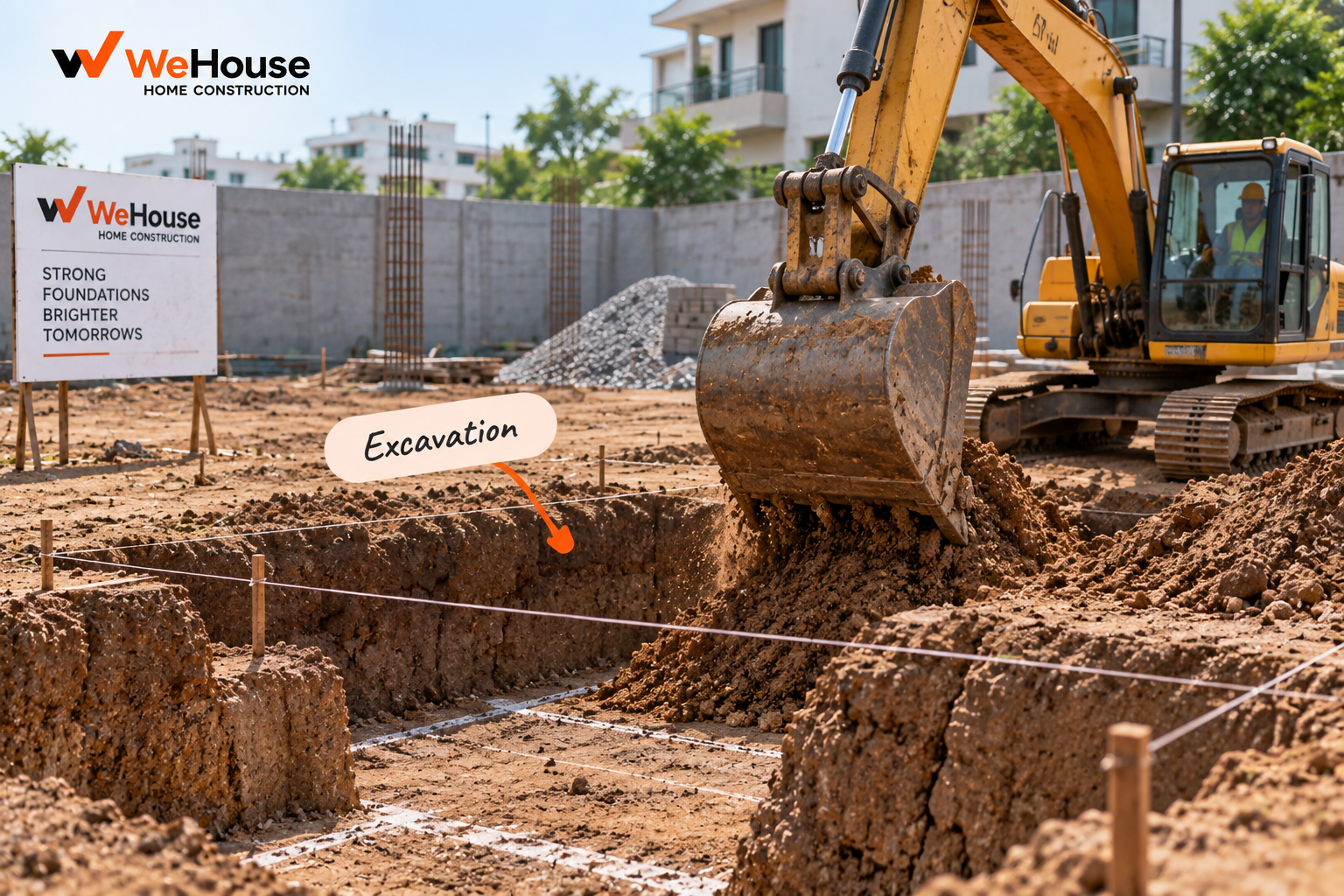
 What is excavation in construction?
Excavation is the removal of soil, and sometimes rock, from the ground to create the depth and shape needed for a foundation, basement, or other below-ground structure. It is one of the very first physical construction activities on a residential site, carried out after layout marking has set out the building's exact position and after a soil test has established the depth at which adequate bearing capacity is available for the foundation to rest on.
How deep does excavation need to go?
Excavation depth is not a fixed, standard figure — it is set by the structural or geotechnical engineer based on the soil investigation for that specific site, aiming to reach a soil stratum with adequate safe bearing capacity for the building's loads, generally below the zone affected by seasonal moisture variation, surface organic matter, or loose fill. For an ordinary residential building on reasonable soil, excavation depth commonly falls in the range of roughly 1 to 2 metres, but it can be considerably shallower on rock or considerably deeper on poor, soft, or filled soil, or where a basement is planned. Excavating to an assumed ""standard"" depth without reference to an actual soil report for the site is a common and risky shortcut on budget projects.
What types of excavation are there?
| Type | Description | Typical use |
|---|---|---|
| Bulk excavation | Removal of soil over a large area to a uniform level | Basements, large raft foundations, site levelling |
| Trench excavation | Narrow, linear excavation following the line of a strip footing or foundation wall | Load-bearing wall or strip footing foundations |
| Pit excavation | Isolated excavation for a single point, typically under a column | Isolated footing foundations under an RCC frame |
Machine excavation versus manual excavation
Machine excavation, using a JCB or excavator, is faster and generally cheaper per unit volume than manual digging, and is the default choice wherever site access allows a machine to operate. Manual excavation remains necessary in tight urban plots without machine access, close to existing structures where machine vibration or excavation precision is a concern, or for final trimming and levelling of a pit or trench base to the precise profile needed before foundation concrete, since machine excavation alone rarely achieves the clean, accurate base profile foundation work requires.
What safety and stability issues matter during excavation?
- Slope stability / shoring. Deep or vertical-sided excavations, especially in loose or sandy soil, risk collapse of the excavation walls; sloping the sides back at a safe angle, or shoring (temporary retaining supports) for deeper or space-constrained excavations, protects both workers and any adjacent structure.
- Proximity to existing structures. Excavating close to an adjoining building's foundation risks undermining it if not carefully sequenced, shored, or set back adequately; this is a particular concern on dense urban plots.
- Groundwater / dewatering. Excavation reaching below the water table fills with water and needs active dewatering (pumping) to allow foundation work to proceed on a dry, stable base.
- Exposure and disturbance of the base soil. Excavated soil at the base should not be left exposed to rain or foot traffic for an extended period before concreting, since this can soften or disturb the very bearing surface the foundation depends on.
How is excavation quality verified before foundation work proceeds?
The site engineer should verify that the exposed soil at the base of the excavation visually and, where required, through further testing, matches the condition assumed in the soil report — firm, undisturbed soil rather than loose fill, soft pockets, or standing water. Any variance from the expected soil condition should be referred to the structural or geotechnical engineer before proceeding, since it may indicate that the foundation depth needs to be adjusted rather than simply proceeding on the originally assumed depth. A thin layer of PCC (plain cement concrete) is typically laid immediately over the excavated and levelled base before the main footing reinforcement and concrete, both to provide a clean working surface and to protect the exposed soil from further disturbance.
How much does excavation cost in India?
As of September 2026, manual excavation in ordinary soil costs roughly Rs 25-60 per cubic foot (about Rs 900-2,100 per cubic metre), while machine excavation, where site access permits, typically costs 30-50 percent less per unit volume. Costs rise substantially for hard soil or rock requiring breaking, for sites needing dewatering due to a high water table, or for excavation near existing structures requiring careful, slower, often partly manual work to avoid disturbance.