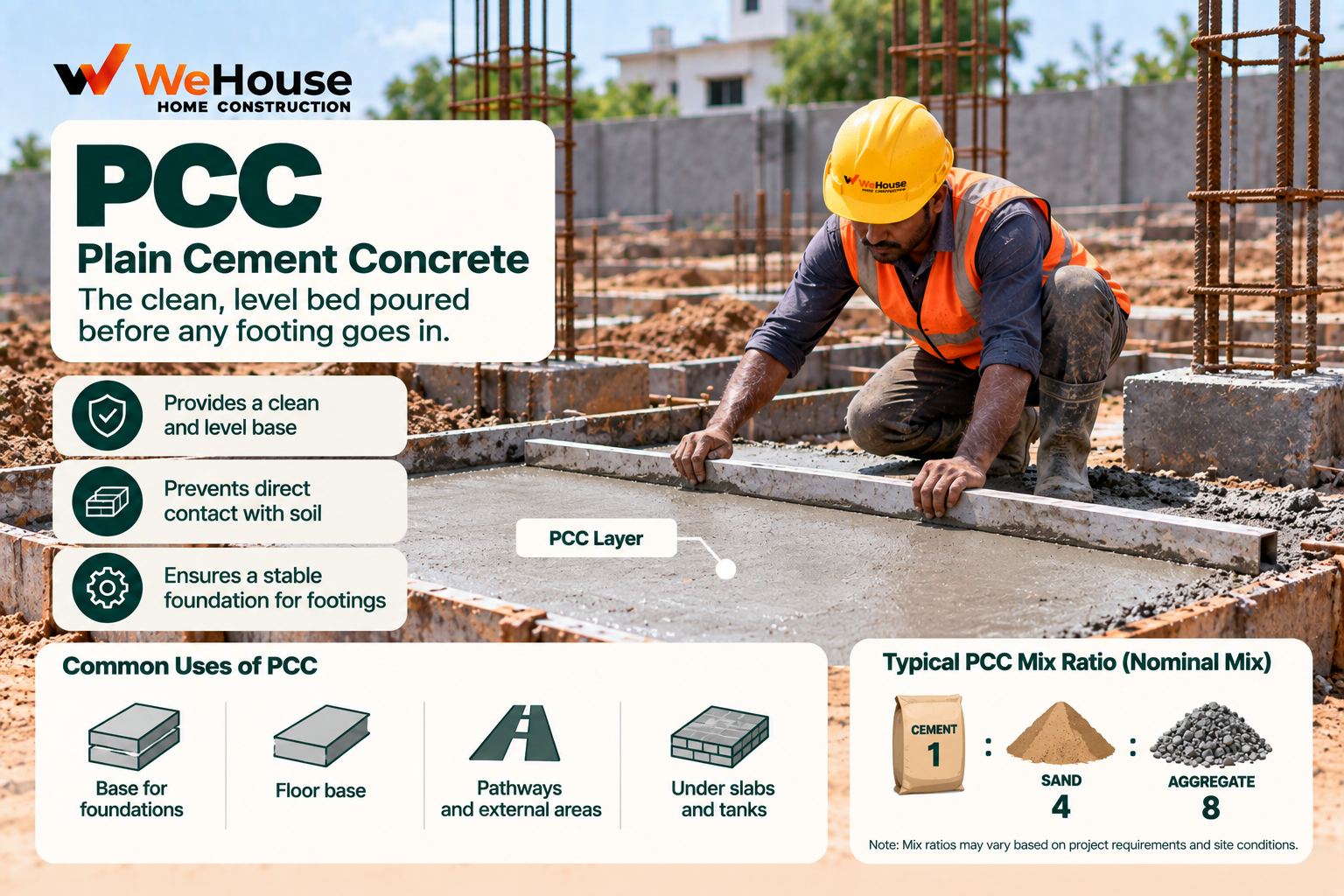
 What is PCC?
PCC, short for Plain Cement Concrete, is concrete produced and placed without any embedded reinforcing steel, in contrast to RCC (Reinforced Cement Concrete), which incorporates steel bars specifically to carry tensile forces that plain concrete, being strong in compression but essentially negligible in tension, cannot resist on its own. PCC is therefore used only where an application genuinely does not need to resist significant tension or bending — compressive-only or purely preparatory and non-structural roles — rather than for primary load-bearing structural elements like columns, beams or footings themselves, which require reinforcement to safely carry their actual structural loads.
Where is PCC commonly used?
| Application | Typical thickness | Typical grade |
|---|---|---|
| Levelling layer beneath footings (lean concrete) | 50-75 mm | M5-M10 |
| Sub-base beneath flooring | 75-100 mm | M10-M15 |
| Driveway / paving sub-base or wearing course | 100-150 mm, varying with expected load | M15-M20 |
| General non-structural fill or backfill stabilisation | Varies by application | M5-M10 |
The common thread across these applications is that none of them requires the element to resist significant bending or tensile stress — they either carry purely compressive load (like a paving surface under a vehicle's weight) or serve a preparatory, non-load-bearing function (like a levelling layer), both roles plain, unreinforced concrete handles adequately and more economically than reinforced concrete would.
What is the difference between PCC and lean concrete?
PCC is the broader category — any plain, unreinforced concrete, specified at whatever grade its specific application requires. Lean concrete is a specific, narrower application of PCC: the thin, low-grade (typically M5-M10) levelling and blinding layer laid beneath a footing specifically to prepare the ground before structural concrete work proceeds. All lean concrete is PCC, but not all PCC is lean concrete — a PCC flooring base course at M15, for instance, serves a different purpose and is typically specified at a higher grade than a lean concrete levelling layer.
Why doesn't PCC need reinforcement?
Concrete, as a material, is naturally strong in compression (resisting a squeezing or crushing force) but very weak in tension (resisting a pulling or stretching force) — a fundamental material property that is the entire reason reinforcing steel exists in structural concrete, since steel is excellent in tension and the combination of the two materials in RCC gives reinforced concrete both compressive and tensile capacity. PCC applications are specifically chosen or designed to avoid significant tension — a levelling layer or paving slab under typical loading primarily experiences compression, not meaningful bending or tension — which is precisely why these applications can safely and economically use unreinforced concrete rather than requiring the added cost and complexity of reinforcement.
What goes wrong when PCC is used incorrectly?
- Using PCC where reinforcement is actually needed, such as a slab or beam genuinely spanning and carrying bending load, which requires RCC, not PCC; using plain concrete in a role requiring tensile capacity is a serious structural error, not a cost-saving option.
- Inadequate thickness or grade for the actual load, such as a PCC driveway base too thin or too low-grade for the vehicle loads it will actually carry, leading to premature cracking.
- Skipping PCC where it serves a genuine preparatory function, such as omitting a proper levelling layer beneath a footing, discussed in more detail under lean concrete, risking contamination and poor reinforcement placement in the structural concrete above it.