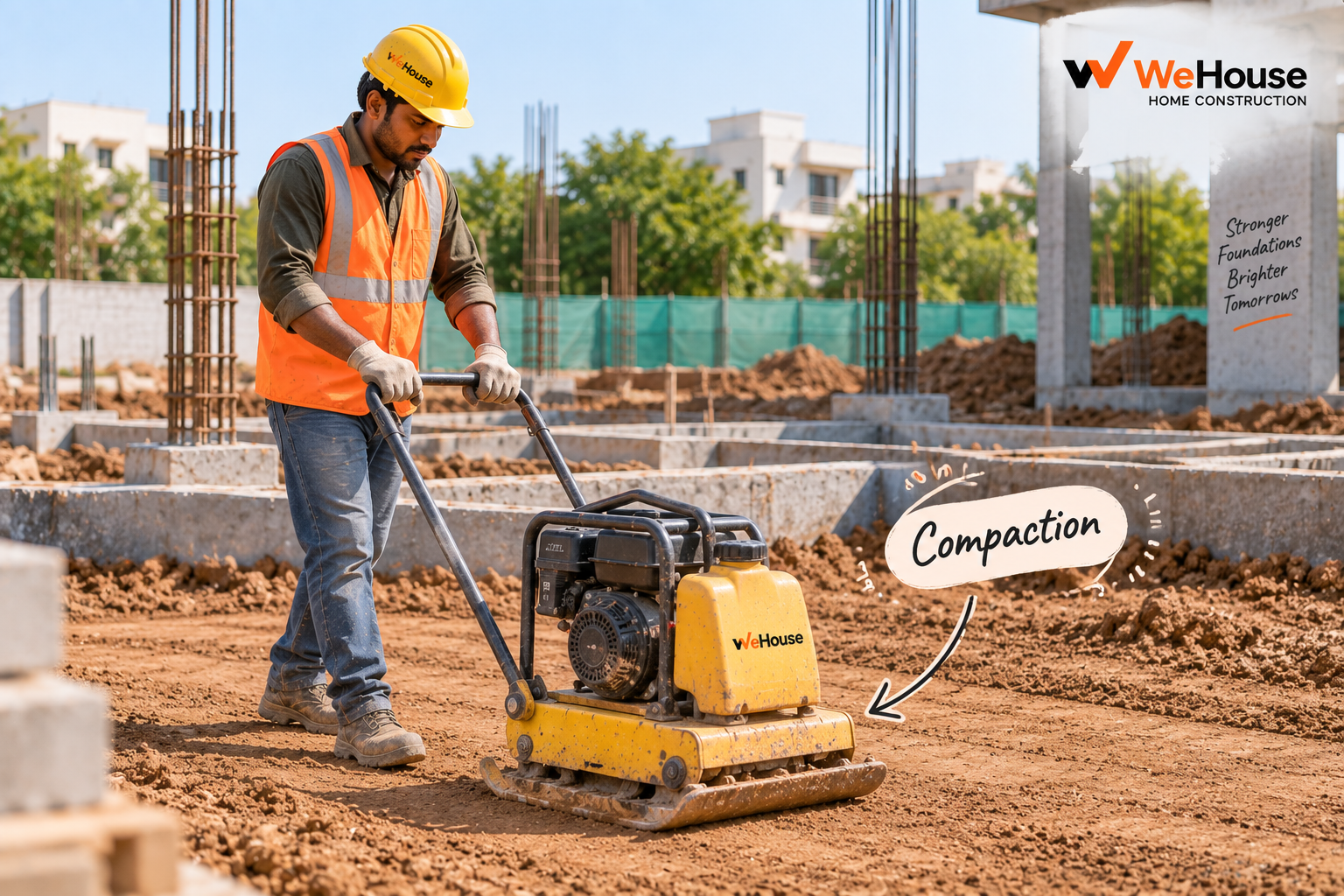
 What is compaction in construction?
Compaction means removing air voids to increase the density of a material, and the term covers two distinct site activities that share the same underlying goal. In concrete work, compaction removes entrapped air bubbles from the freshly placed mix so the cement paste and aggregate pack together tightly around the reinforcement. In earthwork, compaction densifies loose soil in a fill, backfill or sub-base layer so it will not settle unpredictably once loaded.
Why does concrete need to be vibrated?
Fresh concrete, even a well-designed mix with good workability, traps air as it is poured and placed around congested reinforcement, formwork corners and construction joints. Left untouched, this trapped air becomes permanent voids once the concrete hardens. Each 1 percent of entrapped air left in hardened concrete typically costs roughly 5-7 percent of compressive strength, so even a modest amount of under-compaction has a disproportionate effect on the final structural performance, quite apart from the visible surface defect it can cause.
How is concrete compacted on site?
The standard method in Indian construction is an immersion vibrator (also called a needle or poker vibrator): a vibrating steel head, typically 25-60 mm in diameter, inserted vertically into the fresh concrete at regular points, roughly 400-600 mm apart, and held for around 5-15 seconds at each point before being withdrawn slowly. The vibrator should penetrate slightly into the previously placed layer below (where concreting is done in layers) to knit the layers together, and should never be dragged sideways through the concrete, which segregates the mix rather than compacting it evenly.
Signs that compaction is adequate: the concrete surface stops releasing large air bubbles, a thin film of cement paste (laitance) appears at the surface, and coarse aggregate is no longer visible poking through. Over-vibration is also a real risk — continuing too long at one point can cause segregation, where heavier aggregate sinks and excess water and fine paste rise to the surface, weakening the mix in the opposite way to under-compaction.
What is soil compaction and why does it matter for construction?
Soil compaction is the mechanical densification of a fill or backfilling layer, typically using a plate compactor for small areas or a roller for larger ones, to reduce air voids between soil particles and increase the soil's load-bearing capacity. It matters directly under floor slabs, driveways, paving and any backfill around a foundation, because loosely placed, uncompacted soil continues to settle under load for months or years after construction, often unevenly, producing cracked flooring, sunken paving or a floor that visibly dips near a wall.
Soil is compacted at its optimum moisture content (OMC), determined by a standard or modified Proctor test in a soil laboratory, since soil that is too dry or too wet compacts poorly regardless of how much mechanical energy is applied. Compaction is done in layers — typically 150-300 mm of loose material at a time, reduced to a target thickness after rolling — because compacting a thick layer in one pass leaves the lower portion under-compacted even if the surface looks well finished.
How is compaction quality checked?
| Material | Check | Typical target |
|---|---|---|
| Concrete | Visual (surface finish, no visible voids); core testing for critical elements | No honeycombing; design compressive strength met on cube/core test |
| Soil fill | Field density test (sand replacement or nuclear density gauge) against lab Proctor value | Typically 90-98% of maximum dry density, depending on application |
What goes wrong with compaction on site?
- Skipping vibration for ""convenient"" pours. Small pours are sometimes compacted only by rodding (manually poking with a rod), which is a legitimate method for very small quantities but is often inadequate for anything beyond a small footing or lean concrete layer.
- Uncompacted backfill around foundations and under floors. Soil is dumped and left to ""settle naturally,"" leading to sunken flooring and cracked paving later.
- Over-vibration causing segregation. Leaving the needle in one spot too long, or dragging it sideways.
- Compacting soil layers too thick. Placing 400-500 mm of loose fill and compacting it in one pass, leaving the bottom under-densified.
- Wrong moisture content. Compacting soil that is too dry (poor particle bonding) or too wet (soil squeezes out rather than densifying).
Compaction is a step that is almost invisible in the finished work but leaves clear evidence when done poorly — honeycombed concrete surfaces, or floors and paving that settle and crack within a year or two — which is exactly why it is worth confirming as it happens rather than after the fact.