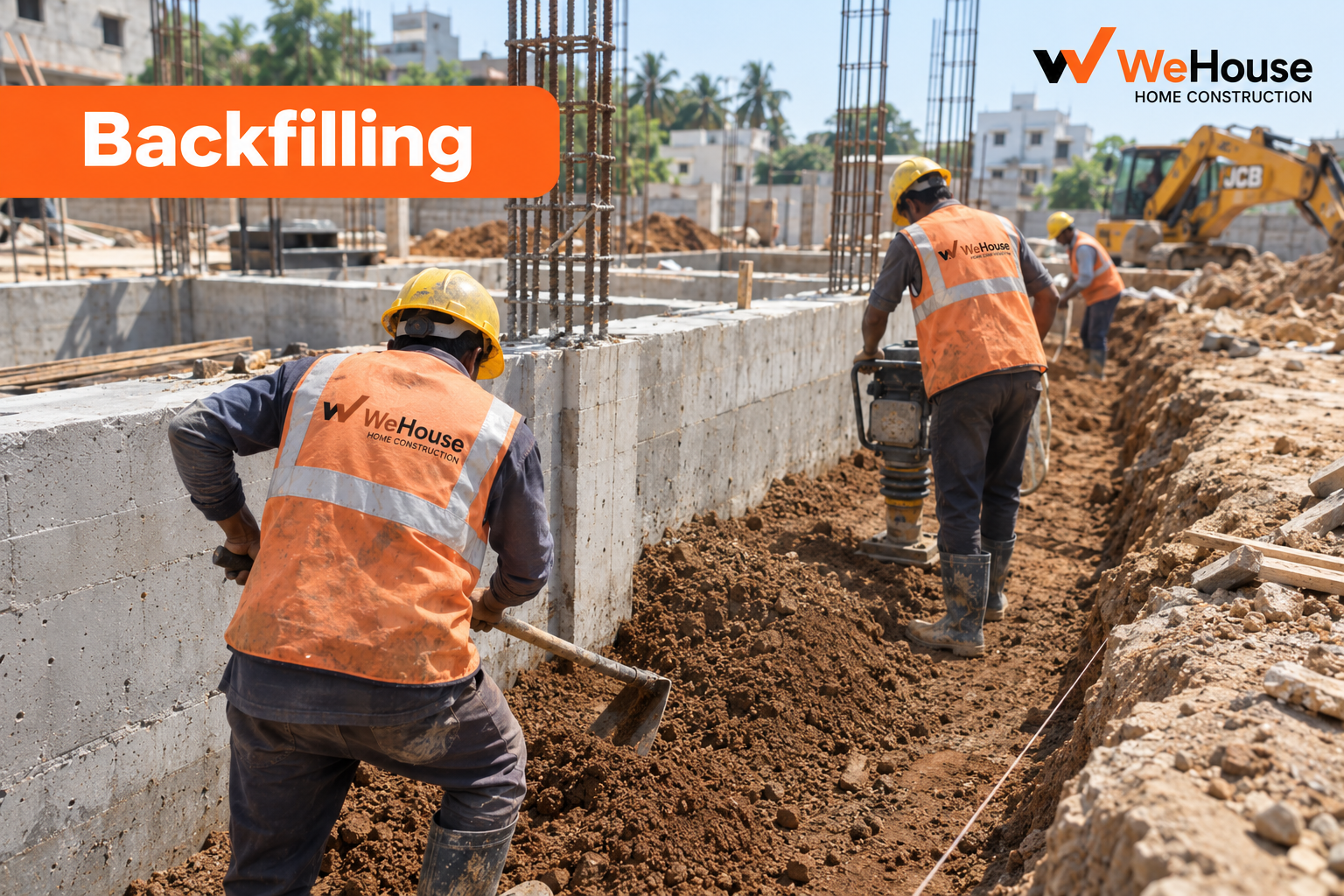
 What is backfilling in construction?
Backfilling is putting earth back. After excavation for footings, trenches or a basement, you have a hole substantially larger than the concrete placed in it. The space between the finished structure and the undisturbed ground has to be refilled, and the ground inside the plinth has to be brought up to level.
The word backfilling covers what sounds like a simple activity, and this is exactly why it goes wrong so often. Tipping soil into a trench and walking away is technically backfilling. So is placing it in 200 mm layers at optimum moisture and compacting each one to 95 percent density. The two produce very different buildings five years later.
Why does backfill compaction matter?
Loose soil contains voids. Over the following monsoons, water enters those voids, the soil consolidates, and the fill settles. Anything resting on it goes down with it. The visible symptoms are familiar on Indian sites:
- Ground floor tiles cracking or sounding hollow, two to four years after occupancy.
- A gap opening between the floor and the skirting.
- Sunken driveway or paving next to the building.
- Drainage lines cracking as the soil under them drops.
- Water ponding against the plinth, feeding damp into the walls.
None of these are structural failures of the building frame. The columns and beams are fine, because they bear on the footings. It is everything bearing on filled earth that suffers, which is why the problem surfaces as a finishes complaint and gets misdiagnosed as poor tiling.
What soil is suitable for backfilling?
| Material | Suitability | Notes |
|---|---|---|
| Sandy or gravelly soil | Excellent | Compacts well, drains freely |
| Murram / decomposed rock | Excellent | Standard imported fill across much of India |
| Silty soil | Acceptable | Needs careful moisture control |
| Black cotton soil | Reject | Swells when wet, shrinks when dry; heaves floors and walls |
| Clay with high plasticity | Reject | Poor drainage, volume change |
| Soil with organic matter, roots, debris | Reject | Decomposes and leaves voids |
| Construction debris and broken masonry | Reject | Bridges over voids that collapse later |
The instinct on site is to reuse whatever came out of the excavation, because it is already there and free. That is correct only when the soil is suitable. Where black cotton soil is excavated, it should be carted away and replaced with murram or granular fill, and the cost of doing so should sit in the BOQ from the outset rather than appearing as a surprise variation.
How is backfilling done correctly?
- Wait for strength. Do not backfill against foundation concrete or a retaining wall until it has cured sufficiently, typically 7 to 14 days depending on the engineer's instruction. Early backfill can push a young wall out of plumb.
- Clear the excavation. Remove shuttering offcuts, wire, debris and standing water first.
- Protect the waterproofing. Where a damp proof course or tanking membrane exists, place a protection layer before filling so stones do not puncture it.
- Fill in layers. 150 to 300 mm loose thickness per layer, depending on equipment. This is the step most often skipped.
- Control moisture. Sprinkle water to bring the soil close to optimum moisture content. Too dry and it will not compact; too wet and it pumps under the roller.
- Compact each layer. Plate compactor for confined spaces around footings, vibratory roller for open areas. See compaction for equipment selection.
- Balance the sides. Fill evenly on both sides of a wall so lateral pressure stays balanced.
- Test. Field density tests at specified intervals, typically one per 250 to 500 square metres per layer on larger work.
How much does backfilling cost in India?
Manual backfilling with hand ramming runs Rs 25 to Rs 50 per cubic metre. Mechanical compaction with a plate compactor runs Rs 45 to Rs 90 per cubic metre. Where excavated soil is rejected and fill must be imported, murram or granular material adds Rs 300 to Rs 800 per cubic metre including transport, and haul distance is the dominant variable.
Field density testing costs Rs 800 to Rs 2,000 per location. On a residential plot, three or four tests are enough to establish whether the work is being done properly, and that is money well spent. Check with your quantity surveyor whether the contractor's rate covers compaction to a stated density or merely refilling, because those are different items at different prices.
What are the common backfilling mistakes?
- Dumping the full depth in one go. A compactor influences perhaps 200 to 300 mm below the surface. Soil dumped 1.5 m deep and rolled on top is compacted only at the top.
- Backfilling in heavy rain. Saturated soil cannot be compacted and will consolidate later.
- Burying debris. Broken blocks and formwork offcuts create voids.
- Backfilling one side of a retaining wall fully before the other. This can push the wall over.
- Blocking weep holes. Retaining walls need drainage behind them; fill packed against weep holes traps water and doubles the pressure on the wall.
- No testing. Compaction that is not measured is compaction that was not specified.
- Filling before the termite treatment of the plinth area. Sequence matters; anti-termite chemical is applied to the filled surface before the floor PCC.
Which IS codes apply to backfilling?
IS 2720 is the multi-part code for testing soils. Part 7 and Part 8 cover Proctor compaction tests establishing maximum dry density and optimum moisture content, and Part 28 covers the field sand replacement method for in-situ density. IS 1200 Part 1 sets out how earthwork is measured for billing. IS 3764 covers safety in excavation work. See IS Code for how to reference these in a specification.
Who is responsible for backfill quality?
The structural engineer or geotechnical consultant specifies the material, the layer thickness and the density to achieve, informed by the soil test done at the start of the project. The site engineer enforces it, which in practice means being present at the right moments rather than inspecting after the fact. Once fill is in place, nobody can tell by looking whether it was laid in layers. As a homeowner, the two things worth doing are asking for the compaction test reports and visiting the site during filling rather than after it.