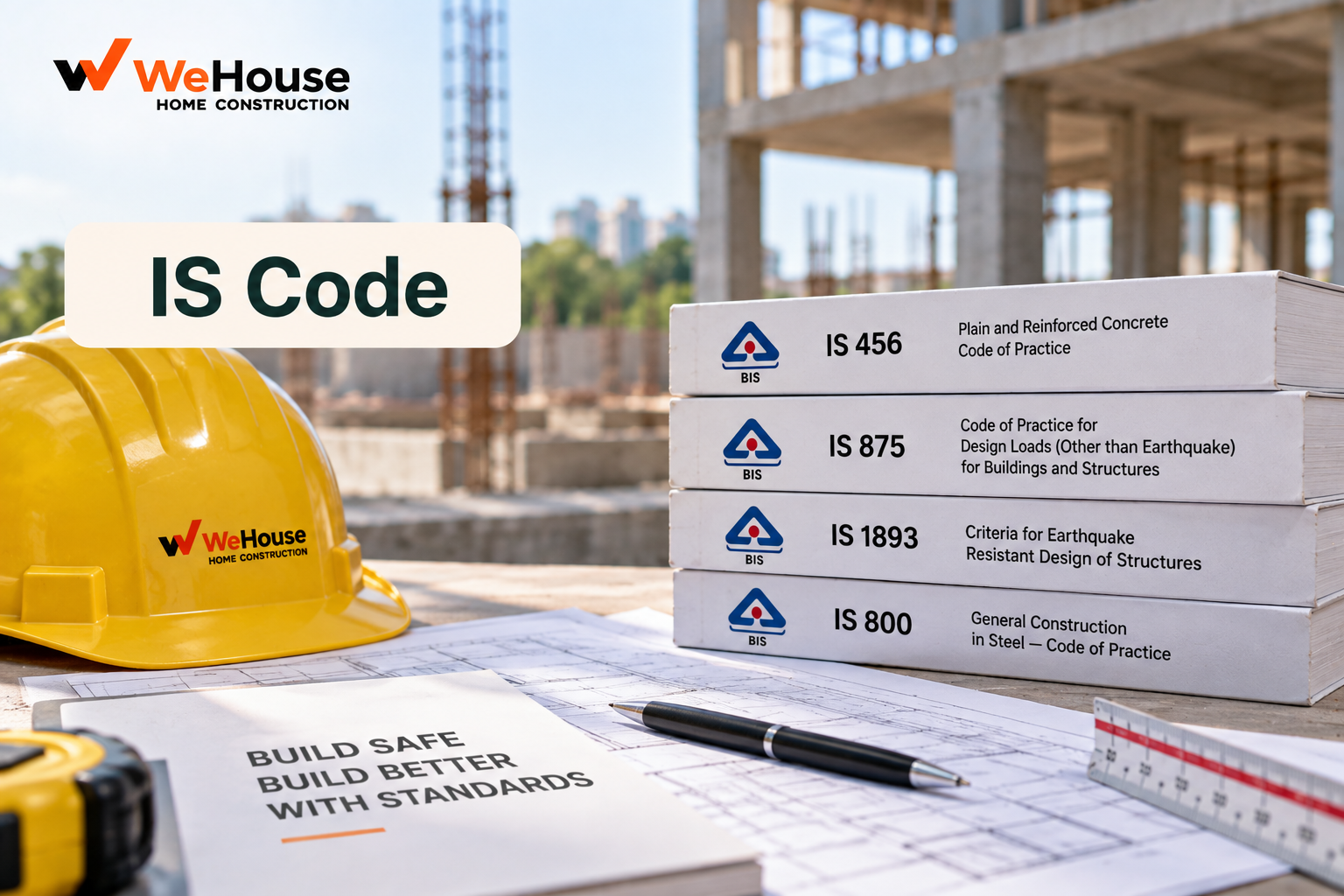
 What is an IS Code?
An IS Code, short for Indian Standard, is a technical document published by the Bureau of Indian Standards (BIS), India's national standards body, setting out requirements for a material, a design method, a testing procedure, or a code of practice for executing a specific type of work. Each code is identified by a number — for example IS 456, IS 875, or IS 1077 — and larger codes covering multiple related topics are often split into numbered parts, such as IS 875 Part 1 (dead loads) through Part 6.
Which IS Codes matter most for residential construction?
| Code | Covers |
|---|---|
| IS 456 | Plain and reinforced concrete — code of practice, the central structural design reference |
| IS 875 (Parts 1-5) | Design loads: dead loads, live loads, wind loads, snow loads, and special/other loads |
| IS 1893 | Criteria for earthquake resistant design of structures |
| IS 269 / IS 1489 | Specifications for Ordinary Portland Cement (OPC) and Portland Pozzolana Cement (PPC) |
| IS 1077 | Common burnt clay building bricks — specification |
| IS 1786 | High strength deformed steel bars (TMT bars) for reinforcement |
| IS 2212 | Code of practice for brickwork execution |
| IS 3043 | Code of practice for earthing |
| IS 3067 | Prevention of dampness in buildings, including DPC |
| IS 10262 | Guidelines for concrete mix proportioning (design mix) |
This is a small selection of the codes most frequently relevant to ordinary Indian residential construction; BIS publishes several hundred civil engineering and construction-related standards in total, covering everything from tile adhesives to lift safety, and a structural engineer or specialist consultant will typically draw on the specific subset relevant to their discipline and the project at hand.
Are IS Codes legally mandatory?
This depends on context. Some codes become legally binding because state or municipal building bylaws explicitly reference and incorporate them, most notably IS 456 for structural concrete design and the National Building Code of India (which itself references numerous individual IS Codes) for a wide range of building safety, fire and accessibility requirements. Other codes function as recognised good practice and industry-standard reference documents, generally followed by competent engineers and used as the basis for product certification and quality expectations, without being individually named in every local building bylaw. In practice, deviating from a widely recognised code like IS 456 without strong engineering justification is treated as a serious quality and liability concern by any competent structural engineer or contractor, regardless of the precise legal mandate in a specific jurisdiction.
How are IS Codes structured?
Most IS Codes follow a broadly similar structure: a scope section defining what the code covers, definitions of key terms, material or design requirements (often including tables of minimum values, permissible limits or standard sizes), and, for many codes, specified test methods and acceptance criteria for verifying compliance. Codes are periodically revised by BIS technical committees as engineering knowledge, materials and construction practice evolve — for example, IS 456 has been revised several times since its original publication, each revision reflecting updated understanding of concrete design and durability. Using an outdated edition of a code, particularly for structural design, is itself a quality risk worth checking for on any project.
How should an owner or non-engineer use IS Code references?
An owner without an engineering background does not need to read the full text of every relevant code, but knowing that specific IS Code references exist — and asking a contractor or engineer to confirm compliance with the relevant one for a specific concern (for example, ""what cover is specified per IS 456 for this column,"" or ""is this cement tested against IS 269"") — is a practical, useful way to hold construction quality to an objective, verifiable standard rather than relying purely on a contractor's verbal assurance. Throughout this glossary, individual entries reference the specific IS Code relevant to that topic, giving a starting point for exactly this kind of verification.