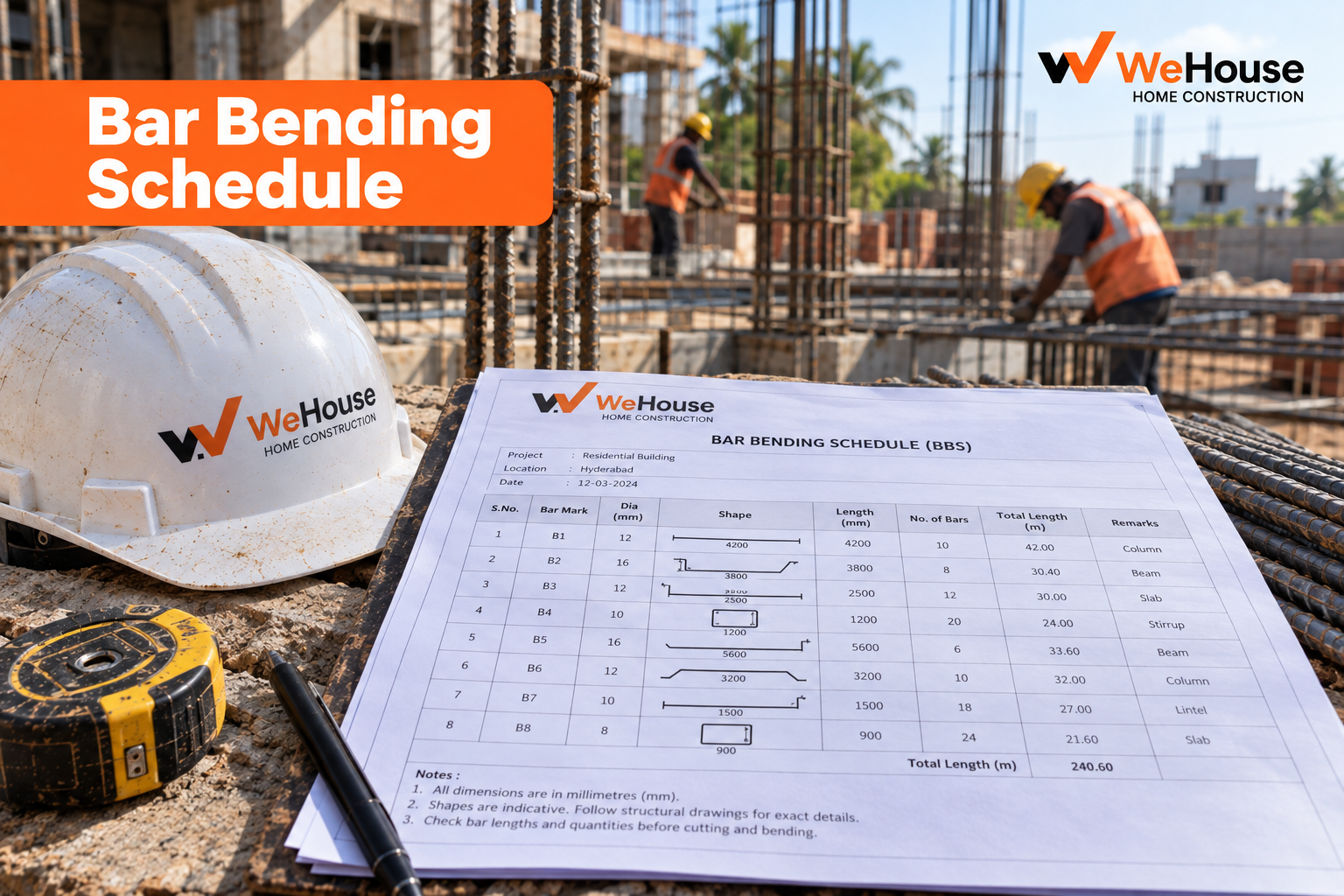
 What is a bar bending schedule?
A bar bending schedule is a table that turns a structural drawing into a cutting list. The drawing shows a beam with four 16 mm bars at the bottom, two at the top and 8 mm stirrups at 150 mm centres. The BBS translates that into: bar mark B1, diameter 16 mm, shape code, cutting length 5,340 mm, quantity 4, weight 33.7 kg. Someone in the bending yard can work from the second version. Nobody can work efficiently from the first.
Every row carries a bar mark, diameter, shape, cutting length, number of bars, length per bar and total weight. Summed by diameter, the schedule tells you exactly how much TMT steel to order in each size.
How is bar weight calculated?
The standard formula across Indian practice is:
Weight per metre (kg) = d² ÷ 162, where d is the bar diameter in millimetres.
| Diameter | Weight per metre | Weight per 12 m bar |
|---|---|---|
| 8 mm | 0.395 kg | 4.74 kg |
| 10 mm | 0.617 kg | 7.40 kg |
| 12 mm | 0.888 kg | 10.66 kg |
| 16 mm | 1.580 kg | 18.96 kg |
| 20 mm | 2.469 kg | 29.63 kg |
| 25 mm | 3.858 kg | 46.30 kg |
The 162 derives from steel density of 7,850 kg per cubic metre applied to a circular section. It is an exact derivation, not an approximation, which is why the same figure appears in every Indian textbook and billing sheet.
What is cutting length and why is it not the same as drawing length?
This is the part that catches people out. When a steel bar is bent, the outer face stretches and the inner face compresses. The bar effectively gains length at the bend. If you cut a bar to the sum of the dimensions shown on the drawing, the bent bar comes out too long and will not fit inside the cover.
So the cutting length subtracts a bend deduction at every bend:
Cutting length = sum of all straight lengths + hook allowances − bend deductions
- 45 degree bend: deduct 1 × d
- 90 degree bend: deduct 2 × d
- 135 degree bend (stirrup hook): deduct 3 × d
- Standard hook allowance: add 9 × d per hook, or 10 × d for a 135 degree hook
For a 16 mm bar with two 90 degree bends, that is a deduction of 64 mm. Over hundreds of bars the errors compound into either short bars that fail inspection or long bars that will not fit the shuttering.
What else does a BBS account for?
- Lap length. Where a bar must be joined, the overlap is typically 40 to 50 times diameter for bars in tension, as specified by the engineer per IS 456. For a 16 mm bar, 640 to 800 mm. Laps must be staggered, not all at the same section.
- Development length. The embedment needed for a bar to develop its full strength into a support, again usually expressed as a multiple of diameter.
- Cover. Cutting lengths are measured to the bar centreline inside the concrete face less the specified cover, which is usually 40 mm for footings, 40 mm for columns, 25 mm for beams and 15 to 20 mm for slabs.
- Crank bars. Bent-up bars in slabs need the diagonal length computed, not the horizontal projection.
- Wastage allowance. Usually 2 to 5 percent added to the ordered quantity, stated explicitly.
How does a BBS save money?
Reinforcement is typically 12 to 18 percent of civil cost, the second-biggest material line after concrete. With Fe 500D TMT at Rs 68,000 to Rs 85,000 per tonne, wastage is expensive.
Without a schedule, bars are cut on demand from 12 m stock, and the offcuts pile up. Typical wastage runs 5 to 8 percent. With a BBS, the detailer can nest cutting lengths so that a 12 m bar yields, say, two 5.3 m bars and one 1.3 m bar that is actually needed elsewhere. Wastage falls to 2 to 3 percent. On a 10-tonne residential project, three percentage points is roughly Rs 20,000 to Rs 25,000, against a detailing cost of Rs 8,000 to Rs 25,000. The schedule generally pays for itself, and the accuracy benefit is free on top.
How is a BBS used to check work on site?
This is its most valuable and least used function. Before any pour, the site engineer should walk the reinforcement with the schedule and verify, for each member: bar diameters, number of bars top and bottom, stirrup spacing, lap positions and lengths, and cover block placement.
Once concrete goes in, none of this is checkable without destructive testing. A photograph of the tied cage against the schedule sheet, taken before shuttering is closed, takes two minutes and settles any later dispute. It also feeds the as-built drawing.
Common BBS mistakes
- Ignoring bend deductions. Produces bars that are systematically too long.
- Using a single lap length everywhere. Tension and compression laps differ; so do laps in different concrete grades.
- All laps at one section. IS 456 requires staggering; bunched laps create a weak plane.
- Schedule not revised after a drawing revision. The single most dangerous error. Every BBS sheet must carry the drawing revision number it was built from.
- Weight billed from BBS rather than actual. Agree in the BOQ whether payment is on theoretical schedule weight or weighbridge weight, because the two differ.
- Substituting bar diameters. Two 12 mm bars are not a substitute for one 16 mm bar, whatever the area arithmetic suggests. That is an engineer's call.
Which codes govern bar bending schedules?
IS 2502 is the code of practice for bending and fixing of bars for concrete reinforcement, and it defines standard shape codes and bend dimensions. SP 34 is the handbook on concrete reinforcement and detailing, and is the practical reference most Indian detailers work from. IS 456 governs cover, lap and development lengths. IS 1786 covers the specification for high strength deformed bars including Fe 500 and Fe 550 grades. See IS Code for citation practice and yield strength for what the grade designations mean.