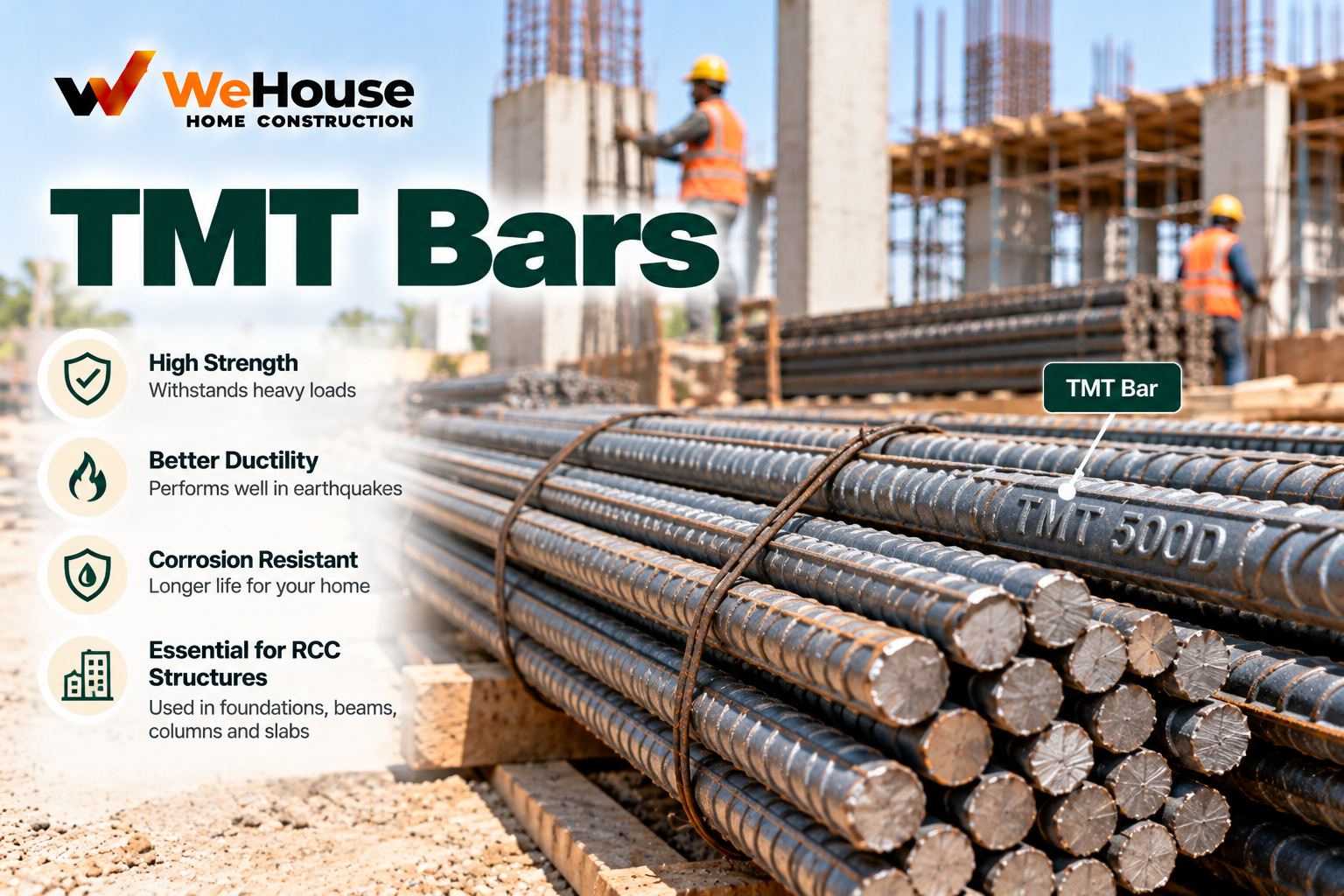
 What are TMT bars?
TMT bars, short for Thermo-Mechanically Treated bars, are the standard steel reinforcement used in virtually all contemporary Indian RCC construction, manufactured through a specific heat-treatment process applied immediately after hot rolling: the bar is rapidly quenched with water as it emerges from the rolling mill, hardening its outer surface into a tough layer called martensite, while the bar's retained internal heat then tempers this hardened outer layer as it conducts outward, and the bar's core, never fully quenched, remains in a softer, more ductile ferrite-pearlite structure. The result is a single bar combining a strong, hard outer rim with a softer, ductile core — a structure that gives TMT bars simultaneously higher strength and better ductility, bendability and weldability than the older manufacturing processes they have largely replaced.
What grades of TMT bars are available?
| Grade | Minimum yield strength | Typical use |
|---|---|---|
| Fe415 | 415 N/mm2 | General residential construction, now less common than Fe500/Fe500D for primary structural work |
| Fe500 | 500 N/mm2 | Common general-purpose grade for residential and commercial RCC structures |
| Fe500D | 500 N/mm2, with enhanced ductility | Widely favoured for seismic zones and general structural use given its improved elongation and ductility performance |
| Fe550 / Fe600 | 550 / 600 N/mm2 | Higher-strength applications where reduced reinforcement quantity for a given load is specifically valuable |
The grade number denotes the bar's minimum yield strength, the stress at which the steel begins to deform permanently rather than returning to its original shape; Fe500D has become a particularly common choice in contemporary Indian construction, valued specifically for its combination of high strength with the enhanced ductility (""D"" denotes ductile) that gives a structure better capacity to deform without fracturing during an earthquake, an important consideration across much of India's seismic zone classification.
Why did TMT bars replace older CTD/TOR bars?
Older cold-twisted deformed (CTD, sometimes called TOR) bars achieved their strength through a cold-working process — physically twisting the bar after rolling — which increased strength but at the cost of reduced ductility and a less favourable overall strength-to-ductility balance compared to the thermo-mechanical treatment process. TMT bars achieve comparable or higher strength through heat treatment rather than cold-twisting, preserving considerably better ductility, weldability and bendability, along with generally improved corrosion resistance and fire resistance performance (since the quenching process does not introduce the same internal residual stress that cold-twisting does), which collectively made TMT bars the clearly superior and now near-universal choice for contemporary Indian reinforcement steel.
What quality checks matter when procuring TMT bars?
- IS 1786 conformity certification, verifying the bars meet the specified grade's minimum yield strength, elongation and other mechanical property requirements.
- Consistent diameter and weight per running metre, checked against the standard theoretical weight for that diameter — bars significantly underweight for their nominal diameter indicate a manufacturing shortfall that directly reduces actual load capacity despite appearing correctly sized.
- Surface condition. Bars should be free of excessive rust, scale or visible defects; light surface rust is generally acceptable and does not significantly affect bond or strength, but heavy pitting or scaling is a quality concern.
- Rib pattern and deformation. TMT bars have a distinctive rib pattern that improves mechanical bond with the surrounding concrete; this pattern should be clearly visible and consistent along the bar's length.
Are corrosion-resistant TMT bar variants used in India?
Yes, corrosion-resistant steel (CRS) TMT bar variants, with modified alloy composition specifically improving resistance to corrosion, are increasingly used in coastal construction, marine structures, and other applications with particularly aggressive exposure conditions, where ordinary TMT bars would be at meaningfully higher long-term corrosion risk despite adequate concrete cover. The structural engineer specifies whether a standard or corrosion-resistant TMT grade is appropriate based on the specific project's exposure environment, discussed in more detail under IS Code and cover block.