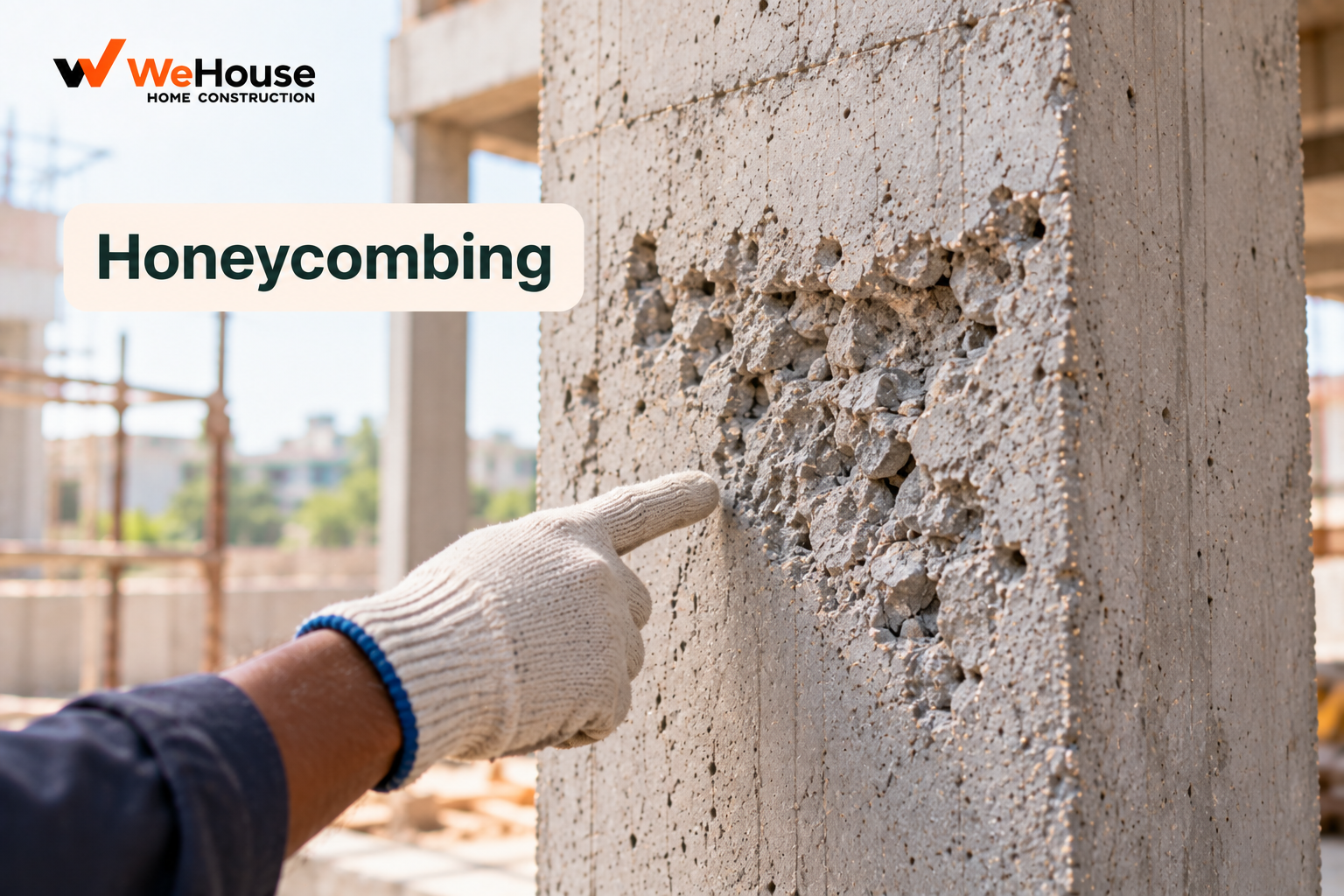
 What is honeycombing in concrete?
Honeycombing is a surface defect in hardened concrete where the cement mortar (the paste of cement, water and fine sand that is meant to fully surround and bind the coarse aggregate together) fails to completely fill the spaces between aggregate particles, leaving a visible pattern of interconnected voids and gaps that resembles a honeycomb. It ranges from minor, cosmetic surface pitting to serious structural voids extending well into a concrete element, and its severity — not merely its presence — determines whether it is a simple cosmetic fix or a genuine structural concern requiring engineering assessment.
What causes honeycombing?
- Inadequate compaction. The most common cause: insufficient or improperly executed vibration during placement (see compaction) fails to remove trapped air and fully consolidate the fresh concrete around the reinforcement and formwork corners.
- Congested reinforcement. Closely spaced reinforcement bars, common at beam-column junctions and heavily reinforced elements, can physically restrict the flow of fresh concrete and the reach of a vibrator, leaving voids in hard-to-access pockets even when compaction is attempted conscientiously.
- Poor workability of the concrete mix. A stiff, low-slump mix that does not flow readily around reinforcement and into formwork corners is more prone to leaving voids, particularly in congested sections, even with adequate vibration effort.
- Segregation. Where coarse aggregate separates from the cement paste during placement or over-vibration, the aggregate can settle unevenly, leaving aggregate-rich, paste-deficient pockets that show up as honeycombing once hardened.
- Leaking formwork joints. Gaps in formwork panels let cement paste (grout) leak out of the mix during the pour, leaving a locally aggregate-rich, weak zone right at that joint location.
- Excessive drop height during placement. Dropping concrete from too great a height into formwork can cause the mix to segregate before it even settles into place, particularly in narrow, heavily reinforced sections like columns.
How is honeycombing assessed?
| Severity | Description | Typical action |
|---|---|---|
| Minor / surface | Shallow pitting, a few millimetres deep, cosmetic in nature, not exposing reinforcement | Surface repair with cement mortar or polymer-modified patch |
| Moderate | Deeper voids, potentially approaching or slightly exposing reinforcement, in a non-critical location | Removal of unsound concrete, proper repair mortar, engineer's review recommended |
| Severe / structural | Deep voids exposing reinforcement, occurring in a critical structural element (column, beam, footing) or over a significant area | Mandatory structural engineer assessment; may require specialised repair (micro-concrete, epoxy grouting) or, in extreme cases, demolition and recasting of the element |
The critical distinction an owner or site supervisor should draw is not simply whether honeycombing is present — some very minor surface pitting is not unusual and is straightforward to repair cosmetically — but its depth, extent, and location. Honeycombing in a load-bearing column, beam or footing, or anywhere reinforcement is visibly exposed, should always be referred to a structural engineer rather than patched over cosmetically without assessment, since it can meaningfully reduce the element's effective cross-section and load-carrying capacity, and patching over it without proper structural repair can conceal an ongoing problem rather than fix it.
How is honeycombing repaired?
Repair begins with removing all loose, unsound concrete around the honeycombed area — chipping back to solid, well-bonded concrete, similar in principle to hacking but more extensive — followed, for structural repairs, by cleaning and treating any exposed reinforcement (which may need anti-corrosive treatment if exposure has been prolonged), then filling with an appropriate repair material. Minor surface repairs typically use a cement-sand mortar or a polymer-modified repair compound. More significant structural repairs may require specialised micro-concrete (a flowable, shrinkage-compensated repair concrete designed to be poured or pumped into prepared voids) or epoxy-based structural repair systems, following a method specified by the structural engineer based on the assessed severity and location.
How can honeycombing be prevented?
Prevention is considerably more reliable and economical than repair, and centres on the same fundamentals that govern good concreting practice generally: adequate compaction using correctly used vibration, a concrete mix with adequate workability for the specific reinforcement congestion of that element, well-sealed formwork joints to prevent grout leakage, and controlled placement to avoid excessive drop heights or segregation. Because honeycombing is only discovered after formwork is removed, when the pour itself can no longer be corrected, prevention through careful execution at the time of concreting is the only real control point available.