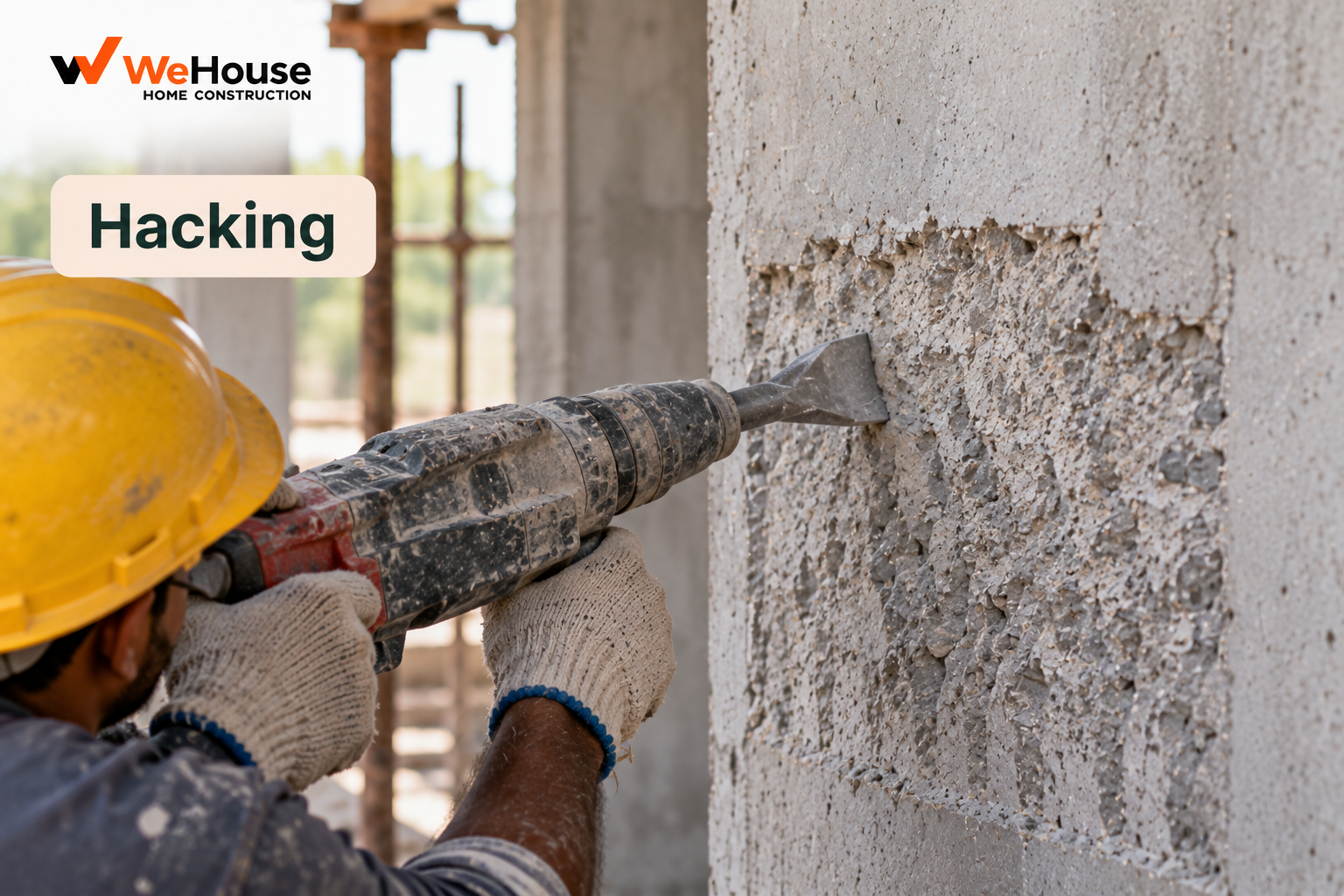
 What is hacking in construction?
Hacking is the deliberate roughening of a smooth, hardened concrete surface, done to break up its naturally dense, low-porosity finish and expose the coarse aggregate underneath, creating a mechanically keyed texture that a subsequent layer — most commonly cement plaster — can bond to far more securely than it would to the original smooth surface straight from formwork. It is one of the simplest, cheapest and most frequently skipped preparatory steps in Indian construction, despite being directly responsible for a common and highly visible later defect: plaster that debonds, sounds hollow when tapped, or falls away from a ceiling or column surface months or years after finishing.
Why do RCC surfaces need hacking before plastering but brick walls don't?
The underlying issue is porosity and surface texture. Brick masonry is naturally porous and, once the mortar joints and slight surface irregularities of individual bricks are accounted for, offers reasonable mechanical key for plaster to grip onto without additional preparation. Cast-in-place RCC, by contrast, comes out of formwork with a comparatively smooth, dense surface — precisely because good formwork and adequate concrete compaction are meant to produce exactly that kind of clean, void-free finish. That same smoothness, ideal for the concrete's own structural quality, works against plaster adhesion, since there is very little for a plaster coat to physically grip onto without some deliberate roughening first.
How is hacking done on site?
- Manual hacking (chipping). Using a hammer and chisel, or a similar hand tool, to strike the concrete surface repeatedly in a scattered pattern, chipping away the thin, dense surface laitance layer and exposing the coarse aggregate beneath. This remains the most common method for ordinary residential column, beam and slab soffit surfaces.
- Mechanical scarifying. A powered scarifying tool, with rotating cutting wheels or a mechanical hammering action, roughens large concrete areas much faster than manual chipping, typically used for larger commercial, industrial or renovation projects where the area to be prepared is substantial.
- Chemical surface retarders (less common in typical residential work). Applied to the formwork face before pouring, these delay the surface (but not the bulk) of the concrete from hardening fully, so the thin retarded layer can simply be washed or brushed off shortly after deshuttering, exposing aggregate without any mechanical chipping at all — a technique more common in precast or specialised applications than ordinary site-cast residential RCC.
What does adequately hacked concrete look like?
A properly hacked surface shows a consistent, evenly distributed rough texture across the entire area, with the coarse aggregate visibly exposed rather than just superficially scratched, and without any large, loose, precariously attached chips of concrete left in place (which would themselves later debond, taking a patch of fresh plaster with them). It is a visual, tactile check rather than a measured dimension — running a hand across the surface should feel distinctly rough and gritty, not smooth, before plastering proceeds.
What goes wrong when hacking is skipped or done poorly?
- Plaster debonding. The most common consequence: plaster applied directly onto an unhacked, smooth RCC surface has poor mechanical grip and can separate from the concrete over time, especially under thermal movement or minor structural vibration, producing hollow-sounding patches that eventually crack and fall.
- Skipped on ceilings specifically. Slab soffits (the underside of a floor slab, forming the ceiling below) are a particularly common location for skipped hacking, since the work is overhead and harder to inspect casually, yet ceiling plaster debonding and falling is also one of the more hazardous versions of this defect.
- Inconsistent roughening. Patchy hacking, thorough in some areas and skipped in others, produces uneven bond quality across a single wall or ceiling surface, sometimes showing up as plaster failing in a distinct patch pattern that traces back to where hacking was inconsistently done.
Because hacking happens before plastering covers the surface entirely, it is one of the easiest preparatory steps to verify with a quick visual and tactile check on site, and one of the cheapest ways to materially reduce the risk of later plaster debonding.