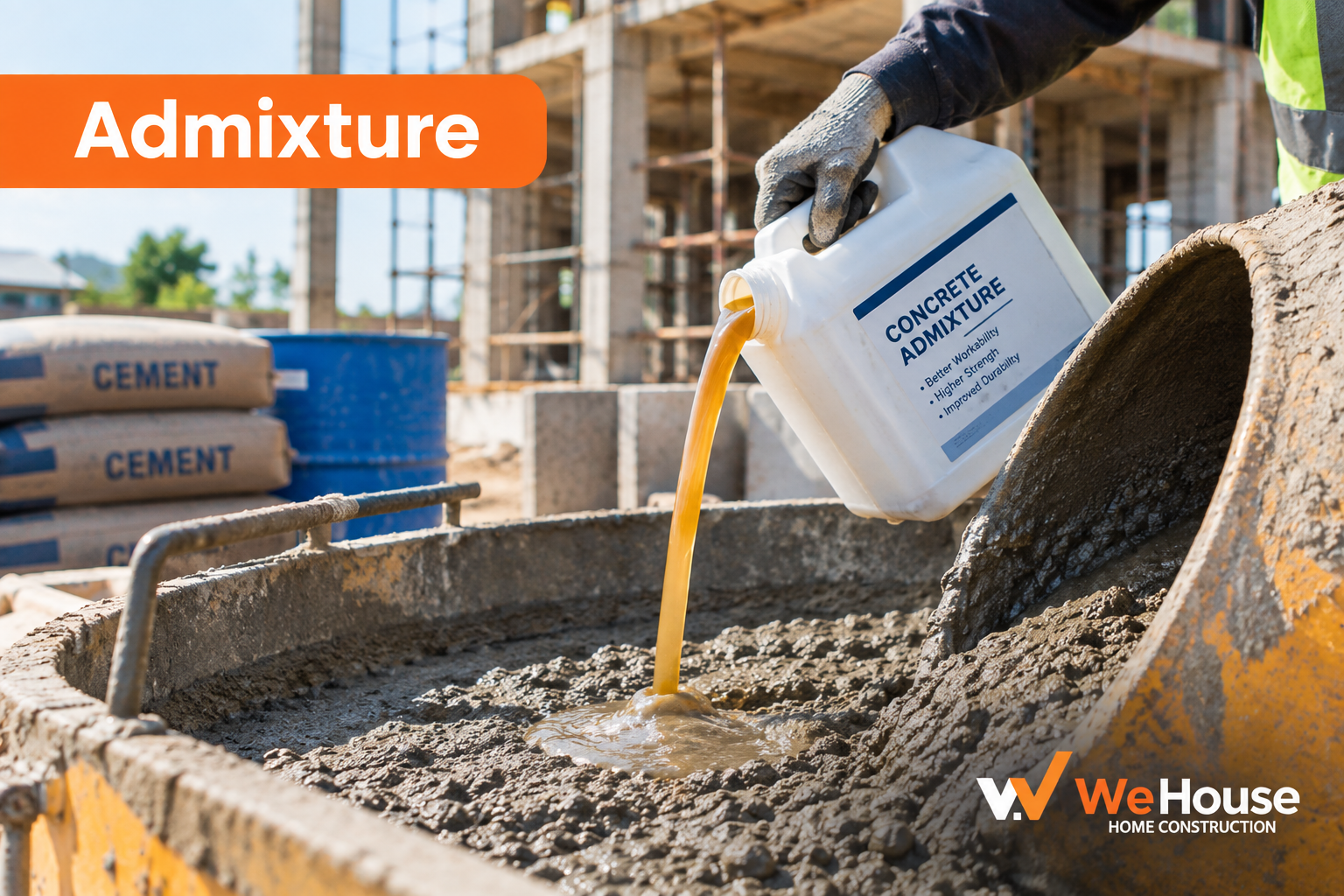
 What is an admixture in concrete?
An admixture is a chemical added to a concrete or mortar mix in a very small quantity to change the way it behaves. The five main ingredients of concrete are cement, fine aggregate, coarse aggregate, water and air. An admixture is the sixth ingredient, and unlike the others it is measured in litres per cubic metre rather than kilos or bags.
The core idea is simple. Concrete needs only about 0.25 to 0.30 kg of water per kg of cement to hydrate fully. But a mix that lean is unworkable, so masons add water to make it flow. Every extra litre of water permanently weakens the hardened concrete. An admixture lets you get flow without the extra water. That is why the most widely used admixtures are called water reducers.
What are the main types of concrete admixture?
| Type | What it does | When it is used |
|---|---|---|
| Plasticiser (water reducer) | Cuts water demand 5-12% | General RCC work, M20 to M25 |
| Superplasticiser (PCE / SNF) | Cuts water demand 15-30% | M30 and above, pumped concrete, congested steel |
| Retarder | Delays initial set by 1-4 hours | Long RMC transit, large raft pours, hot weather |
| Accelerator | Speeds early strength gain | Cold weather, early deshuttering, repairs |
| Air-entraining agent | Creates fine stable air bubbles | Freeze-thaw exposure, hill regions |
| Waterproofing / integral compound | Reduces permeability | Basements, tanks, terraces |
| Shrinkage compensating | Reduces drying shrinkage cracks | Large slabs, industrial floors |
Most commercially sold products are combinations. A retarding superplasticiser is standard for ready mix concrete in Indian cities, because the truck may take 45 to 90 minutes to reach site in traffic and the concrete must still be pourable on arrival.
How does an admixture affect the water-cement ratio?
This is the entire point of the material. The water-cement ratio is the strongest single predictor of concrete strength. Reduce it, and strength goes up. Increase it, and strength falls sharply. A mix at 0.45 w/c might reach 32 N/mm2; the same mix at 0.60 w/c might barely touch 20 N/mm2.
A superplasticiser disperses cement particles that would otherwise clump together, releasing the water trapped between them. The concrete flows better at a lower water content. In practice a good PCE admixture lets you drop from 0.55 to 0.42 w/c while keeping the same slump. That is the difference between an M20 outcome and an M30 outcome from broadly the same materials.
How much admixture is added to concrete?
Dosage is expressed as a percentage of cement weight, not of total concrete volume. The usual band is 0.2 to 2 percent. For an M25 mix containing 340 kg of cement per cubic metre, a 1 percent dosage is 3.4 kg, or about 3 litres allowing for density.
Dosage must be established by trial mix, not guesswork, because it interacts with the cement brand. The same admixture at the same dosage will behave differently with OPC than with PPC, and differently again across manufacturers. Overdosing is a real risk: too much retarder can leave a slab unset for 24 hours, and too much superplasticiser causes segregation, where the aggregate sinks and a layer of paste floats to the top.
Are admixtures used in mortar and plaster too?
Yes, and the products differ from concrete admixtures. Masonry and plaster admixtures are usually air-entraining or water-retaining agents that keep the mix workable for longer on the trowel and reduce the tendency of a wall to suck water out of fresh mortar. That water loss is a common cause of weak bond and hairline cracking in plastering.
Integral waterproofing compounds are the other widely used category in residential work, dosed into plaster on external faces, sunken slabs and wet areas. They reduce permeability but do not create a waterproof layer on their own, which is a point worth being clear about with a contractor who offers integral compound as a substitute for a proper waterproofing system. The two solve different problems and a good specification uses both.
How much do admixtures cost in India?
Standard plasticisers run about Rs 45 to Rs 70 per litre. PCE-based superplasticisers run Rs 80 to Rs 120 per litre. Integral waterproofing compounds sit around Rs 55 to Rs 90 per litre. At typical dosage, the net addition to concrete cost is roughly Rs 120 to Rs 400 per cubic metre.
Set against that, a 15 percent water reduction commonly allows 20 to 30 kg less cement per cubic metre at equal strength, worth Rs 160 to Rs 250. In most mixes, the admixture is close to cost-neutral. It should appear as a separate line in the concrete rate analysis of your BOQ; if it is not there, ask your quantity surveyor whether it has been assumed inside the RMC rate.
What goes wrong with admixtures on site?
- Adding admixture and water. Site teams sometimes dose the chemical and still add water for flow. This destroys the benefit entirely.
- Retempering at site. Adding water to an RMC truck that has stiffened during transit. Always refuse this; ask the supplier to re-dose with admixture instead, or reject the load.
- Eyeballed dosage. Measure with a calibrated dispenser or graduated jug, never a random bucket.
- Mixing brands. Two admixtures from different manufacturers can react badly. Use one supplier per pour.
- Expired stock. Most liquid admixtures have a 6 to 12 month shelf life and separate on standing. Check the date and stir before use.
- Treating admixture as a substitute for curing. It is not. Curing is still mandatory.
Which IS code covers admixtures?
IS 9103 is the specification for concrete admixtures and defines the performance requirements for each type. IS 456, the code of practice for plain and reinforced concrete, permits admixtures provided they conform to IS 9103 and do not impair durability or promote corrosion of reinforcement. IS 10262 covers concrete mix proportioning and sets out how admixture-driven water reduction is factored into a mix design. See IS Code for how to read these references.
One hard rule from IS 456: admixtures containing chlorides must not be used in reinforced or prestressed concrete, because chlorides corrode TMT bars. Ask for a chloride content declaration on the test certificate. For post-tensioned work this is non-negotiable.
Who decides which admixture to use?
The structural engineer specifies the requirement, for example a retarding superplasticiser conforming to IS 9103 with initial setting time extended by at least 90 minutes. The RMC supplier or the contractor selects a specific product and establishes dosage through trial mixes. The site engineer checks the batch slip on every delivery and records the dosage used. As a homeowner, the useful question at a pour is simply: what admixture is in this mix, at what dosage, and can I see the batch slip?