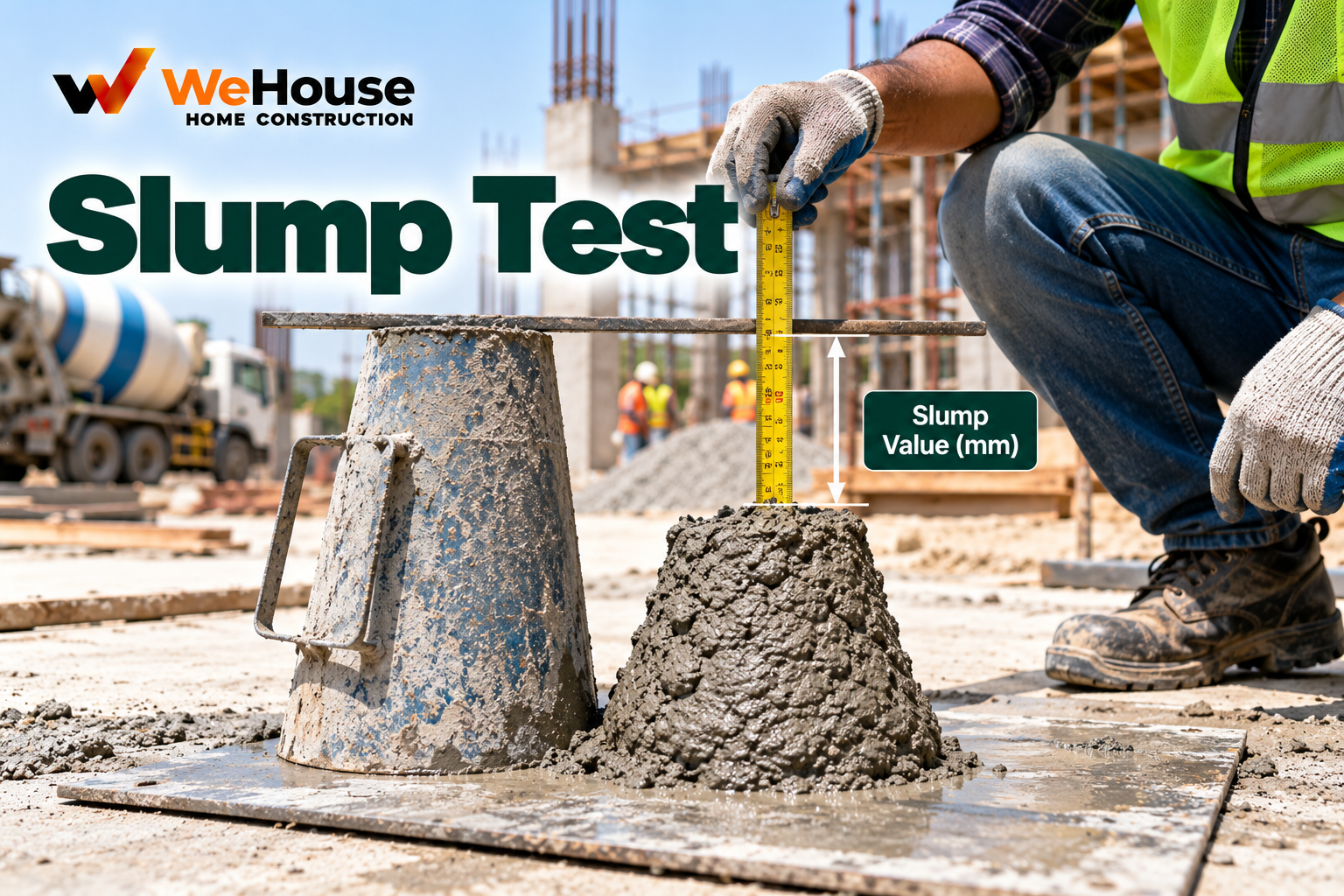
 What is a slump test?
A slump test is a simple, standardised field test measuring the workability of fresh concrete — essentially how fluid and easy to place and compact the mix is — performed using a specific, standard truncated cone mould and measured according to the procedure set out in IS 1199, the Indian Standard methods of sampling and analysis of concrete. It is one of the most frequently performed and genuinely useful quality checks on an active construction site, precisely because it gives an immediate, actionable result right at the point of placement, before the concrete hardens and any workability problem becomes a permanent, uncorrectable defect.
How is a slump test performed?
- A standard slump cone (200 mm base diameter, 100 mm top diameter, 300 mm height) is placed on a flat, non-absorbent surface and filled with fresh concrete in three equal layers, each layer compacted with 25 strokes of a standard tamping rod.
- Once filled and the top surface struck level, the cone is lifted straight upward, carefully and smoothly, allowing the unsupported concrete sample to settle under its own weight.
- The difference between the cone's original height (300 mm) and the height of the settled concrete sample's highest point is measured — this difference is the ""slump,"" expressed in millimetres.
What do different slump values indicate?
| Application | Typical specified slump |
|---|---|
| Mass concrete, foundations, lightly reinforced elements | 25-75 mm |
| Ordinary columns, beams and slabs | 75-100 mm |
| Heavily reinforced or congested sections, pumped concrete | 100-150 mm |
A higher slump value indicates a more fluid, flowable mix, which is useful and sometimes necessary for placing concrete around densely congested reinforcement or pumping it through a pipe to a difficult-to-reach location, but an excessively high slump, beyond what the mix design actually calls for, often signals too much water has been added, which weakens the hardened concrete's final strength even though it may seem to make placement easier at the time. A slump lower than specified suggests an overly stiff mix that will be difficult to properly compact around reinforcement, risking honeycombing and voids if forced into place without adequate vibration effort.
Why is slump testing performed at the point of placement, not just at the batching plant?
Concrete's workability changes over time after batching, generally decreasing (becoming stiffer) as the mix begins to hydrate during transport, particularly in hot weather or over longer transport distances for ready mix concrete. A slump test performed only at the batching plant, before transport, does not reliably reflect the concrete's actual workability by the time it reaches the site and is ready to be placed, which is why the test is performed, or at minimum re-verified, at the actual point of placement on site — giving the site team the opportunity to reject a batch that has lost too much workability in transit, before that problematic concrete is placed into formwork.
What is the most common cause of out-of-specification slump test results?
Adding extra water to fresh concrete on site, either at the batching plant to compensate for a stiffer-than-expected mix, or at the point of placement to make an already-batched load easier to pour and finish, is the most common cause of a slump test reading higher than specified, and is also one of the most damaging quality shortcuts in concrete work, since added water directly increases the mix's water-cement ratio beyond its designed value, significantly reducing the concrete's final hardened strength even though the fresh mix may appear to pour and finish more easily at the time. A slump test performed rigorously, with any out-of-specification batch genuinely rejected rather than accepted under site pressure to keep a pour moving, is one of the most effective, low-cost safeguards against this specific and common quality risk.