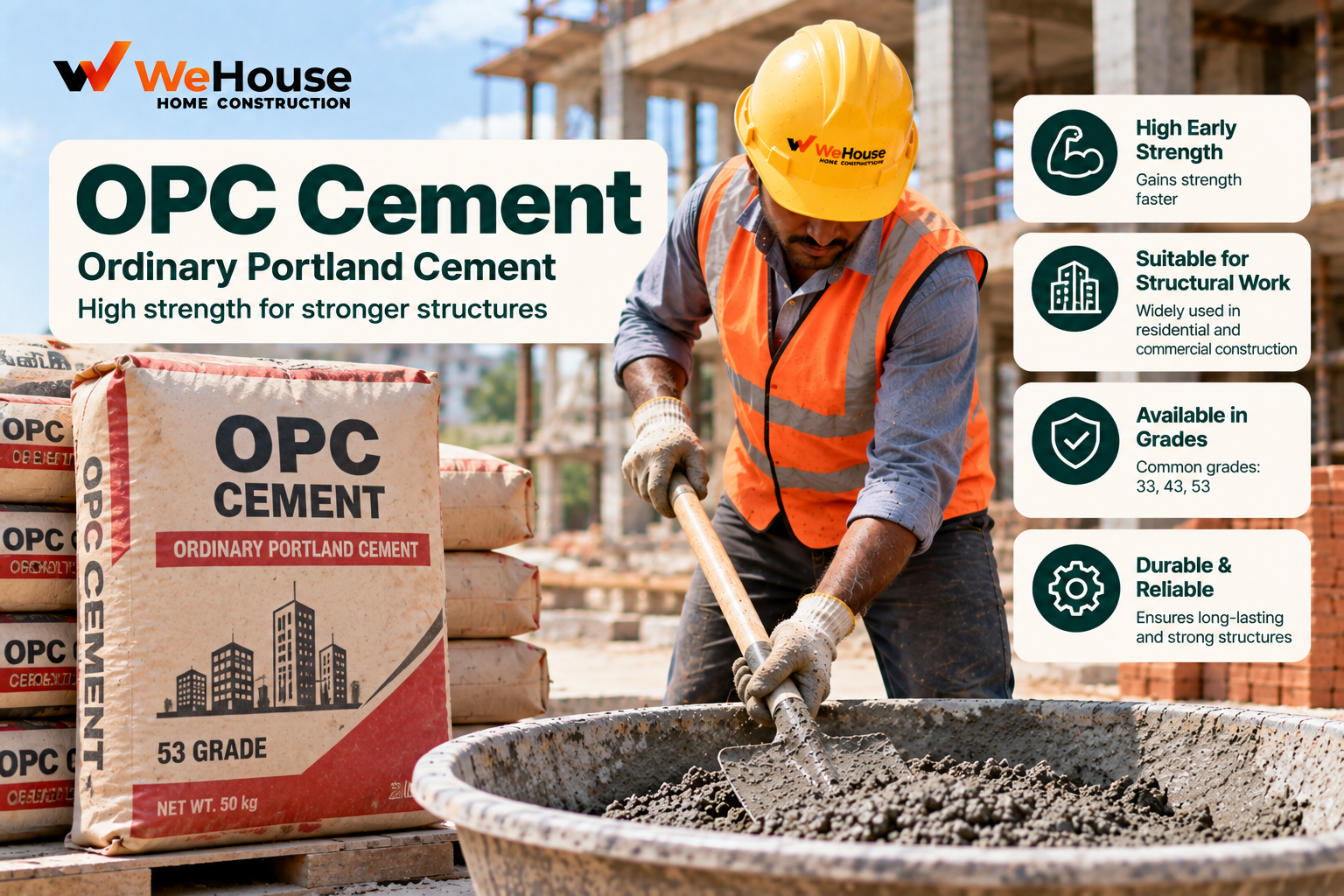
 What is OPC cement?
OPC, or Ordinary Portland Cement, is the most basic, traditional form of Portland cement, manufactured by grinding clinker (produced by heating limestone and clay in a kiln) together with a small proportion of gypsum, without the fly ash, slag or other pozzolanic materials blended into cements like PPC. It is specified under IS 269 and remains a fundamental, widely available cement type in Indian construction, even as blended cements have become the more common default for general-purpose concrete and masonry work.
What are the grades of OPC?
| Grade | Minimum 28-day compressive strength | Typical use |
|---|---|---|
| OPC 33 | 33 N/mm2 | Largely superseded by PPC and higher OPC grades for most contemporary work |
| OPC 43 | 43 N/mm2 | General-purpose structural concrete and masonry where OPC specifically is wanted |
| OPC 53 | 53 N/mm2 | Precast concrete, high-strength applications, situations needing fast early strength gain |
The grade number indicates the minimum compressive strength the cement must achieve, tested on a standard mortar cube at 28 days following IS 4031 test methods, with higher-grade OPC generally also developing strength somewhat faster at earlier ages (such as 7 days) than lower grades, a relevant factor for precast production cycles where rapid formwork turnaround is valuable.
How does OPC compare to PPC?
- Strength gain speed. OPC generally gains strength faster, particularly at early ages (3-7 days), than PPC, which hydrates more gradually due to its fly ash content.
- Heat of hydration. OPC generates more heat during hydration than PPC, a consideration for mass concrete pours where excessive internal heat buildup can increase early-age thermal cracking risk.
- Long-term durability. PPC is generally considered to offer favourable long-term durability characteristics in many exposure conditions, including better resistance to sulphate attack, a factor contributing to its widespread adoption for general residential and commercial construction.
- Availability and cost. Both OPC and PPC are widely available in India at broadly comparable cost, with the specific choice driven by the application's performance requirement rather than a large cost difference between the two.
Where is OPC specifically preferred over PPC?
OPC, particularly Grade 53, is favoured in applications where fast early strength gain genuinely matters — precast concrete manufacturing, where rapid strength development allows faster formwork reuse and production cycle turnaround, and certain specialised structural applications where the project schedule specifically benefits from quicker strength gain. Outside these specific cases, PPC has become the more common default choice for general residential RCC and masonry work in India, chosen for its lower heat of hydration (reducing early-age cracking risk in typical pours) and generally favourable durability profile for everyday construction exposure conditions.
How is OPC stored and handled on site?
OPC requires the same careful storage practice as any cement — kept off the ground on a raised platform, stacked no more than 10-12 bags high, protected from moisture, and used within roughly 3 months of manufacture, following the general cement storage principles discussed in the main cement entry. There is no meaningful difference in storage requirement between OPC and PPC; both are equally vulnerable to strength loss from moisture absorption and prolonged storage.