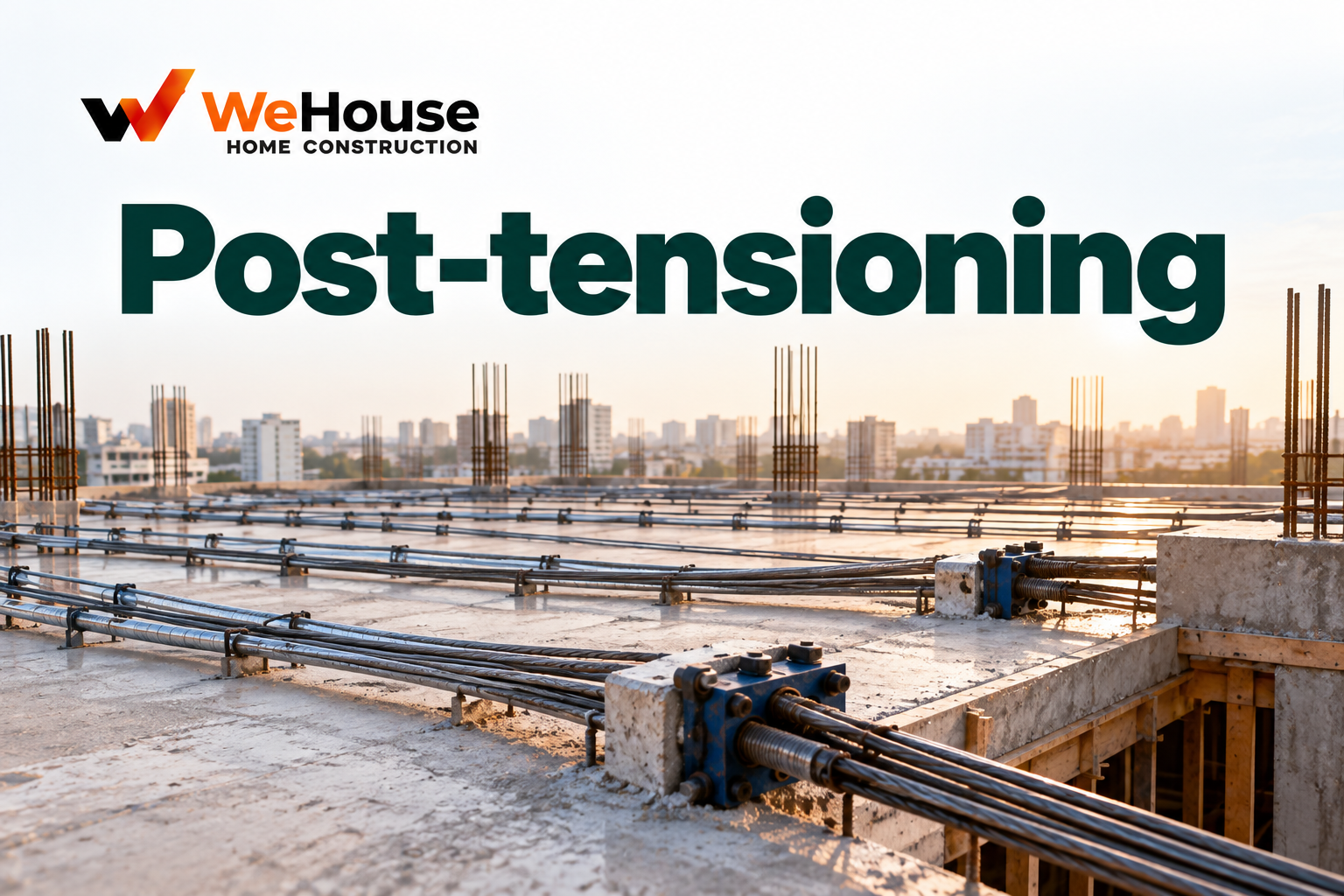
 What is post-tensioning?
Post-tensioning is a prestressing technique in which high-strength steel tendons (either individual strands or cables) are placed within ducts cast directly into a concrete element — typically a slab or beam — during construction, and then, once the concrete has hardened and gained sufficient strength, tensioned (stretched tight using hydraulic jacking equipment) and anchored at each end. This tensioning process compresses the surrounding concrete, deliberately introducing a beneficial internal compressive stress that counteracts the tensile stress the element would otherwise experience under its actual service load, allowing the element to span further or carry more load for a given thickness than conventional RCC, which relies solely on passive, unstressed reinforcement.
How is post-tensioning different from ordinary reinforced concrete?
| Aspect | Conventional RCC | Post-tensioned concrete |
|---|---|---|
| Reinforcement role | Passive — only activates and resists tension once the concrete is actually under load | Active — tendons are deliberately pre-stressed before service load is applied, pre-compressing the concrete |
| Typical achievable span | Shorter, generally up to roughly 6-8 m economically for a slab | Considerably longer, commonly 8-12 m or more for a slab |
| Slab thickness for a given span | Thicker, needed to control deflection and carry bending without pre-compression assistance | Thinner, since pre-compression reduces effective bending stress and improves deflection control |
| Construction complexity | Standard reinforcement fixing and concreting | Requires specialist tendon placement, ducting, and a separate tensioning and grouting operation after concrete curing |
What are the advantages of post-tensioning?
- Longer spans. Post-tensioned slabs can achieve considerably longer spans between supports than conventional RCC, reducing the number of intermediate columns needed, particularly valuable for parking structures, large open commercial floors, or architecturally open residential layouts.
- Thinner slabs. For an equivalent span, post-tensioning generally allows a thinner slab than conventional RCC would need, reducing the building's overall dead load and, over multiple floors, compounding into a meaningful reduction in cumulative structural weight and, correspondingly, foundation load.
- Improved crack and deflection control. The pre-compression post-tensioning introduces helps counteract the tensile stresses and deflection a slab would otherwise experience under load, often resulting in better long-term crack control than an equivalent conventional RCC slab.
Where is post-tensioning typically used in Indian construction?
Post-tensioning is used selectively, specifically where its structural and architectural advantages justify its added specialist cost — commonly in parking decks and podium levels (where long, column-free spans allow more efficient parking layouts), large-span commercial floors, and some high-rise residential or mixed-use developments seeking particularly open, column-light floor plans at specific levels. It is not a technique typically used or economically justified for ordinary individual residential houses or typical low to mid-rise apartment floors, where conventional RCC with standard spans remains both structurally adequate and considerably more economical.
What is the difference between pre-tensioning and post-tensioning?
Both are prestressing techniques, but differ in when the tendons are tensioned relative to the concrete being cast. Pre-tensioning, generally used for factory-produced precast elements, tensions the tendons before the concrete is cast, with the concrete cast around the already-tensioned, taut tendons, which are then cut and released once the concrete has cured and bonded directly to them. Post-tensioning, the technique discussed here, tensions the tendons after the concrete has already hardened, through ducts cast into the element, making it the more practical and widely used method for cast-in-place structural elements on an actual building site, as opposed to precast factory production.