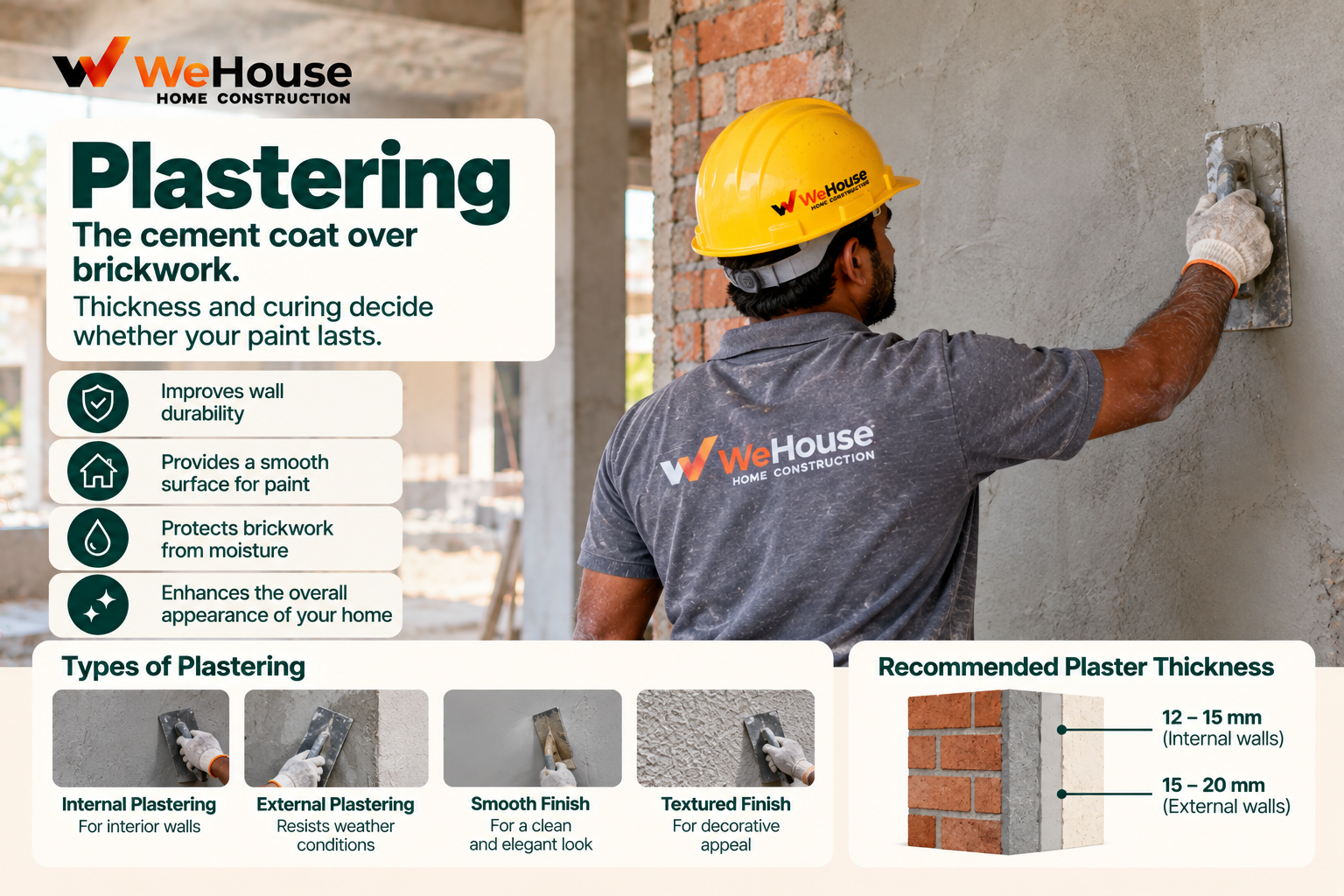
 What is plastering?
Plastering is the application of a cement-sand mortar coat over a masonry or concrete surface — walls and ceilings both internal and external — to produce a smooth, even, protective and paint-ready finish. It serves several functions simultaneously: concealing the inherent surface irregularities of brickwork or cast concrete, providing an additional protective layer against weathering and moisture ingress, and creating the uniform, smooth surface that painting and other final finishes require to look right.
What mix ratio and thickness is used for plastering?
| Application | Typical mix ratio | Typical thickness |
|---|---|---|
| Internal wall plastering | 1:4 to 1:6 | 12-15 mm, single coat |
| External wall plastering | 1:4 to 1:5 | 15-20 mm, often two coats (rough base coat plus finishing coat) |
| Ceiling plastering | 1:4 | 10-12 mm, typically a single, carefully finished coat |
External plastering generally uses a slightly richer mix and greater thickness than internal plastering, given its greater exposure to weathering, rain and temperature variation; a two-coat approach for external work — a rougher base coat to build up thickness and key to the wall, followed by a finer finishing coat for a smooth final surface — is common practice for higher-quality external finishes.
What surface preparation is needed before plastering?
Different surfaces need different preparation before plaster will bond adequately. Brick masonry, being naturally porous, generally needs only to be adequately wetted before plastering, without further mechanical preparation. Cast RCC surfaces — column faces, beam soffits, slab undersides — are smooth and dense, and need hacking (deliberate roughening to expose the coarse aggregate) before plastering, since plaster applied directly onto a smooth, unhacked RCC surface has very little to mechanically bond to and is prone to later debonding. All surfaces should be clean, free of dust, loose material or oil contamination, and adequately pre-wetted immediately before plaster is applied, since a dry surface draws water out of fresh plaster too quickly, weakening the bond in a way similar to how unsoaked bricks weaken brickwork mortar joints.
Why does plastering need curing?
Plaster is a cement-based material and, like concrete or brickwork, needs sustained moisture for at least 7 days after application to allow the cement to hydrate fully and develop its design strength, following the same principles discussed in more detail under curing. Plaster that dries out too quickly — common in hot, dry or windy conditions without adequate curing — develops shrinkage cracks, loses strength, and is considerably more prone to later cracking and debonding than properly cured plaster of the same mix.
What goes wrong with plastering on site?
- RCC surfaces plastered without hacking, a leading cause of later plaster debonding, particularly on ceilings (slab soffits), discussed in more detail under hacking.
- Inadequate curing, resulting in shrinkage cracking, surface dusting, and reduced plaster strength and durability.
- Plastering over a dry, unwetted surface, which draws moisture out of the fresh plaster too quickly, weakening the bond.
- Uneven thickness or poor levelling, producing a visibly wavy or uneven wall surface, particularly problematic where the underlying brickwork or RCC itself was not built accurately to line and level, requiring the plaster coat to compensate for larger-than-ideal irregularities.
- Cracking at material junctions, such as where brick masonry meets an RCC column or beam, a common crack location due to differential shrinkage and thermal movement between the two materials; this area sometimes benefits from an embedded reinforcing mesh within the plaster at the junction to control cracking.