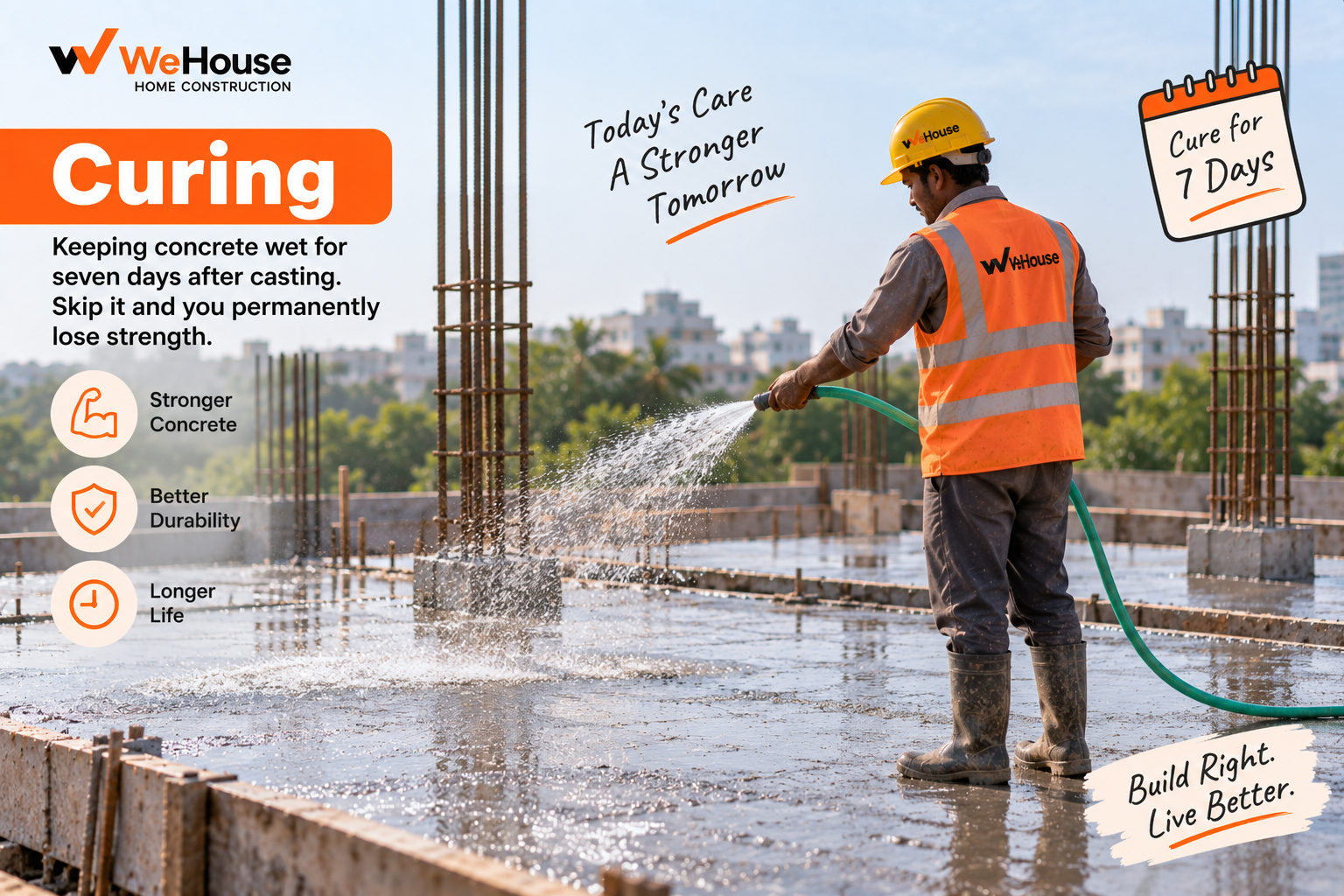
 What is curing in construction?
Curing is the deliberate process of keeping fresh concrete, mortar or plaster moist and at a reasonably stable temperature for a sustained period after it is placed, so that the cement can continue its chemical hydration reaction and keep gaining strength. It is easy to mistake curing for simply ""letting concrete dry,"" but drying is actually the opposite of what curing is meant to prevent — concrete that dries out too early stops hydrating properly and never reaches its full design strength, no matter how good the original mix was.
Why does concrete need to be cured?
Cement gains strength through hydration, a chemical reaction with water that continues for weeks and, at a slower rate, for years, not a one-time event that finishes when the concrete sets. Roughly 70-75 percent of a concrete's ultimate strength develops within the first 28 days, but a meaningful share of that development only happens if enough water remains available at the surface and within the concrete for hydration to continue. If the surface dries out in the first few days — very easy to happen in Indian heat, especially with direct sun and wind exposure — hydration effectively stops in the dried zone, leaving a weaker, more porous surface layer prone to shrinkage cracking, dusting and reduced durability, even though the interior of the element may be fine.
How long should concrete be cured?
| Condition | Minimum curing period |
|---|---|
| OPC concrete, normal conditions | 7 days |
| OPC concrete, hot or dry weather | 10 days |
| PPC or other blended cement concrete | 10-14 days |
| Water-retaining structures, critical elements | 14-21 days |
IS 456, the code of practice for plain and reinforced concrete, sets these as minimums, not targets to stop at exactly; erring toward the longer end of a range, especially in hot or windy conditions, is inexpensive and has no real downside. Blended cements like PPC, now the most common cement type used in Indian residential construction, hydrate more slowly than plain OPC and need a correspondingly longer curing period to reach comparable early strength, a detail that is sometimes overlooked when site teams apply an OPC-era 7-day habit to PPC concrete.
What are the common curing methods?
- Ponding. Building a small earthen or brick bund around a horizontal surface (a slab or floor) and keeping it continuously flooded with water. Very effective but only practical for flat, bounded surfaces.
- Wet covering. Covering the surface with wet gunny bags, hessian cloth or sand, kept continuously damp by periodic watering. The most common method for vertical elements like columns and walls.
- Sprinkling. Direct periodic watering of the surface, simple but easy to under-apply since it dries between waterings if not done frequently enough, especially in hot weather.
- Curing compounds. A sprayed-on membrane-forming liquid that seals surface moisture in, used where continuous water application is impractical (large exposed slabs, vertical formed surfaces, or water-scarce sites). Must be applied as soon as the surface is set enough to accept it.
- Formwork retention. Leaving formwork in place, which itself helps retain moisture at the surface, though it is not a substitute for active curing once deshuttering occurs.
Does brickwork and plaster need curing too?
Yes, and this is one of the most commonly overlooked areas of curing on Indian sites. Brick masonry and plaster are both cement-mortar based work and need the same minimum 7-day curing as structural concrete to develop full mortar strength and bond. Skipping curing on brickwork is a common cause of hairline cracking and poor bond between mortar and brick; skipping curing on plaster is a leading cause of plaster shrinkage cracking, dusting, and poor adhesion to the wall behind it.
What goes wrong when curing is skipped or shortened?
- Reduced final strength. Under-cured concrete can lose 20-40 percent of its potential strength compared to properly cured concrete of the same mix.
- Shrinkage cracking. Rapid moisture loss from the surface causes plastic and drying shrinkage cracks, especially in slabs, plaster and screeds.
- Surface dusting and weak top layer. A dried-out surface layer that never fully hydrated remains soft and porous even though the interior may be sound.
- Reduced durability. Poorly cured concrete is more porous and permeable, letting moisture and chlorides reach reinforcement faster over the building's life, accelerating corrosion.
Because curing failures are invisible at the time and only show up as reduced strength or cracking weeks or months later, it is one of the few construction steps worth actively checking day by day rather than assuming it is happening.