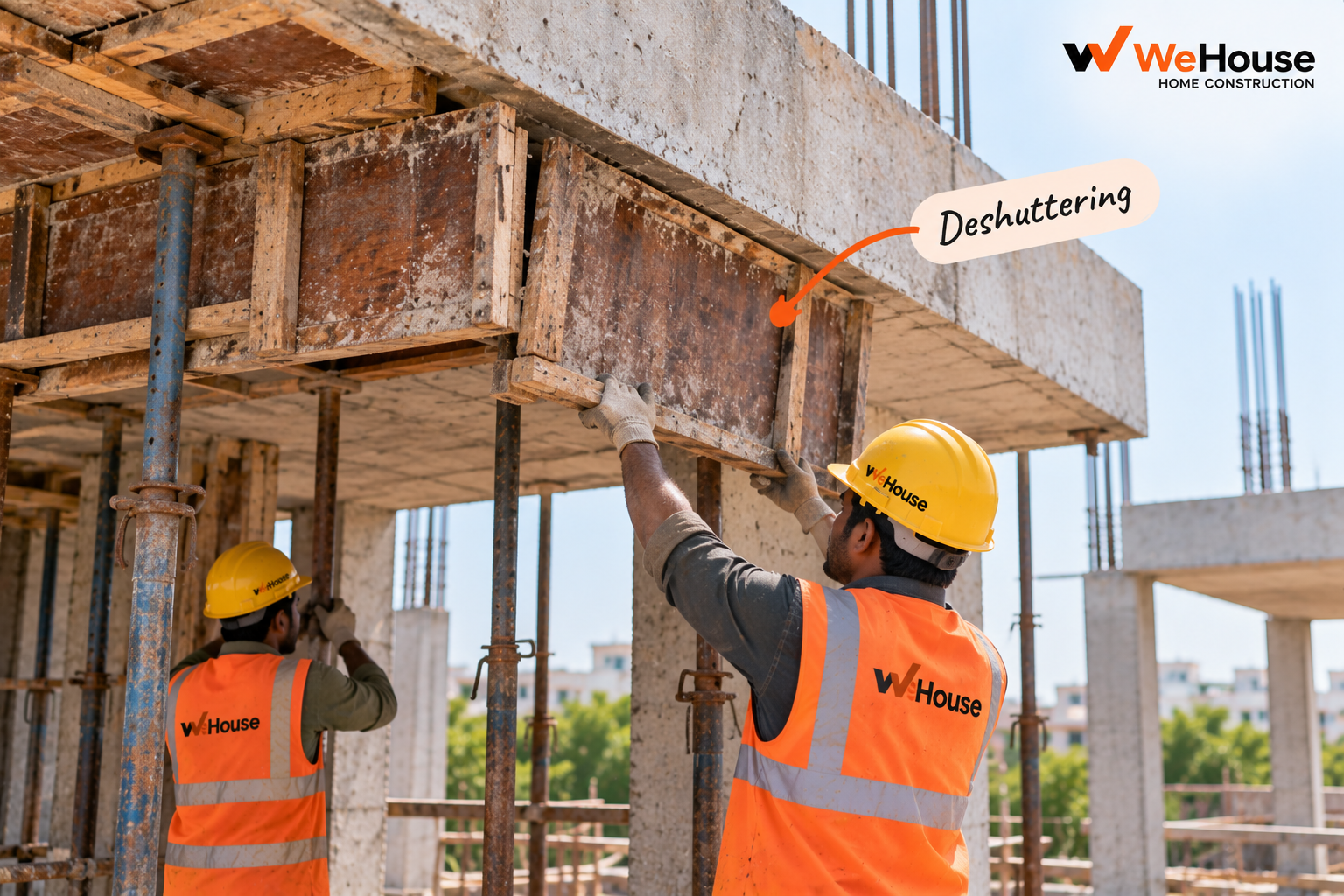
 What is deshuttering?
Deshuttering, also called striking formwork, is the removal of the temporary shuttering or formwork that holds fresh concrete in shape while it cures. It happens element by element as each pour reaches the minimum strength needed to support itself, and, for horizontal elements like slabs and beams, to support any load placed on it once the props are gone. Getting deshuttering timing right is one of the most consequential yet easy-to-shortcut steps in RCC construction, because concrete that looks solid on the surface within a day or two of pouring has typically gained only a fraction of its eventual strength.
What are the minimum deshuttering periods under IS 456?
| Element | Minimum period before removal |
|---|---|
| Vertical formwork: columns, walls, beam sides | 16-24 hours (commonly extended to 1-2 days on site) |
| Slab soffit props, span up to 4.5 m | 7 days |
| Slab soffit props, span over 4.5 m | 14 days |
| Beam soffit props, span up to 6 m | 14 days |
| Beam soffit props, span over 6 m | 21 days |
| Cantilever props | 21 days or more |
Vertical formwork can come off relatively quickly because, once the concrete has set, the sides of a column or beam are no longer carrying any load — they were only ever holding the fresh concrete's shape. Horizontal props under a slab or beam are a different matter entirely: they continue to physically carry the weight of the concrete (and often, construction loads from the floor being built above) until the concrete itself has developed enough strength to be self-supporting, which is why their minimum period is far longer and scales with span.
Why do longer spans and cantilevers need longer deshuttering periods?
A longer span carries proportionally higher bending stress for the same load, and a cantilever — fixed at only one end with no support along its length — has essentially zero redundancy if the concrete has not gained enough strength when props are removed, since there is no adjacent support to share the load. This is exactly why cantilever props stay up the longest of any common element, typically 21 days or more, and why premature removal of cantilever props is one of the most frequent causes of visible long-term balcony or chajja sag in Indian residential buildings.
Does weather and cement type affect deshuttering timing?
Yes. IS 456's minimum periods assume roughly normal ambient temperature conditions; concrete gains strength more slowly in cold weather, so minimum periods should be extended in cooler climates or during winter in northern India. Concrete made with PPC or other blended cements also gains early strength more slowly than OPC concrete, and the same caution applies — the standard IS 456 periods, which were originally framed with OPC in mind, should be treated as a floor rather than a target when blended cement is used, and extended where practical, particularly for the more load-critical elements like beams and cantilevers.
What goes wrong with deshuttering on site?
- Early removal to reuse formwork faster. The most common cause of premature deshuttering, driven by pressure to keep limited formwork stock moving to the next pour rather than by the concrete's actual strength gain.
- Removing all props at once instead of progressively. On larger spans, props are sometimes removed in a staged sequence (re-propping) rather than all at once, to avoid a sudden load transfer onto concrete that has only just reached minimum strength; skipping this staging is itself a risk on longer spans.
- Ignoring weather and cement type. Applying a flat ""7 days for everything"" rule regardless of span, cement type or season.
- No cube test verification for critical elements. For unusually large spans or critical structural elements, relying on time alone rather than confirming actual strength with a concrete cube test result before removing props.
The practical question worth asking on any site is simple: what was the pour date for a given element, and has the applicable IS 456 minimum period actually elapsed before the formwork comes down — a check that takes a moment to make and is one of the cheapest ways to avoid a serious structural problem.