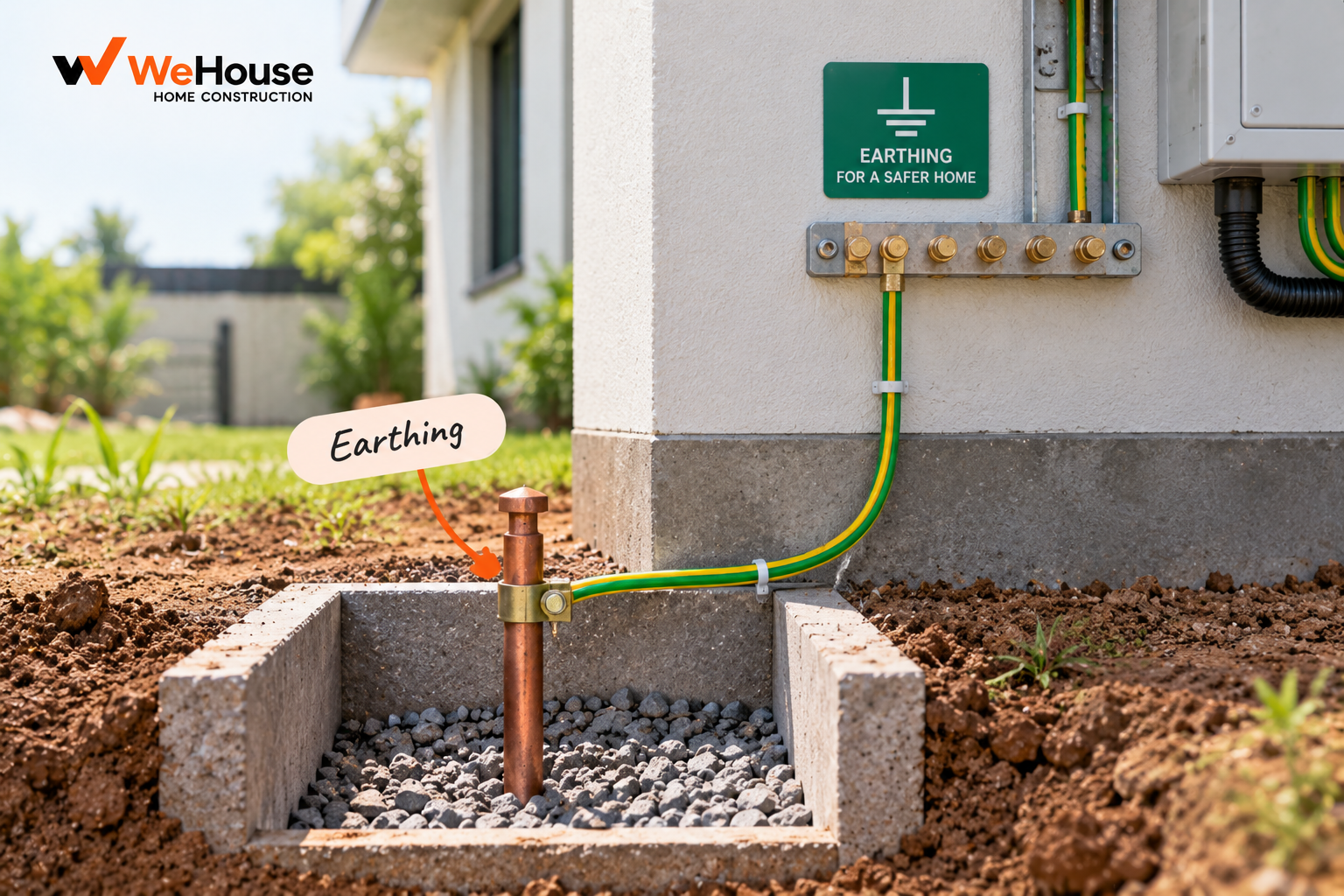
 What is earthing in construction?
Earthing, called grounding in some countries, is the practice of electrically connecting the metal bodies of electrical equipment, wiring enclosures, and specific points in a building's electrical system to the earth itself, through a dedicated low-resistance path. Its purpose is simple but critical: if a live wire accidentally touches the metal casing of an appliance or a switchboard, the earth connection gives fault current a safe path of least resistance to flow away through, rather than through a person who happens to touch that metal surface, and this fault current flow is also what triggers a circuit breaker or fuse to trip and cut power to the faulty circuit.
Why is earthing essential for electrical safety?
Without an earth connection, a fault (a live wire touching an equipment's metal body) can leave that metal surface energised at full voltage indefinitely, with no path for the fault current to flow and no reason for a circuit breaker to trip, since the breaker only responds to abnormal current flow. Anyone touching that energised surface while also in contact with the ground — a very common situation, since most people stand on the floor — becomes the path to earth themselves, receiving a potentially fatal electric shock. Proper earthing ensures the fault current instead flows through the low-resistance earth conductor, both protecting anyone who touches the equipment and reliably tripping the protective device.
What types of earthing electrodes are used in India?
| Type | Description | Typical use |
|---|---|---|
| Plate earthing | A 600x600 mm GI or copper plate buried vertically, 1.5-3 m deep, surrounded by alternate layers of charcoal and salt to reduce soil resistance | Common for residential and commercial buildings |
| Pipe earthing | A 40-50 mm diameter, 2-3 m long GI pipe driven vertically into the ground | Widely used, simpler installation than plate earthing |
| Chemical earthing | A pipe electrode surrounded by a conductive chemical compound that maintains low resistance even in dry or rocky soil | Used where soil conditions make conventional earthing resistance hard to achieve |
A typical residential installation uses at least two separate earth electrodes — commonly one for the neutral/system earth and one for equipment or body earthing — kept a minimum separation distance apart so a fault on one does not raise the potential of the other.
What earth resistance value is required?
IS 3043, the Code of Practice for Earthing, generally requires earth electrode resistance not to exceed 5 ohms for ordinary residential and commercial installations, measured using an earth resistance tester. Lower values, sometimes 1 ohm or less, are required for sensitive installations such as data centres, hospitals or installations with specific lightning protection requirements. Soil type has a major effect on achievable resistance — moist, clayey soil naturally gives lower resistance than dry, sandy or rocky soil, which is why chemical earthing compounds or deeper electrodes are sometimes needed in difficult soil conditions to meet the required value.
What gets connected to the earthing system?
- The metal body of every switchboard, distribution board and electrical panel.
- The earth pin of every socket outlet, connected back to the main earth terminal.
- Metal water pipes, structural steel and other conductive building elements that could accidentally become energised, in some designs bonded to the main earth as an additional safety measure.
- Lightning protection systems, where installed, which use their own dedicated earthing arrangement, sometimes shared with but electrically coordinated alongside the main building earth.
What goes wrong with earthing on site?
- Undersized or corroded electrode. A poorly sized or old, corroded GI electrode can develop high resistance over time, silently defeating the earthing system's purpose.
- Electrode placed in dry, poorly conductive soil without adequate backfill (charcoal/salt) or a chemical compound to reduce resistance.
- Earth continuity broken somewhere in the wiring, for example at a socket where the earth wire was never actually connected, leaving that specific point unprotected even though the main system is sound.
- No periodic resistance testing. Earth resistance can change over time as soil dries out seasonally or the electrode corrodes, so periodic re-testing, not just a one-time check at installation, is recommended.
The single most useful verification for an owner or site supervisor is simply asking for the earth resistance test result and confirming it meets the 5 ohm (or applicable) limit under IS 3043, rather than assuming an earthing system is adequate just because electrodes were physically installed.