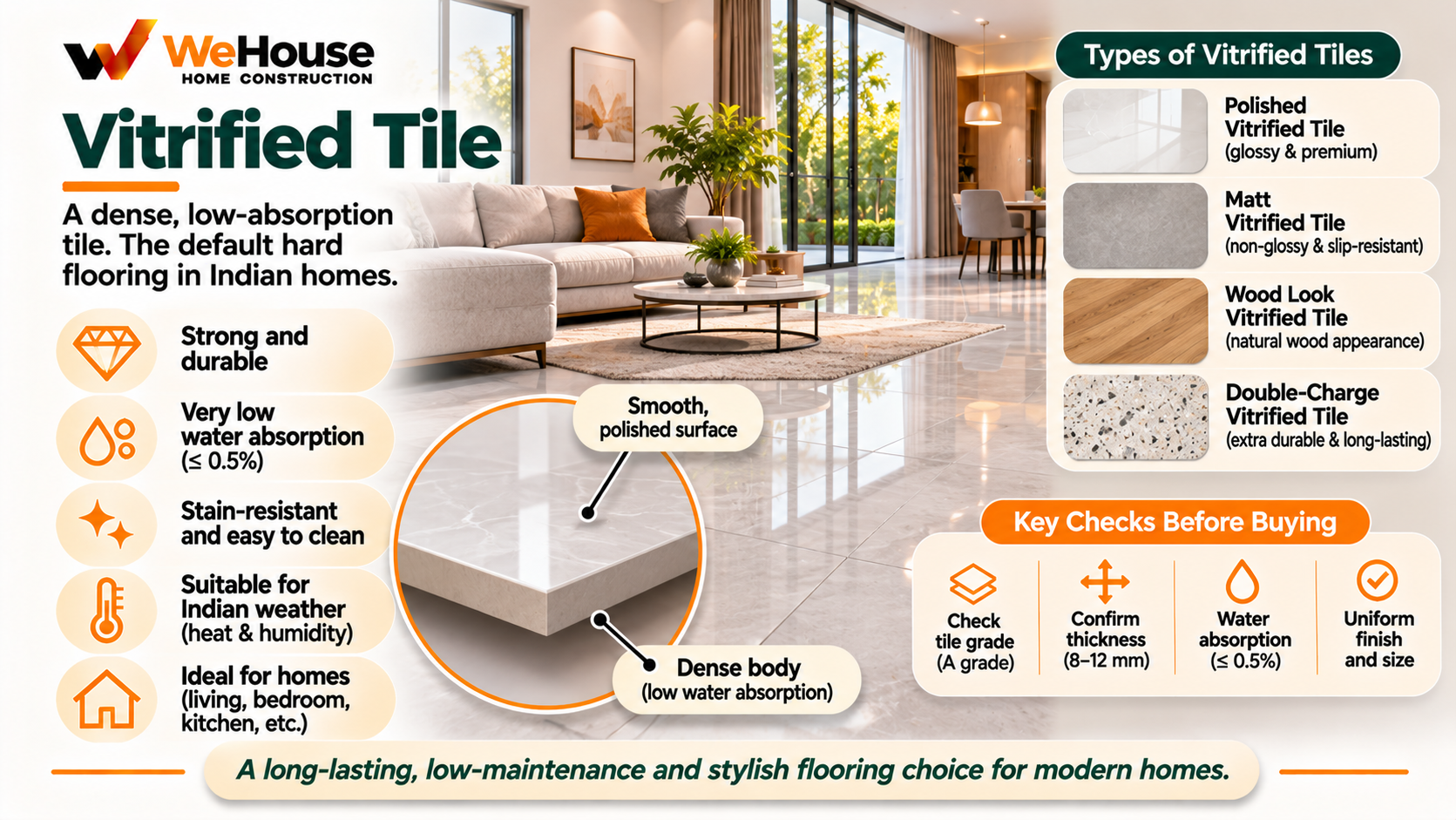
 Vitrified tiles are made by pressing a blend of clay, silica and feldspar and firing it at very high temperature until the body vitrifies, meaning the particles fuse into a dense, glass-like structure with almost no pores. This gives very low water absorption, high strength and good stain resistance, which is why they have become the default flooring tile for Indian homes, offices and malls.
What types of vitrified tiles are available?
| Type | Description |
|---|---|
| Soluble salt / nano polished | Printed with soluble salts, then polished; budget friendly, good for living areas |
| Double charge | Two layers of pigment pressed together, thicker wear layer, better for high traffic |
| Full body | Colour runs through the full thickness, so chips are less visible |
| Glazed vitrified (GVT/PGVT) | Surface glaze with digital print, wide design range including marble and wood looks |
How are vitrified tiles laid?
The base is levelled and, in wet areas, waterproofed and tested. Tiles are set on cement mortar or polymer tile adhesive with a notched trowel, aligned with spacers, and tapped down to avoid hollow spots. Joints are grouted after the adhesive cures, ideally with epoxy or polymer grout in kitchens and bathrooms. Large slabs need more careful flatness of the base and full adhesive coverage.
What quality checks matter?
- Water absorption below 0.5 percent confirms real vitrification.
- Dimensional accuracy and flatness so joints and edges line up.
- Same-batch shade. Check batch and caliber numbers so tiles match across the floor.
- Anti-skid rating for bathrooms, balconies and kitchens, since highly polished tiles are slippery when wet.
What goes wrong with vitrified tile flooring?
- Hollow-sounding tiles from poor adhesive coverage, which crack under point loads.
- Lippage (uneven edges) from an uneven base or poor laying.
- Cracked or popped tiles where expansion or movement joints were not provided in large areas.
- Slipperiness when glossy tiles are used in wet zones.