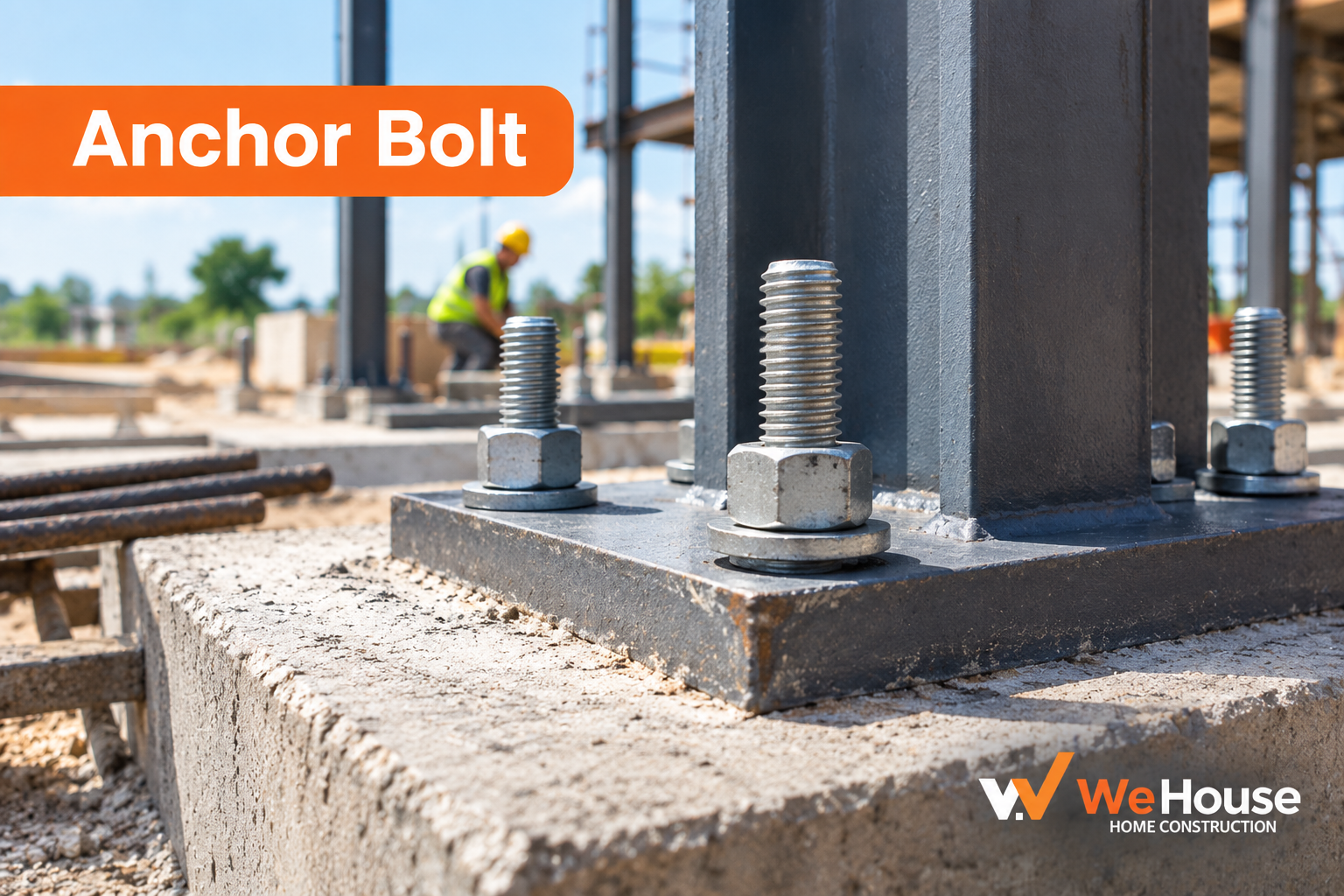
 What is an anchor bolt?
An anchor bolt is a threaded steel fastener that ties something to concrete or masonry. On a house or a commercial building it is the connection that holds a steel column to its footing, a staircase railing to a landing, an overhead tank support frame to the terrace slab, or a lift machine to its base.
The bolt itself is the visible part, but the engineering happens below the surface. An anchor bolt does not hold by friction alone. It works by transferring tension and shear into a cone of concrete around it. If that concrete cone is too small, too close to an edge, or cracked, the anchor fails regardless of how strong the steel is. This is why embedment depth and edge distance matter as much as bolt diameter.
What are the types of anchor bolt?
| Type | How it works | Typical use |
|---|---|---|
| Cast-in J-bolt / L-bolt | Hooked end embedded before pouring; the hook resists pull-out | Steel column base plates, machine foundations |
| Cast-in headed bolt | Bolt head or plate washer bears against concrete | Heavier base plates, higher tension |
| Wedge anchor | A clip expands against the hole wall as the nut is tightened | Racks, brackets, light equipment |
| Sleeve anchor | Expanding sleeve grips the hole; better in variable substrate | Masonry, older concrete |
| Chemical anchor | Epoxy or vinylester resin bonds a threaded rod to the hole | High load, close to edges, retrofit connections |
| Drop-in anchor | Internally threaded shell set flush; bolt screws in | Soffit fixings, false ceiling, cable trays |
The first distinction to get right is cast-in versus post-installed. A cast-in bolt is stronger and cheaper per point, but it commits you to a position before the concrete is poured. A post-installed anchor gives flexibility at the cost of a drilled hole, dust and a dependence on installation quality.
How deep should an anchor bolt be embedded?
For cast-in foundation bolts, embedment is usually 8 to 12 times the bolt diameter. An M20 bolt therefore sits 160 to 240 mm into the concrete. IS 5624, the specification for foundation bolts, tabulates standard lengths for each diameter.
For post-installed anchors, the manufacturer's data sheet governs. A typical M12 wedge anchor needs 70 to 90 mm of embedment; a chemical anchor for the same rod may need 110 mm. Two rules matter alongside depth:
- Edge distance. Keep at least 1.5 to 2 times the embedment depth from any free concrete edge. Anchors placed near an edge split the concrete out sideways rather than pulling straight out.
- Spacing. Keep anchors at least 2 times embedment depth apart, or their concrete cones overlap and the group capacity drops sharply.
Never drill through reinforcement. If the drill hits a bar, stop and relocate rather than cutting through it. A cut stirrup or main bar in a beam is a structural defect that a good anchor cannot compensate for. Use a rebar scanner on any drilling into a structural member.
How are cast-in anchor bolts positioned correctly?
This is where most site failures originate. The bolts must be held rigidly in a steel template plate, drilled to the same hole pattern as the base plate that will land on them. The template is tied to the formwork or to the reinforcement cage so it cannot shift.
The sequence is: fix the cage, position the template, set the bolts, check level and diagonals, sleeve the projecting threads with PVC or tape to keep concrete off them, pour, and then re-check position after deshuttering. Vibration during concreting is the usual culprit when bolts move, so the person running the vibrator must be told to keep clear of the template.
Tolerance is tight. Most fabricators allow around 3 mm on individual bolt position and 6 mm on the overall group. Beyond that the base plate will not seat, and the remedies are all bad: slotting the plate, flame-cutting holes, or breaking out concrete and re-anchoring.
What does an anchor bolt cost in India?
Post-installed anchors are sold per piece. An M10 to M16 wedge anchor runs Rs 40 to Rs 140. A chemical anchor point, counting resin cartridge share plus threaded rod, nut and washer, is Rs 180 to Rs 450. Fabricated cast-in J-bolts are priced by weight plus threading and typically land at Rs 120 to Rs 600 each.
Installation labour adds Rs 30 to Rs 120 per point depending on access and drilling difficulty. In a BOQ these usually appear either as a per-point rate or bundled into the steel fabrication item. Confirm with your quantity surveyor which it is, because anchor supply is a common gap between the civil and steel contractor scopes.
Common anchor bolt mistakes
- Not cleaning the drilled hole. Dust in the hole can cut chemical anchor capacity by more than half. Blow, brush, blow again.
- Installing into green concrete. Wait for adequate curing, normally 21 to 28 days, before loading post-installed anchors.
- Wrong hole diameter. An oversized hole ruins a wedge anchor entirely. Match the bit to the anchor spec.
- No torque control. Under-tightening leaves the anchor unset; over-tightening strips the concrete. Use a torque wrench at the stated value.
- Anchoring into hollow block or brick masonry with a concrete anchor. Hollow substrates need sleeve anchors with mesh sleeves, not expansion types.
- No corrosion protection in wet areas or coastal sites. Specify hot-dip galvanised or stainless grade A4.
Which codes cover anchor bolts?
IS 5624 covers foundation bolts, including dimensions and standard lengths. IS 800, the code of practice for general construction in steel, governs the design of the connection the bolt serves. IS 1367 covers the mechanical properties of threaded fasteners and defines property classes such as 4.6, 8.8 and 10.9. For post-installed anchors, Indian practice generally follows the manufacturer's European Technical Assessment data, because no equivalent IS specification exists. See IS Code for how to cite these in a specification.
Who decides the anchor bolt specification?
The structural engineer, without exception. Diameter, grade, embedment, edge distance and anchor type all follow from the tension and shear the connection carries, and a substitution that looks harmless on site can halve the capacity. The steel fabricator supplies the template and the bolt schedule. The site engineer verifies position before the pour and records it on the as-built drawing. If an anchor is discovered in the wrong place after concreting, the fix is an engineer's decision, not a mason's.