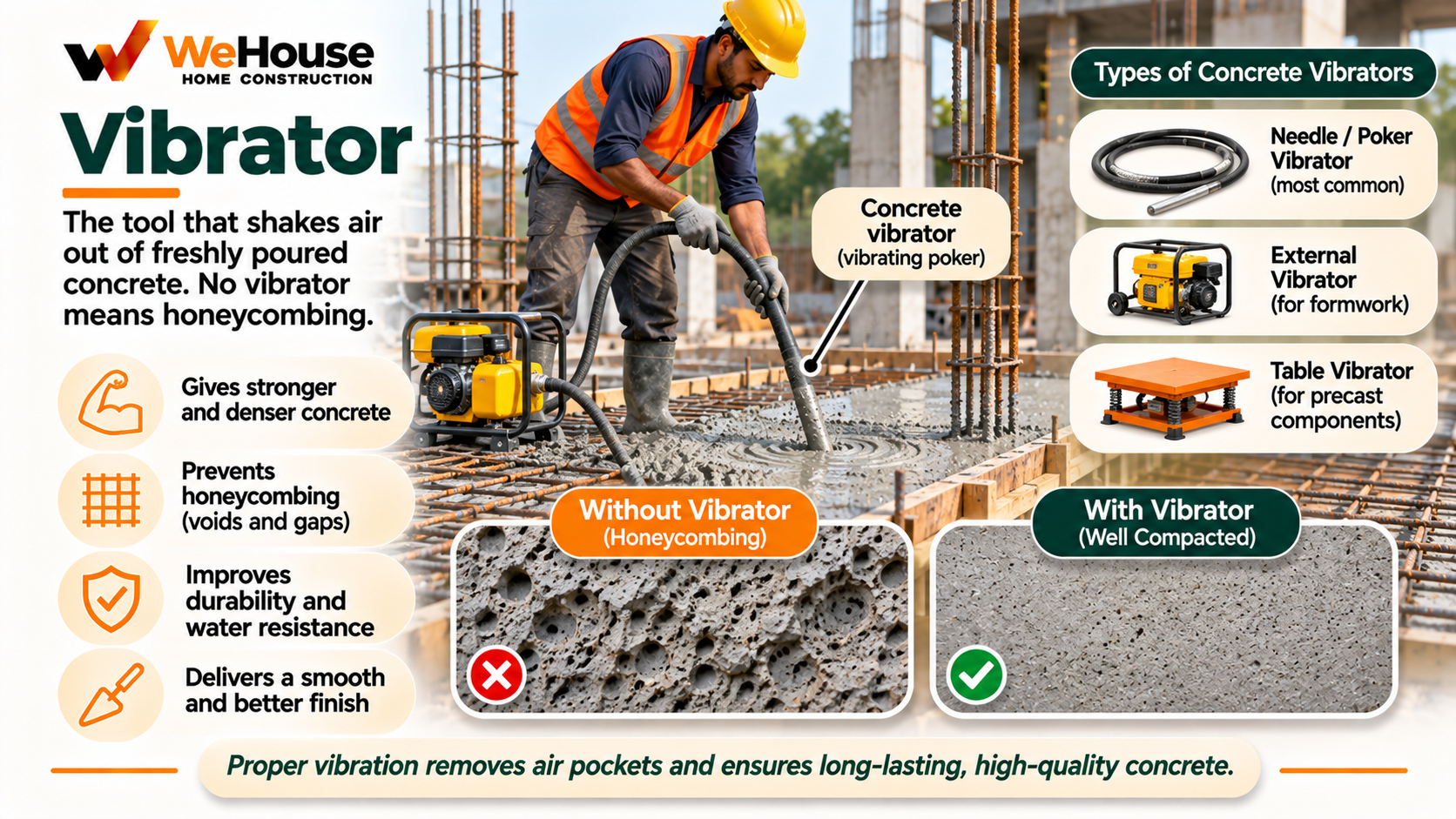
 A vibrator is a motor-driven tool that agitates fresh concrete so trapped air escapes and the mix settles into a dense, void-free mass around the reinforcement. It is the standard tool for compaction on Indian building sites, and its correct use is one of the main defences against honeycombing.
What types of concrete vibrators are used?
| Type | How it works | Typical use |
|---|---|---|
| Immersion (needle) vibrator | Vibrating head pushed into the concrete | Columns, beams, footings, thick slabs |
| Surface vibrator (screed) | Vibrates the top surface via a beam or plate | Thin slabs, pavements, industrial floors |
| Formwork (external) vibrator | Clamped to the shuttering, vibrating the whole form | Precast elements, thin walls, congested sections |
| Vibrating table | Whole mould placed on a vibrating bed | Precast factories, cube moulds |
How should a needle vibrator be used?
- Insert the head vertically and quickly, let it sink under its own weight, and withdraw slowly.
- Space insertions roughly 400-600 mm apart and hold each for about 5-15 seconds until air bubbles stop rising and a thin film of paste appears.
- Penetrate slightly into the layer below when concreting in layers so they knit together.
- Never drag the head sideways and avoid touching reinforcement or formwork, which can cause segregation or displace steel.
- Do not use the vibrator to move concrete horizontally.
What goes wrong with vibrators on site?
- Under-vibration leaves voids, especially at beam-column junctions where bars are dense.
- Over-vibration causes segregation, with aggregate sinking and water and paste rising to the surface.
- No spare unit. A breakdown mid-pour forces rodding, which cannot match mechanical compaction.
- Wrong head size. A head too large for the bar spacing cannot reach into the cage.
Confirming that a working vibrator and a spare are on site before the first truck arrives is one of the simplest, most valuable pre-pour checks, as discussed with slump testing and workability.