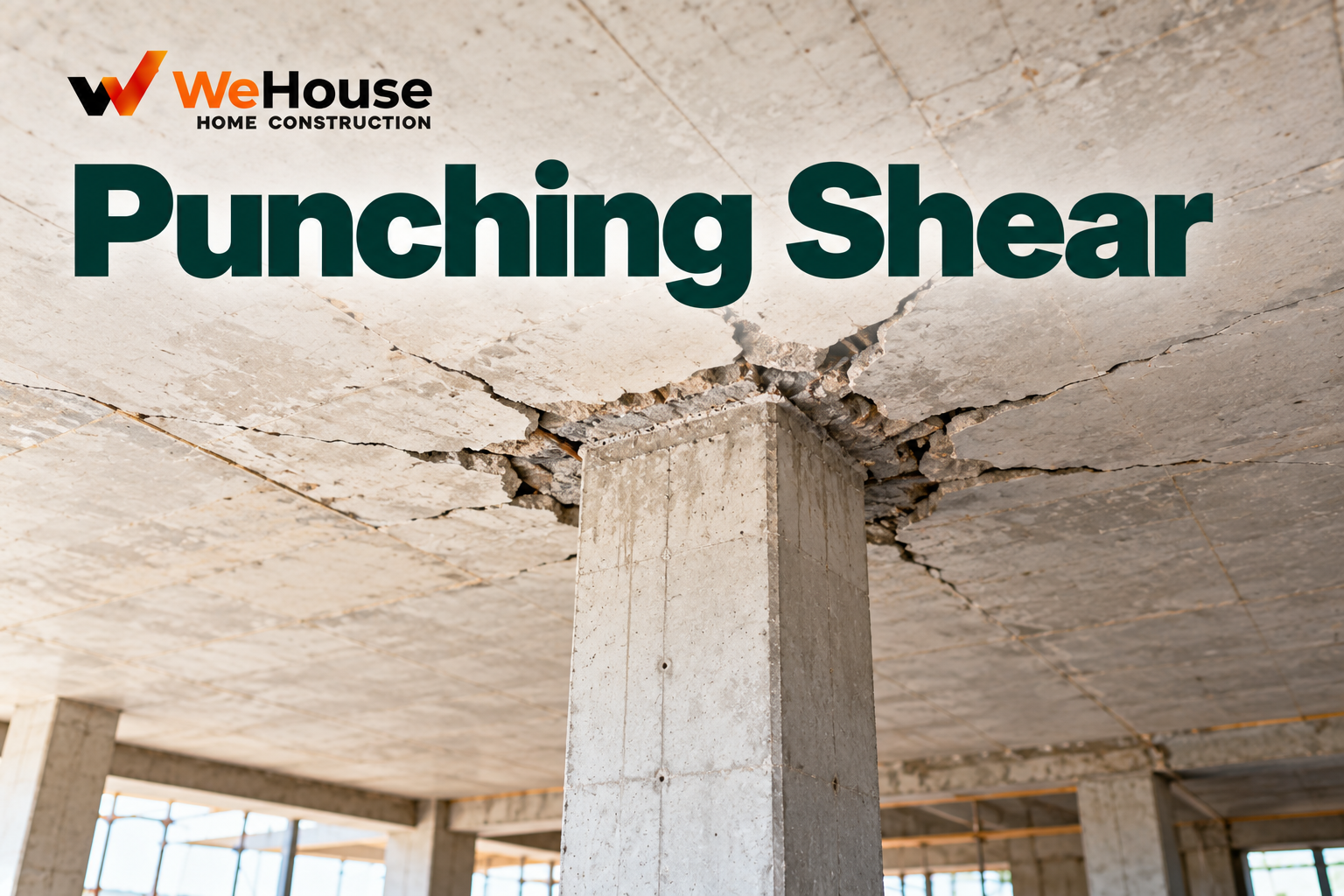
 What is punching shear?
Punching shear is a localised structural failure mode in which a concentrated load, most commonly from a supporting column, causes a roughly cone-shaped or truncated pyramid-shaped section of slab around the column to shear away and punch through, rather than the slab failing through ordinary bending across its full span. It is a fundamentally different failure mechanism from the bending failure a slab is normally designed to resist across its span, concentrated instead at a single, relatively small location rather than spread across the slab's overall area.
Why is punching shear a particular concern in flat slab systems?
In a conventional beam-and-slab structural system, a column's load is first transferred into a beam, which then distributes that load along its length into the slab gradually, rather than concentrating the full column reaction at a single point. In a flat slab system — a slab supported directly on columns without beams, increasingly common in Indian apartment construction using Mivan and similar beamless construction methods — the slab itself must directly resist the column's full concentrated reaction with no beam to distribute it first, making the slab-column connection the critical point where punching shear failure risk concentrates. This is precisely why flat slab design requires a specific punching shear check at every column, a check that is not typically a governing concern in conventional beam-and-slab construction.
How is punching shear addressed in design?
| Solution | How it works |
|---|---|
| Adequate overall slab thickness | A sufficiently thick slab provides enough inherent shear capacity at the column without further localised strengthening, viable for lighter loads or shorter spans |
| Drop panel | A localised thickening of the slab around the column, adding depth exactly where the concentrated load is highest |
| Column head / capital | A widened, often tapered enlargement of the column top itself, increasing the effective shear perimeter at the slab-column junction |
| Shear reinforcement (stud rails, shear stirrup cages) | Steel elements placed around the column within the slab, adding shear capacity without thickening the concrete, keeping a flat ceiling |
The choice between these solutions, discussed in more detail under the drop panel entry, depends on the specific load and span at each column, the architectural preference for ceiling appearance, and overall project cost considerations, determined individually by the structural engineer for each column-slab connection in a flat slab building rather than applied uniformly across the entire structure.
What does a punching shear design check actually calculate?
IS 456 sets out a specific methodology for checking punching shear, which conceptually examines the shear stress acting around a defined ""critical perimeter"" — a boundary drawn at a specified distance out from the column face, approximately following the shape the actual punching shear failure cone would take — and compares the shear stress the slab experiences at that perimeter against the concrete's permissible shear strength, adjusted for factors like the slab's reinforcement ratio and the column's specific geometry (an edge or corner column, for instance, has a smaller available shear perimeter than an interior column and is correspondingly often more critical for punching shear design).
Why does punching shear failure risk get particular attention from engineers?
Punching shear failure is a genuine structural safety concern specifically because of how it can manifest: unlike a gradual, visibly progressive bending failure that often gives some warning through visible deflection or cracking before a critical point, a punching shear failure can occur relatively suddenly, with the column effectively punching through the slab with comparatively little advance visible warning. This characteristic, combined with the potential for a localised punching failure at one column to trigger progressive collapse affecting adjacent structure if not properly contained, is precisely why structural engineers treat punching shear design as a mandatory, carefully checked element of any flat slab design rather than a secondary consideration, and why any deviation from the specified drop panel, shear reinforcement, or slab thickness at a flat slab column during construction is a serious structural concern rather than a minor site-level adjustment.