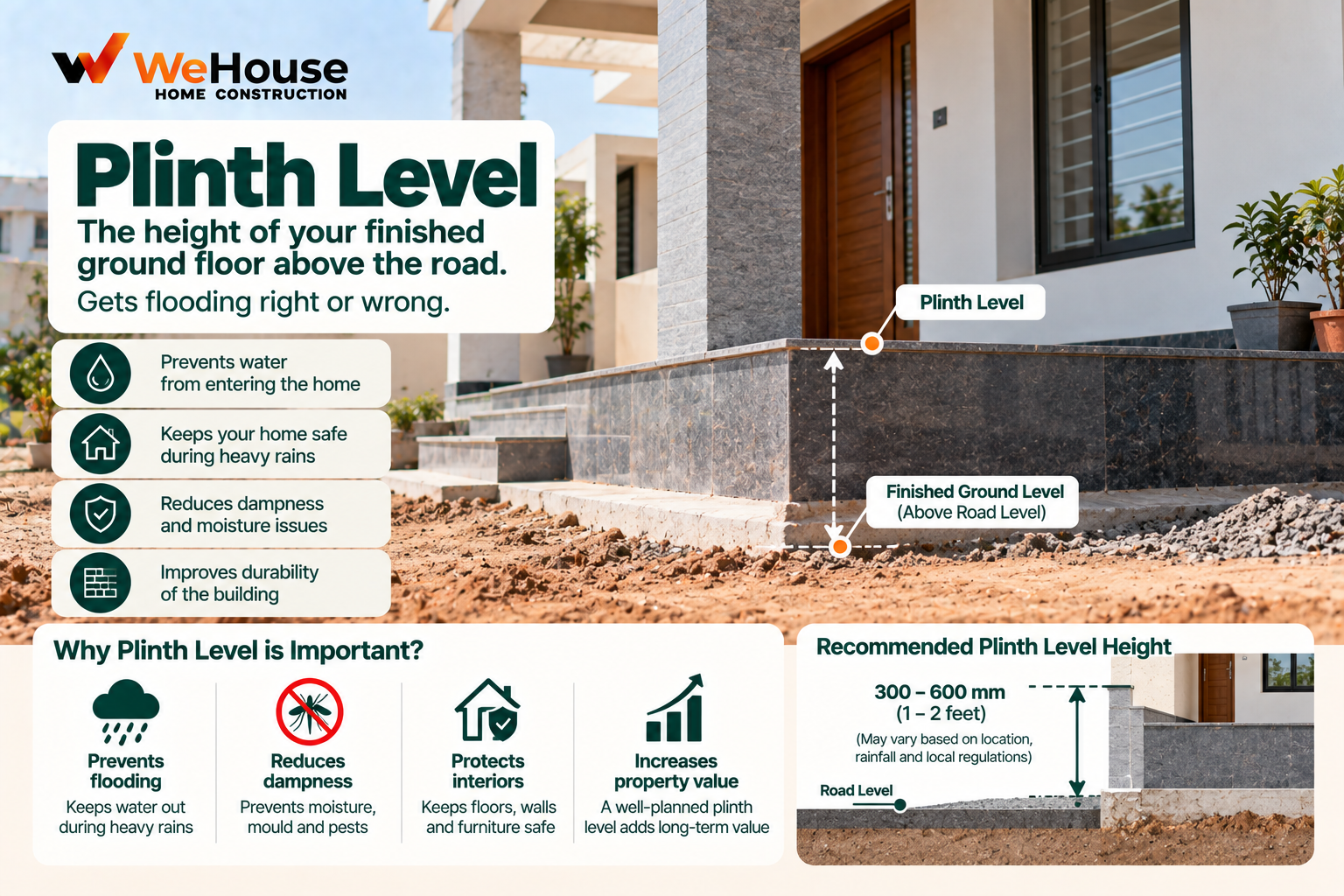
 What is plinth level?
Plinth level is the finished top level of a building's plinth, the raised solid platform of masonry or concrete built between the foundation below and the ground floor above. It represents a critical transition point in construction: everything below plinth level is foundation and sub-structure work, built below or close to natural ground level and in direct, ongoing contact with soil moisture, while everything above plinth level is the building's main above-ground structure, intended to remain dry and protected from ground moisture.
Why is plinth level raised above surrounding ground?
Raising the ground floor a deliberate distance above the surrounding natural ground level, typically 450-600 mm in ordinary Indian residential construction, serves several related protective purposes: it keeps the building's main floor and walls clear of surface water pooling or flowing across the site during heavy rain, it provides a buffer against rising ground moisture reaching the floor level, and it positions the critical damp proof course at a height where it can effectively block capillary rise of groundwater before it reaches the above-ground walls. Sites in low-lying areas, with poor natural drainage, or in regions with a history of flooding typically need a correspondingly higher plinth level than this ordinary default, sometimes 750 mm to 1 metre or more above surrounding ground, to provide adequate protection against the specific local flood risk.
What happens at plinth level during construction?
- Damp proof course is laid. The DPC, discussed in detail elsewhere, is laid as a continuous horizontal barrier right at plinth level, across every wall, to block rising damp before it can reach the above-ground structure.
- Plinth filling is completed and compacted. The space within the foundation's outer walls, below the ground floor, is filled with earth or approved fill material and compacted, discussed in more detail under compaction, before the ground floor slab or flooring is laid on top of it.
- Ground floor wall construction begins. Above the DPC and plinth level, the main above-ground brick masonry or RCC structure of the ground floor begins, representing the real start of the building's visible, above-ground structure.
- A key construction milestone. Reaching plinth level is commonly used as a defined milestone in milestone billing schedules for construction contracts, since it represents a clear, physically verifiable point in the project's progress.
How does plinth level relate to the surrounding road and site grading?
Plinth level is not set in isolation — it needs to be considered relative to the surrounding road level, the site's own drainage grading, and neighbouring properties, since a plinth set too low relative to the street or an adjoining higher plot risks surface water draining onto the site and into the building during heavy rain, while a plinth set unnecessarily high can create accessibility challenges and an awkward relationship with the surrounding ground level. This coordination between plinth level and overall site grading and drainage design is an important early design consideration, ideally assessed alongside the site's natural topography and any history of water accumulation or flooding in the area.
What goes wrong with plinth level on site?
- Plinth level set too low relative to surrounding ground or road level, leaving the building vulnerable to surface water ingress during heavy rain, a particularly consequential mistake since it cannot be easily corrected once construction above plinth level has proceeded.
- Inadequate plinth filling compaction, leading to settlement of the ground floor over time, discussed in more detail under compaction.
- DPC omitted or discontinuous at plinth level, undermining the entire purpose of raising the plinth in the first place, discussed in more detail under damp proof course.
- Plinth level not coordinated with neighbouring properties or street level, creating awkward level transitions or, in more serious cases, genuine drainage conflicts with adjacent properties.