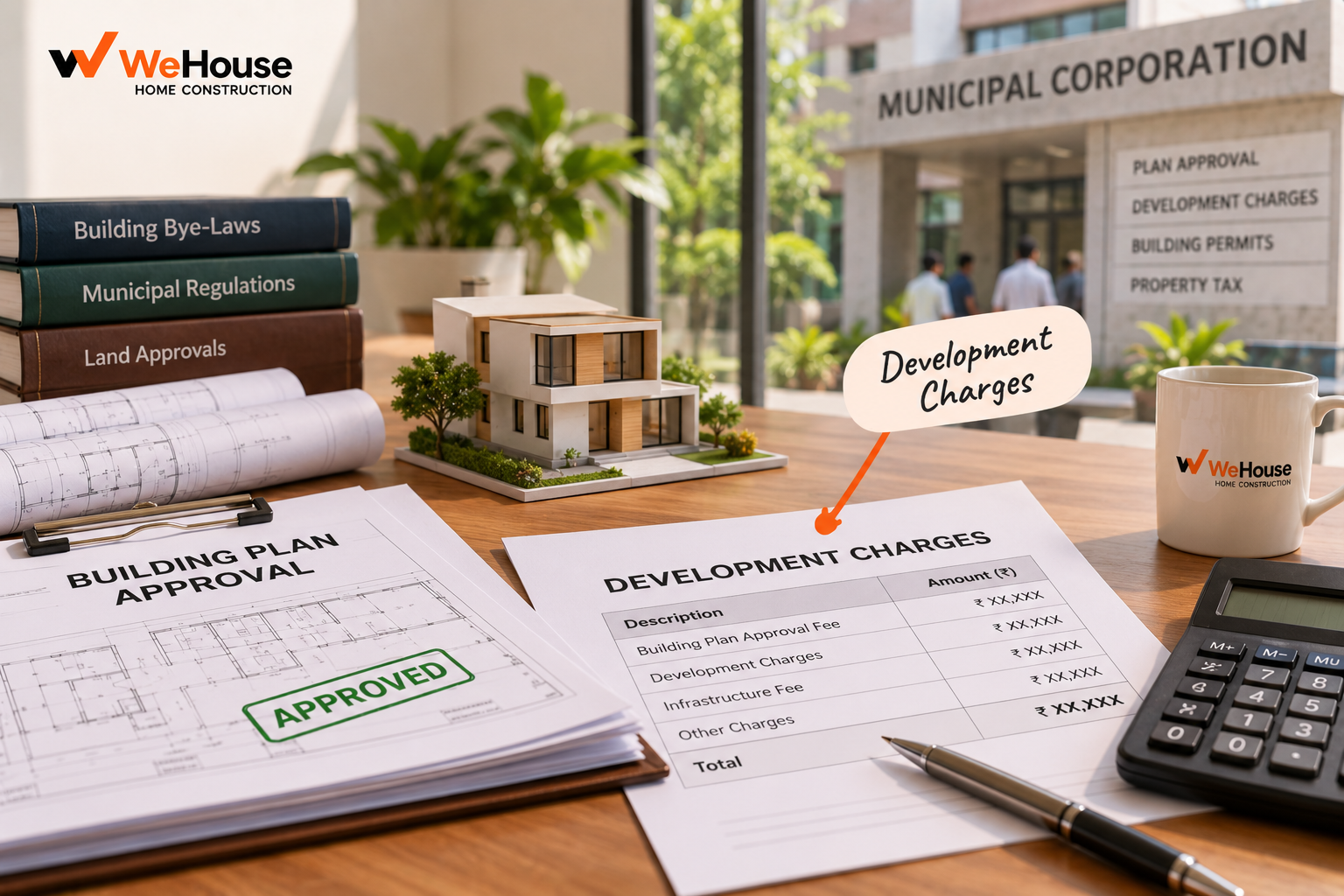
 What are development charges?
Development charges are fees a municipal corporation, development authority or town planning body collects from a builder or owner when sanctioning a building plan, intended to help fund the infrastructure — roads, water supply, sewerage, drainage and sometimes public amenities — that the new construction will place demand on. They are a statutory, legally mandated part of the plan approval process in most Indian cities, distinct from the construction cost of the building itself.
How are development charges calculated?
Most authorities calculate development charges as a rate per square metre or square foot of built-up or permissible built-up area, sometimes differentiated by use (residential versus commercial), zone (central versus peripheral), and road width fronting the plot. Rates are set independently by each state or municipal body under its own building bylaws or town planning act, so there is no single national formula, and the applicable rate for the same size of house can differ substantially between two cities, or even between two zones within the same city.
How do development charges differ from other approval fees?
| Charge | Purpose |
|---|---|
| Development charges | Funds area infrastructure (roads, water, drainage) tied to the new construction |
| Scrutiny fee | Covers the authority's cost of reviewing and processing the building plan application |
| Betterment charges / infrastructure development charge | Levied where the specific project benefits from a planned local infrastructure upgrade |
| Labour cess | A separate statutory levy under labour welfare law, based on estimated construction cost, unrelated to development charges |
These charges are frequently bundled together in an owner's mind as ""government approval cost,"" but each has a distinct legal basis, calculation method and, often, a separate line item and receipt in the plan sanction process, which is worth understanding when reviewing a liaison consultant's fee estimate or an approval cost breakup.
When are development charges paid?
Development charges are typically paid at the building plan sanction stage, before construction can legally commence, as part of the documentation submitted for the sanction plan. Some authorities also levy a related charge closer to project completion or at the occupancy certificate stage, particularly where the development has drawn on infrastructure capacity that was not fully accounted for at the initial sanction. The specific sequence and timing depends entirely on the local authority's process, so it is worth confirming with the architect or liaison consultant handling approvals for a specific project rather than assuming a standard national timeline.
How much do development charges typically cost?
Rates vary enormously by city and authority, commonly ranging from roughly Rs 20 to Rs 200 or more per square foot of built-up or permissible built-up area, with premium urban zones, commercial use, and larger permissible FAR/FSI generally attracting higher rates than peripheral residential plots. As an illustrative order of magnitude, a mid-sized residential project's total development charges might fall anywhere from roughly Rs 1 lakh to Rs 10 lakh or more, depending on plot size and the specific authority's rate schedule; this is not a figure that generalises reliably across India, and a current, location-specific quote from the local authority or a liaison consultant is the only reliable way to budget for it on a real project.
What happens if development charges are not paid?
Without payment of applicable development charges and other statutory approval fees, a municipal or development authority will typically not issue a sanctioned building plan, which means construction proceeding without one risks being treated as unauthorised construction — a status that can expose the owner to penalties, demolition notices, or serious difficulty later in obtaining an occupancy certificate, selling the property, or securing a home loan against it. Because of this, development charges, while sometimes viewed as a frustrating cost, are not a line item that can practically be avoided for a legally compliant project.