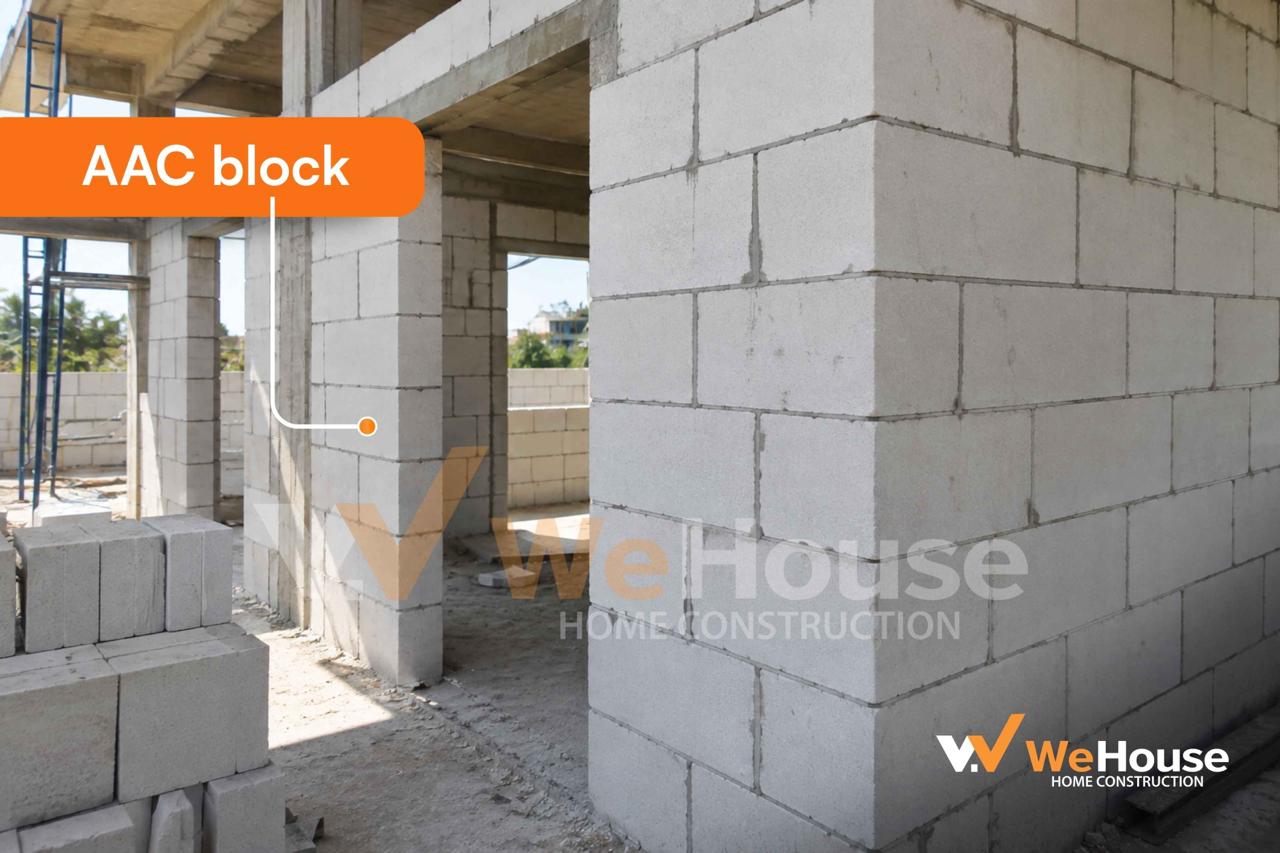
 What it actually does
AAC blocks do three important jobs in a building: they create the walls, reduce the weight carried by the structure, and improve thermal and acoustic performance.
1. It reduces the load on your structure
AAC (Autoclaved Aerated Concrete) blocks are much lighter than conventional red clay bricks because they contain millions of tiny air pockets.
A standard AAC block can weigh significantly less than an equivalent volume of brick masonry. On a G+1 or G+2 house, this reduces the dead load transferred to beams, columns and foundations.
The lighter wall system can also make handling easier on site and reduce the amount of material that workers need to carry manually.
2. It keeps your home cooler
Those tiny air pockets do more than reduce weight. They also slow down heat transfer through the wall.
This means AAC block walls can provide better thermal insulation than conventional brick masonry when the wall thickness, plaster and overall construction are properly designed.
For homes in hot cities such as Hyderabad, this can help reduce heat entering through external walls, particularly on walls exposed to strong afternoon sunlight.
3. It gives you faster, cleaner wall construction
AAC blocks are larger than conventional bricks, so fewer blocks are needed to build the same wall area.
The blocks are generally installed using thin-bed adhesive rather than thick conventional mortar joints. This produces thinner joints and can make the wall surface more uniform.
Because AAC blocks are lightweight and relatively easy to cut, electrical conduits and other service openings can also be planned and chased more easily. However, excessive cutting or chasing should always follow the project specifications.
What this looks like on a real site
200 sq yd plot · G+1 · Hyderabad
Suppose a G+1 house has approximately 2,500–3,000 sq ft of total built-up area. The quantity of AAC blocks depends on the wall layout, wall thickness, door and window openings, and the architectural drawing.
A typical external wall may use 150–200 mm AAC blocks, while internal partition walls may use 100–150 mm blocks, depending on the structural and architectural design.
The basic site sequence is:
-
Complete the RCC frame and slab work.
-
Mark wall positions according to the architectural drawing.
-
Check the floor level and clean the masonry surface.
-
Prepare and apply AAC block adhesive.
-
Lay the first course carefully and level it properly.
-
Continue the blocks with staggered vertical joints.
-
Check line, level and plumb after every few courses.
-
Provide required openings, lintels, ties and reinforcement as shown in the drawings.
-
Complete electrical and plumbing chases without unnecessarily weakening the wall.
-
Finish the wall with the specified plaster or surface treatment.
The first course is especially important. If it is not level, the error gets carried upward through the entire wall.
What it costs you
Indicative Hyderabad rates · updated July 2026
| What you pay for | Approx. rate | Notes |
|---|---|---|
| AAC blocks | ₹3,500–5,500 per m³ | Varies by brand, density and quantity |
| AAC block adhesive | ₹350–550 per 40 kg bag |
Coverage depends on joint thickness and workmanship |
| Masonry labour | ₹45–80 per sq ft | Depends on wall height and site conditions |
| Transportation | ₹300–700 per m³ | Varies with distance and order quantity |
| Typical wall masonry | ₹120–190 per sq ft | Block + adhesive + labour; excluding plaster |
These are indicative Hyderabad rates, not a fixed market quotation. Brand, block density, thickness, transportation, wastage, floor height and labour rates can change the final cost.
Always compare your contractor's quotation based on wall area, block thickness, block density, adhesive consumption and wastage, rather than comparing only the price of one block.
How to check it was done right
Six things you can verify yourself
-
Check the block quality — Blocks should have reasonably uniform dimensions without excessive cracks, broken corners or major damage.
-
Check the first course — The first row should be properly levelled. Small errors here can become large alignment problems higher up.
-
Check vertical joints — Vertical joints should be properly staggered rather than forming continuous lines from one course to another.
-
Check the adhesive — AAC blocks should be installed using the specified thin-bed adhesive system, with the manufacturer's recommended application thickness.
-
Check line and plumb — Use a spirit level or plumb tool regularly. Walls should not visibly lean or wave.
-
Check openings and supports — Door and window openings, lintels, wall ties and reinforcement should match the architectural and structural drawings.
Mistakes that cost money later
Using AAC blocks simply because they are cheaper
AAC blocks are not automatically cheaper in every project. The overall cost includes blocks, adhesive, labour, transportation, plaster and wastage.
Compare the complete wall system, not just the block price.
Mixing different block densities or sizes
Using blocks from different specifications on the same wall can create differences in weight, dimensions and performance.
Buy according to the specification provided for the project and keep the block type consistent wherever possible.
Poorly constructed first course
This is one of the easiest mistakes to spot and one of the hardest to correct later.
If the first course is not level, workers may compensate with unnecessarily thick joints or uneven masonry. The result can be a wall that is difficult to plaster and finish properly.
Making excessive electrical chases
AAC is easy to cut, but that does not mean you should cut everywhere.
Deep or unnecessary chases can reduce the effective wall section and create weak areas. Plan electrical and plumbing routes before masonry starts.
Ignoring water exposure
AAC blocks should be protected from prolonged water exposure during storage and construction. Store them properly above ground and follow the manufacturer's recommendations for handling and installation.
Assuming AAC means no plaster is required
AAC blocks provide a relatively uniform masonry surface, but the final wall treatment depends on the project's specification.
Do not skip plaster, skim coat or other finishing requirements unless the architect or engineer has specifically approved an alternative system.
Ask your contractor before you pay for this stage
-
What AAC block brand, size and density are you using?
-
What wall thickness is specified for external and internal walls?
-
What adhesive are you using, and what coverage do you expect per bag?
-
How are you checking the first course for level and alignment?
-
Where are the lintels, wall ties and reinforcement shown in the drawing?
-
How will electrical and plumbing chases be made without damaging the wall?
-
What is included in your quoted rate — blocks, adhesive, labour, transportation and wastage?
-
How are the blocks being stored and protected from damage and excessive moisture?
Common questions
Is AAC block better than red brick?
AAC blocks are lighter and generally provide better thermal insulation than conventional red bricks. They can also make wall construction faster because of their larger size and thin-bed installation.
But the better choice depends on the project's structural design, wall requirements, local availability, budget and workmanship.
What thickness of AAC block is suitable for a house?
Common residential applications use 100 mm, 150 mm and 200 mm blocks, depending on whether the wall is an internal partition or external wall.
The final thickness should come from the architectural and structural requirements rather than being selected only on price.
Are AAC blocks strong enough for a G+1 house?
Yes, AAC blocks are widely used for residential wall construction in framed structures. However, AAC block walls should not be assumed to carry structural loads unless they have been specifically designed as load-bearing masonry.
For an RCC-frame G+1 house, the columns and beams generally carry the primary structural loads, while the AAC walls act as infill or partition walls.
Do AAC blocks absorb water?
AAC blocks are porous and can absorb water. This does not mean they should be left exposed to continuous moisture.
Proper detailing, waterproofing, damp-proofing and the specified external wall finish are important, particularly in areas exposed to rain.
Can I use normal cement mortar for AAC blocks?
AAC manufacturers generally recommend a suitable thin-bed adhesive system for AAC masonry. Using conventional thick mortar may increase joint thickness and can affect material consumption and wall performance.
Follow the block manufacturer's installation specification and the project engineer's instructions.
Do AAC blocks need curing?
AAC masonry itself is not treated exactly like conventional brick masonry because the blocks are factory-cured during manufacturing. The adhesive and subsequent plastering/finishing systems have their own curing and application requirements.
Follow the product manufacturer's instructions rather than applying a generic brick-masonry curing method.
Are AAC blocks good for Hyderabad weather?
They can be a good choice for Hyderabad residential construction because their low density and air-filled pores provide useful thermal insulation. However, overall indoor comfort also depends on wall orientation, windows, shading, roof insulation, ventilation and the complete building design.
How much does AAC block construction cost in Hyderabad?
A broad indicative range for AAC block masonry can be around ₹120–190 per sq ft, excluding plaster, depending on block specification, labour, transportation, height, wastage and site conditions.
Get the contractor to quote the complete masonry system so you can compare like-for-like.
Can AAC blocks be used for external walls?
Yes. AAC blocks are commonly used for external walls in residential construction. The correct thickness, density, detailing and external finish should be selected based on the building design and local conditions.