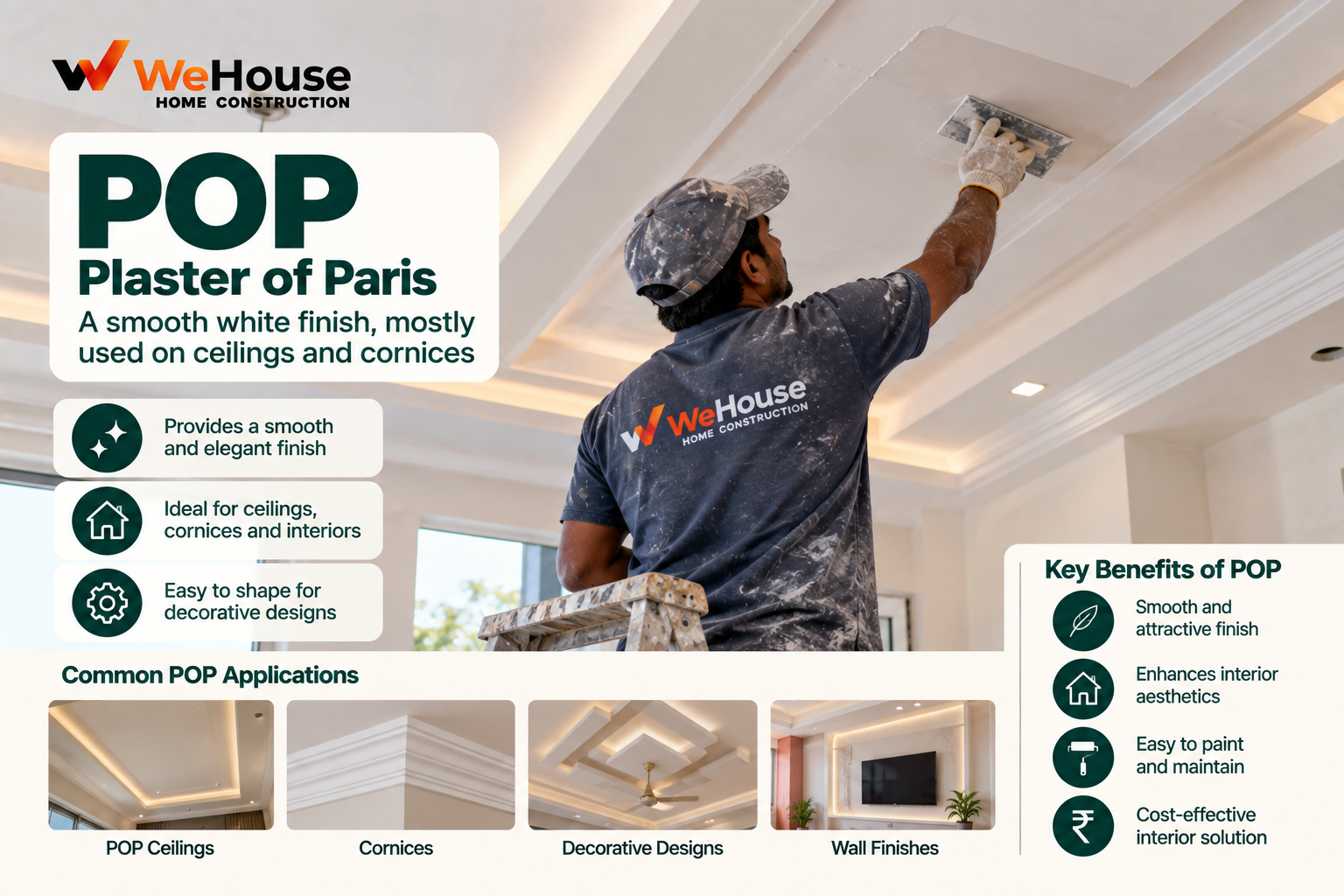
 What is POP?
POP, or Plaster of Paris, is a white powder produced by partially dehydrating gypsum (calcium sulphate) through heating, which, when mixed with water on site, forms a workable, relatively fast-setting paste. Once applied, it sets through a chemical rehydration process — re-absorbing water and recrystallising — hardening into a smooth, relatively hard, bright white finish within roughly 15-30 minutes of mixing, considerably faster than cement-based materials, which take far longer to set and cure.
Where is POP used in Indian construction?
- False ceiling work. Wet POP is applied and moulded over a wire mesh fixed to a wooden or metal frame, allowing intricate curved, stepped or decoratively moulded ceiling designs that are considerably harder to achieve with rigid gypsum board.
- Wall finishing coat. A thin, roughly 2-3 mm skim coat of POP is commonly applied over cured cement plaster to achieve an exceptionally smooth, paint-ready wall surface, functioning similarly to a wall putty finishing step.
- Decorative mouldings and cornices. POP's workability while wet and relatively fast setting make it well suited to decorative architectural details, cornices and ornamental ceiling or wall features.
- Minor repair work. Small cracks, holes or surface defects in plaster are commonly patched with POP given its fast setting time and ease of use for small-scale repairs.
What is the difference between POP and gypsum board?
| Aspect | POP | Gypsum board |
|---|---|---|
| Form | Powder, mixed wet on site | Manufactured rigid sheet, fixed dry |
| Application | Applied wet over a mesh and frame, moulded by hand | Screwed onto a metal (GI) channel framework |
| Design flexibility | Allows intricate curved and moulded designs | Best suited to flat, geometric designs; curves are more limited |
| Installation speed | Slower, with on-site curing/drying time needed | Faster, dry installation with no curing wait |
| Crack resistance over time | Somewhat more prone to hairline cracking, particularly at joints | Generally more dimensionally stable and crack-resistant |
Both materials are gypsum-based at their core, but their form and application method differ fundamentally — POP is a wet, moulded plaster, while gypsum board is a dry, manufactured sheet material — which is why the choice between the two for a specific project, discussed in more detail under false ceiling, depends on the design requirement and desired durability characteristics rather than one being a strictly superior substitute for the other.
How is POP applied for wall finishing?
Once cement plaster has cured and reached adequate strength, a thin POP coat is applied directly over the dampened plaster surface using a trowel, worked to a smooth, even finish, and allowed to set before light sanding to remove any minor surface irregularities, giving a final surface considerably smoother than cement plaster can achieve on its own, ready for painting without further filler or putty application in most cases.
What goes wrong with POP work on site?
- Applied over inadequately cured or dry base plaster, affecting bond and leading to later cracking or debonding of the POP finish coat.
- Mixed in batches too large to use before setting, since POP's relatively fast setting time means over-mixed batches stiffen and become unworkable before they can be properly applied.
- Hairline cracking at joints in false ceiling work, particularly where the design involves moulded sections meeting at an angle or junction, a known characteristic limitation of POP compared to gypsum board.
- Moisture exposure. POP is not well suited to areas with sustained moisture exposure, such as bathrooms, where a moisture-resistant alternative is generally more appropriate.