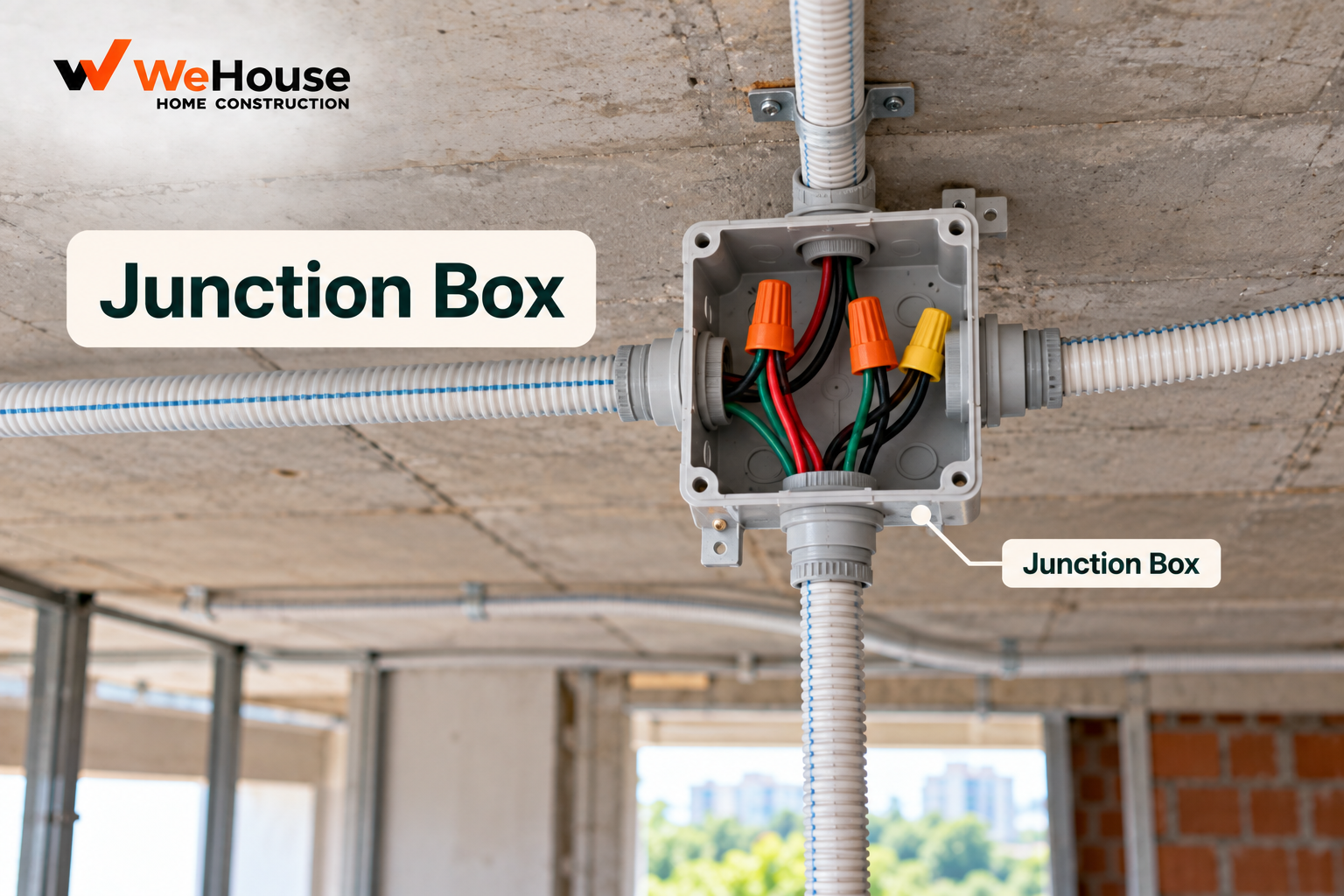
 What is a junction box?
A junction box is a small enclosed fitting, usually metal or PVC, embedded within a wall or ceiling at a point in a concealed electrical wiring run where wires need to join, branch off to a different circuit path, or connect to a switch, socket or light fitting. Its purpose is to contain these connections safely within an accessible, enclosed space, rather than leaving spliced or joined wires simply taped together and buried loose within a conduit or wall chase, which is both a fire safety hazard and effectively impossible to inspect or repair later without breaking open the wall.
Why does concealed wiring need junction boxes?
Concealed electrical wiring, the standard approach in Indian residential construction, runs wires through conduit embedded within walls and ceilings, out of sight once plastering and finishing are complete. Any point where this concealed wiring needs a physical connection — a wire joint, a branch to a different circuit, or the termination point for a switch or socket — creates a location that, unless properly enclosed, becomes both a fire risk (a poorly insulated or loose connection buried within a wall, generating heat with no way to detect or ventilate it) and a practical maintenance problem (a future fault at that connection point cannot be found or fixed without breaking into the finished wall). A junction box solves both issues: it safely contains the connection, and its cover plate remains accessible (or, for boxes serving a switch or socket, is itself the visible fitting) for future inspection or modification.
What sizes and types of junction boxes are used?
| Size / type | Typical use |
|---|---|
| 3x3 inch (or similar small box) | Simple wire joints, single connection points |
| 4x2 inch | Standard single switch or socket outlet point |
| 4x4 inch (or larger) | More complex junctions, multiple circuit connections, distribution points serving several downstream fittings |
| Deep / concealed junction box (for false ceiling) | Housing connections for concealed light fittings or where extra wiring space is needed above a false ceiling |
Metal junction boxes (typically galvanised steel) were traditionally the standard in Indian electrical installation and remain common, while PVC (modular) junction boxes have become widely used alongside modular switch and socket systems, offering easier installation and, for non-metallic construction, no risk of the box itself becoming an unintended earth path in the event of a fault.
Where are junction boxes typically located?
- Behind every switch and socket point, housing the wire terminations for that specific fitting.
- At ceiling points for light fittings, particularly where a fitting needs to be changed or serviced without disturbing the surrounding finish.
- At branch points in a circuit, where one wiring run splits to serve multiple downstream points.
- Above false ceilings, for connections serving concealed lighting or fittings mounted within the ceiling void, positioned to remain accessible through a service panel or removable ceiling tile if the false ceiling system allows it.
What goes wrong with junction boxes on site?
- Wire joints made without a box. Splicing wires directly within a conduit run and simply taping them, without housing the joint in a proper junction box, is an unsafe shortcut that also makes the connection permanently inaccessible once plastered over.
- Undersized box for the number of connections. A box too small for the wiring it needs to house leads to overcrowded, poorly organised connections that are harder to terminate correctly and more prone to loose contacts.
- Box not properly sealed or covered, leaving connections exposed to dust or, in wet areas, moisture ingress.
- Poor coordination with the electrical layout, resulting in junction boxes placed inconveniently relative to where switches, sockets or fittings actually end up in the finished layout, sometimes requiring rework.
Verifying that every concealed wire joint in the electrical first-fix is housed in a proper junction box, before walls are plastered and the wiring becomes permanently concealed, is one of the more important and easily overlooked electrical safety checks during construction.