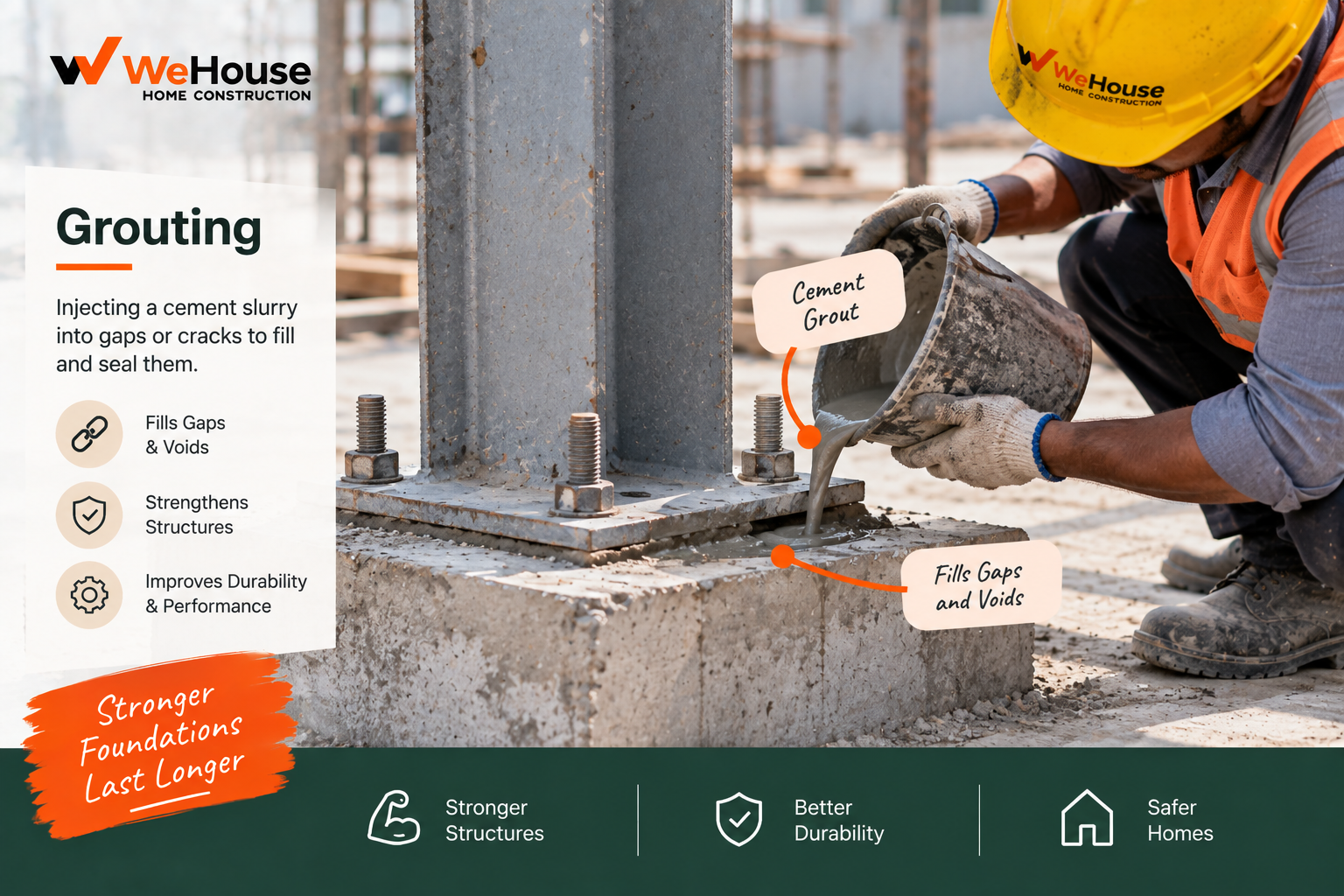
 What is grouting in construction?
Grouting is the process of filling a gap, void, crack or the space beneath a structural element with a flowable cementitious or chemical mixture, called grout, that hardens to fill the space completely and, depending on the application, bond surfaces together, transfer load evenly, or seal against water and air ingress. It appears in several quite different construction contexts, from structural baseplate grouting to crack repair, and the specific grout material and method used varies considerably depending on the application.
What is baseplate and machine foundation grouting?
When a structural steel column baseplate, a machine base, or an equipment foundation is positioned and levelled, a gap — typically 25-50 mm — is deliberately left between the underside of the baseplate and the concrete foundation below, to allow for precise levelling adjustment using shims or levelling nuts before the connection is finalised. Once the equipment or steel member is correctly aligned, this gap is filled with grout, most commonly a non-shrink cementitious grout specifically engineered to not shrink as it cures, ensuring full, uniform contact and load transfer across the entire baseplate area rather than resting on a few high spots or an uneven bearing surface. Ordinary cement mortar is not suitable for this purpose because normal cement-based mixtures shrink slightly as they cure, which can leave small gaps that compromise the load transfer the grout is meant to guarantee.
What is crack and joint grouting?
Grouting is also used to repair cracks and voids in existing concrete, either as a corrective measure for a construction defect (like honeycombing) or as a structural or waterproofing repair on an older structure. For fine, hairline cracks, low-viscosity epoxy resin is injected under pressure through ports drilled or fixed along the crack, penetrating deep into the crack to bond the two faces structurally back together. For wider cracks or voids, a cementitious grout, sometimes with added polymer for improved bond and flexibility, is used instead, being more economical for larger volumes than epoxy resin.
What are the common types of grout used in construction?
| Type | Description | Typical use |
|---|---|---|
| Non-shrink cementitious grout | A specially formulated cement-based grout with additives preventing shrinkage during curing | Baseplate grouting, machine foundations, precast connections |
| Epoxy grout / epoxy injection resin | A two-part chemical resin, higher strength and bond than cementitious grout | Structural crack repair, heavy machinery baseplates with very high load, anchoring in critical applications |
| Polymer-modified cementitious grout | Cement grout with added polymer for flexibility and improved bond | Waterproofing repairs, tile and masonry crack repair, joint sealing |
| Anchor grout / chemical anchor | Fast-curing chemical compound for setting bolts or dowels into drilled holes in hardened concrete | Fixing railings, machinery, structural connections into existing concrete |
What goes wrong with grouting on site?
- Ordinary cement mortar used instead of non-shrink grout for a structural baseplate, risking a gap forming as the mortar shrinks during curing, defeating the purpose of uniform load transfer.
- Incomplete filling. Air trapped in the gap during pouring, especially under a large baseplate, can leave voids if the grout is not poured or pumped correctly, typically from one side with venting to let trapped air escape.
- Wrong material for the crack type. Using cementitious grout for a very fine crack that actually needed low-viscosity epoxy injection to properly penetrate and bond, or vice versa using expensive epoxy where a simpler cementitious repair would have sufficed.
- Grouting a crack without addressing its underlying structural cause. Sealing a crack that resulted from an ongoing structural issue (like differential settlement or an overloaded element) without first correcting that cause simply masks the symptom rather than fixing the underlying problem.