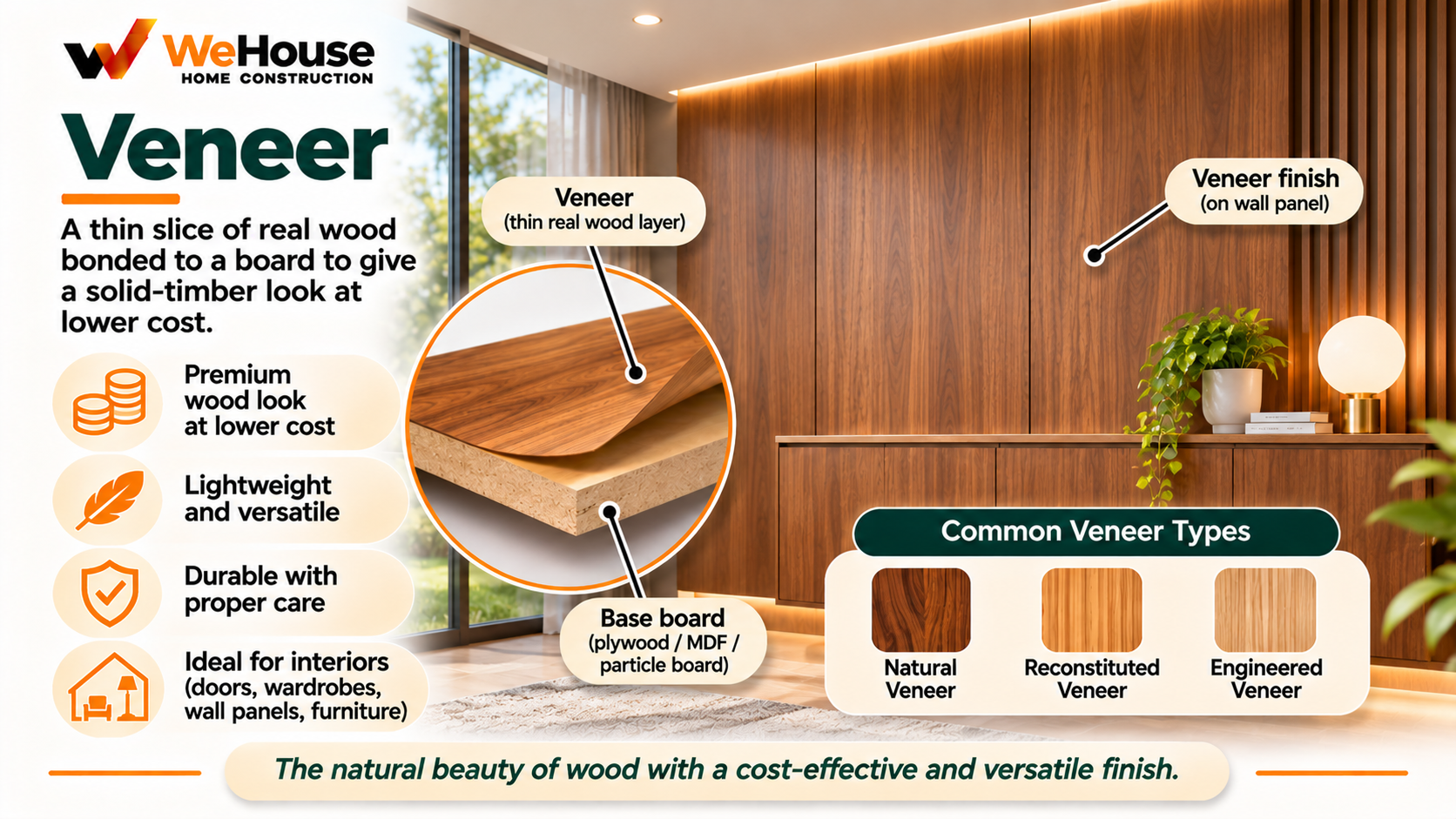
 Veneer is a thin layer of genuine wood, usually between 0.5 and 3 mm thick, cut from a log by slicing or peeling and then glued onto a more economical base board. The result looks like solid timber because its visible surface really is timber, but it uses far less of the expensive wood. It is a standard material for flush doors, wardrobes, panelling and furniture in Indian interiors.
How does veneer differ from laminate?
| Aspect | Veneer | Laminate |
|---|---|---|
| Surface material | Real wood slice | Printed paper under a resin layer |
| Look and feel | Natural, each piece slightly unique | Uniform, repeating pattern |
| Finishing | Needs polish or lacquer | Comes pre-finished |
| Repair | Can be sanded and repolished | Cannot be refinished, only replaced |
| Typical cost | Mid to premium | Budget to mid |
How is veneer produced and applied?
Logs are steamed and then either sliced into thin sheets (giving straight or cathedral grain patterns) or rotary-peeled like unrolling paper (giving a wilder, broader grain). The leaves are dried, trimmed and often matched side by side to create book-matched or slip-matched patterns. They are then glued under pressure to the base board, edge-banded, sanded lightly and finished with melamine, PU or lacquer to protect the thin surface.
What should you check when buying veneered work?
- Base board quality. A good veneer on a poor MDF or plywood core still fails. Moisture-resistant boards matter in humid regions.
- Consistency of grain and colour across panels meant to sit side by side, since natural wood varies.
- Edge sealing. Exposed core edges let moisture in and cause the veneer to lift.
- Finish thickness. Too little lacquer wears through quickly on a thin veneer, and sanding through it exposes the base.
What goes wrong with veneer on site?
- Bubbling or lifting from poor adhesive coverage or moisture ingress at unsealed edges.
- Colour mismatch between panels cut from different batches.
- Sun fading on surfaces exposed to strong direct light without a UV-resistant finish.
- Cracking in very dry conditions if cheap, thin veneer is applied on an unstable base.