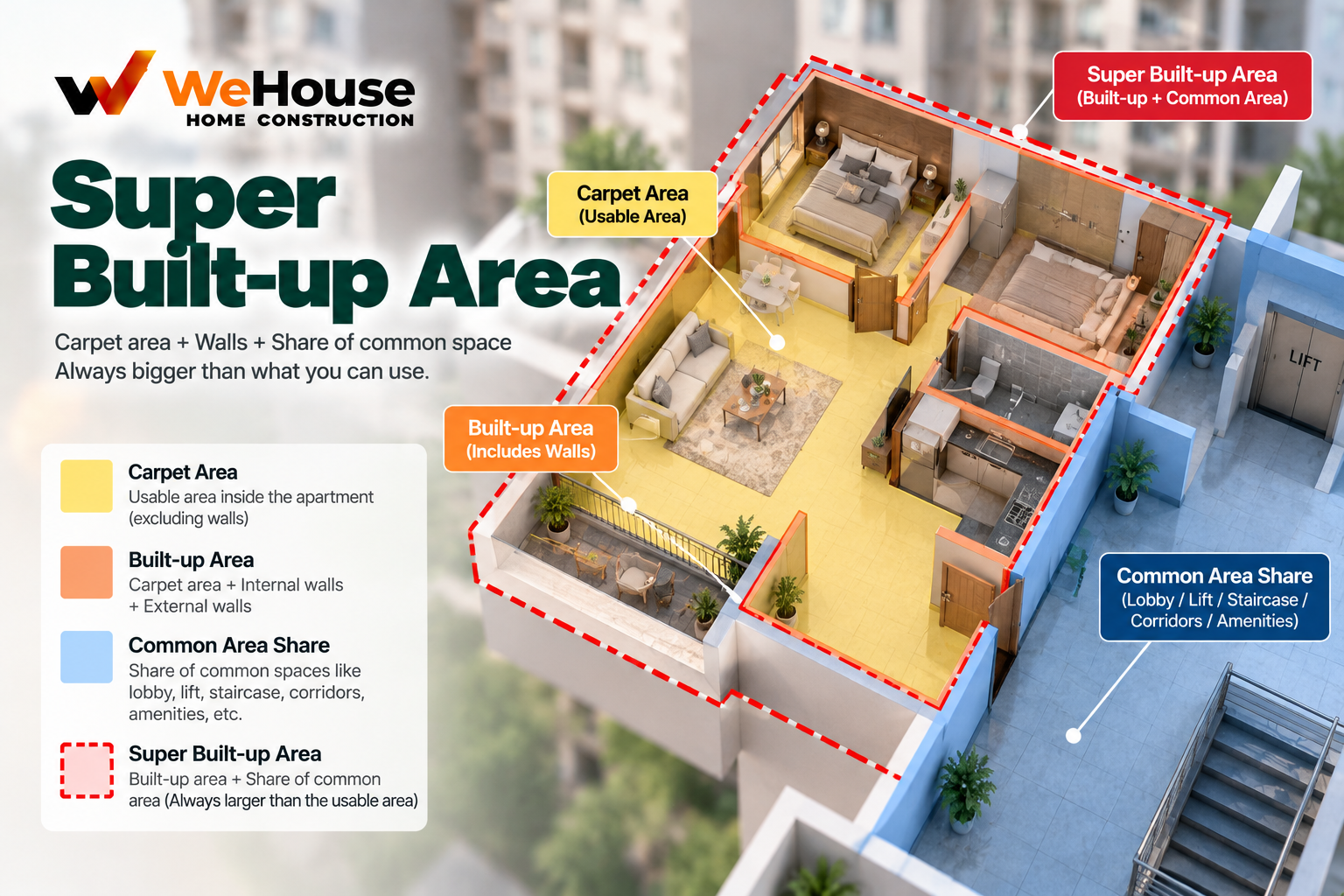
 What is super built-up area?
Super built-up area is the total area figure that Indian developers traditionally used as the basis for pricing a residential flat, calculated by taking the unit's own built-up area and adding a proportionate share of the building's common areas — lobbies, staircases, lift shafts, corridors, and shared amenities like a clubhouse or gym — allocated across all the units in the building based roughly on each unit's relative size. It represents, in principle, ""your share of everything in the building,"" not just the space within your own unit's walls.
How does super built-up area relate to carpet area and built-up area?
| Term | What it includes | Typical relationship to carpet area |
|---|---|---|
| Carpet area | Usable floor area only, wall to wall inside the unit | Baseline (100%) |
| Built-up area | Carpet area plus the unit's own wall thickness and balcony | Roughly 110-120% of carpet area |
| Super built-up area | Built-up area plus a proportionate share of common areas | Roughly 130-155% of carpet area |
The relationship between super built-up area and carpet area is often described through a ""loading factor"" — the percentage by which super built-up area exceeds carpet area. A project with 40 percent loading means its super built-up area is 1.4 times the actual carpet area, so a flat marketed at 1,000 sq ft super built-up area with 40 percent loading would actually have a carpet area of roughly 714 sq ft.
Why did RERA move away from super built-up area as the pricing basis?
Before the Real Estate (Regulation and Development) Act, 2016 came into force, there was no standardised, legally defined method for calculating super built-up area, meaning different developers could and did allocate common area to units using different, inconsistent methodologies, making it genuinely difficult for buyers to fairly compare the actual usable space they were paying for across different projects quoting a similar per-square-foot super built-up rate. RERA addressed this specifically by legally defining carpet area precisely and mandating that registered developers quote and price flats based on this standardised, objectively measurable figure instead, discussed in more detail under carpet area.
Does super built-up area still matter if RERA mandates carpet-area pricing?
Yes, practically, even though it is no longer the legally mandated pricing basis. Super built-up area continues to appear widely in informal marketing material, broker conversations, and buyer comparisons across the Indian real estate market, partly from long-standing habit and partly because it remains a genuinely useful rough proxy for how much shared amenity space and common infrastructure a particular project carries. A buyer evaluating a property today should always confirm the legally governing carpet area figure, as discussed under carpet area, but understanding what super built-up area means and how to estimate the loading factor remains practically useful for interpreting marketing material and comparing projects on a like-for-like basis informally.
How can a buyer estimate the loading factor for a project?
Since RERA now requires developers to disclose carpet area alongside any super built-up area figure still referenced in marketing, a buyer can directly calculate the loading factor for a specific project by comparing the two disclosed figures — dividing the quoted super built-up area by the legally disclosed carpet area, then subtracting one, gives the loading percentage for that specific project, allowing a genuinely like-for-like comparison of the actual usable space delivered per rupee spent across different projects, rather than relying on the super built-up rate alone, which can be misleading if two projects carry meaningfully different loading factors.