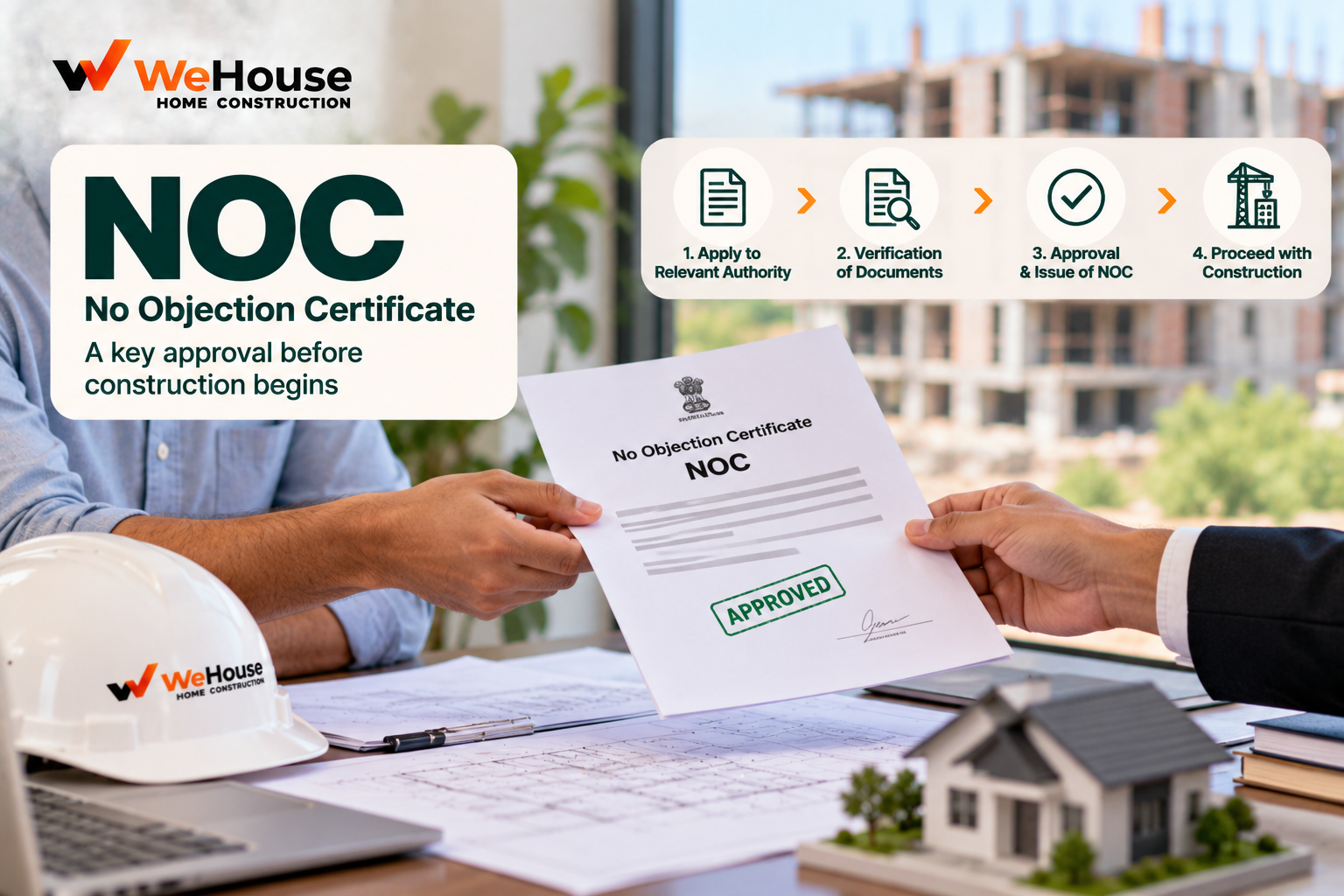
 What is an NOC in construction?
An NOC, or No Objection Certificate, is a formal clearance document issued by a specific government department or statutory authority, confirming that the department has reviewed a proposed construction project (or a specific aspect of it falling within that department's jurisdiction) and has no objection to it proceeding. Unlike the main building plan sanction, which is typically issued by a single municipal corporation or development authority, NOCs are issued by a range of different specialist departments, each covering a specific concern within their own regulatory domain, and a given project may need several different NOCs simultaneously, each from a different authority.
What are the common types of NOCs required in Indian construction?
| NOC type | Issuing authority | When it's needed |
|---|---|---|
| Fire department NOC | State fire services department | Buildings above a certain height or occupancy, commercial and multi-storey residential projects |
| Pollution control board NOC | State pollution control board | Projects above a certain built-up area, or involving specific environmental considerations |
| Airport height clearance | Airports Authority of India / Directorate General of Civil Aviation | Construction within a defined radius of an airport, where building height could affect flight paths |
| Tree authority NOC | Municipal tree authority / forest department | Where existing trees need to be removed or significantly affected by construction |
| Groundwater extraction clearance | Central or state groundwater authority | Where a borewell is planned for water extraction, particularly in notified over-extracted zones |
| Coastal Regulation Zone (CRZ) clearance | State coastal zone management authority | Construction within designated coastal regulation zones |
This is a representative, not exhaustive, list — the specific NOCs required for a given project depend heavily on its location, size, height and nature, and local or state-specific regulations can add further requirements beyond this general list, which is why identifying the full, current set of applicable NOCs for a specific project and location is best done with a knowledgeable local architect or liaison consultant rather than assumed from a general list.
When are NOCs obtained in the construction timeline?
Most NOCs must be secured before or as part of the building plan sanction process, since the local development authority typically requires documentary evidence of the applicable NOCs as a precondition for approving the plan in the first place. Some NOCs, however, particularly a final fire department NOC confirming actual installed fire safety systems match what was approved, are obtained closer to project completion, often as a prerequisite for the occupancy certificate rather than at the initial plan sanction stage.
Why do NOC requirements vary so much between projects?
Each NOC exists to address a specific, narrow regulatory concern — fire safety, environmental impact, air traffic safety, tree preservation, groundwater sustainability, coastal ecology — and a given project only triggers the NOCs relevant to its specific circumstances. A small individual house in an ordinary residential area, with no trees to remove and no borewell planned, may need relatively few NOCs beyond the standard plan sanction process, while a larger building, one near an airport or coastline, or one planning significant groundwater extraction, accumulates several additional specific clearance requirements on top of the baseline approval process.
What happens if a required NOC is missing?
A project missing a legally required NOC faces the same broad category of risk as one proceeding without a sanctioned plan: difficulty obtaining the initial building plan sanction (where the NOC is a precondition for that), potential regulatory penalty or stop-work action if discovered during construction, and, for NOCs required at completion, difficulty obtaining the occupancy certificate or finalising utility connections, which can in turn complicate later resale, financing or insurance of the property.