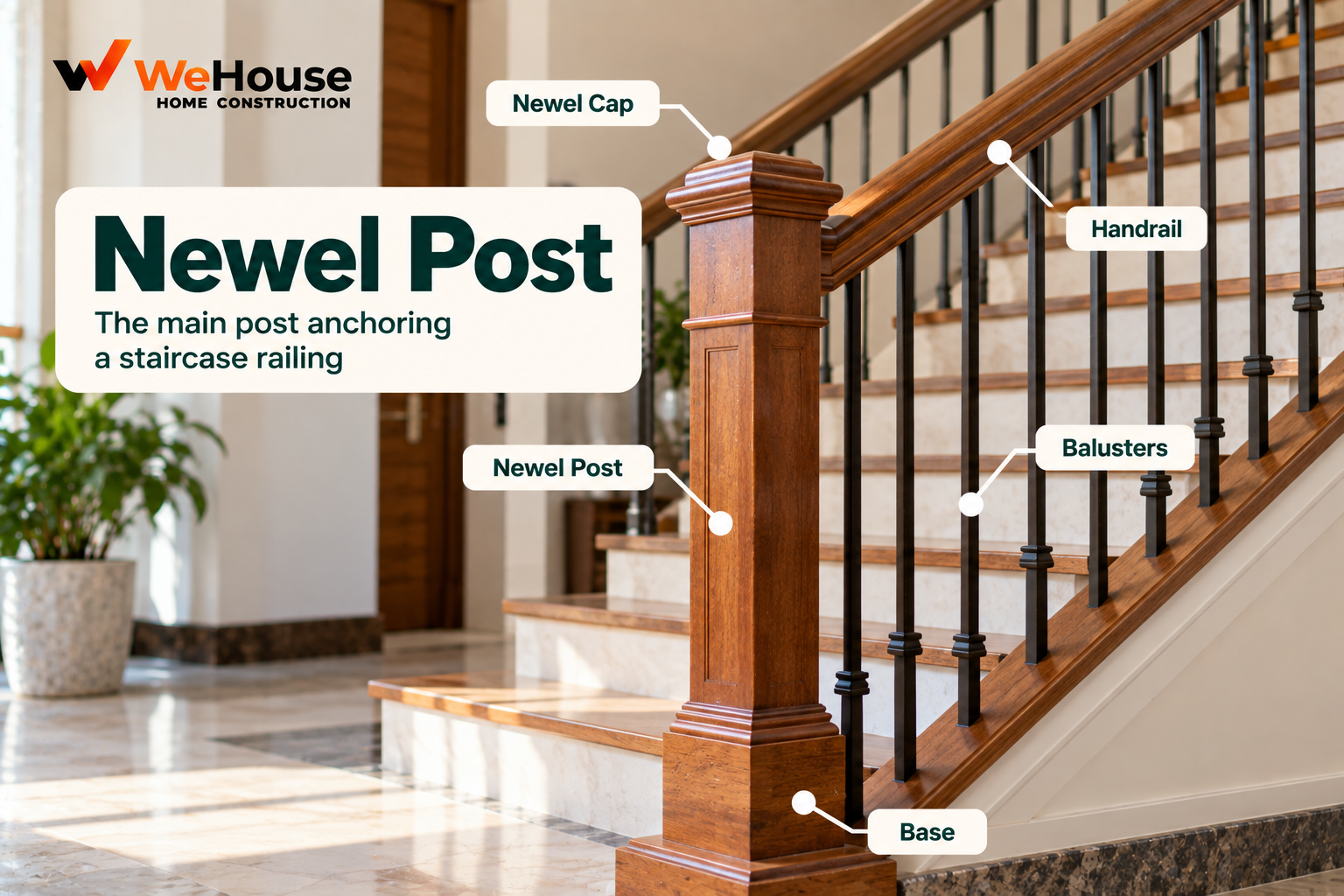
 What is a newel post?
A newel post is the principal vertical support post of a staircase handrail or balustrade system, positioned at the bottom of a flight, the top, and at any intermediate landing where the staircase turns direction. Unlike the intermediate balusters spaced along the length of a railing, which mainly provide lateral support and prevent objects or people from passing through the railing, the newel post is the primary structural anchor — the point the handrail actually terminates at and is firmly fixed to, bearing much of the load a person leaning on or gripping the railing applies.
Why is the newel post the critical structural element of a staircase railing?
A handrail running along a staircase flight needs secure anchoring at both its start and end, and at any point where it changes direction, to remain rigid and safe under the lateral and downward force a person applies when gripping or leaning on it. The newel post provides exactly this anchoring, typically fixed securely into the structural floor slab, landing, or staircase stringer below it using bolts, an embedded steel plate, or, for a timber post, a substantial mortise and tenon or similar mechanical joint. Intermediate balusters, by contrast, are generally lighter members spaced along the railing's length that stiffen the railing against lateral deflection between newel posts but are not individually engineered to anchor the entire railing's structural load — which is why a loose or inadequately fixed newel post is a significantly more serious safety concern than a single loose intermediate baluster.
What materials are newel posts made from?
| Material | Typical use |
|---|---|
| Timber (wood) | Traditional and contemporary residential staircases, often matched to the handrail and flooring material |
| Metal (steel, wrought iron, stainless steel) | Contemporary designs, often combined with glass or cable railing infill |
| Stone or masonry | Heavier, more substantial decorative applications, sometimes in grander or heritage-style staircases |
| Glass (less common, as a design feature) | Rare, typically combined with a separate structural anchoring system concealed within the glass panel design |
How is a newel post properly anchored?
A newel post's anchoring method depends on the staircase structure it is fixed into. For an RCC staircase, the post is commonly bolted to an embedded steel plate or anchor cast into the concrete step or landing, or fixed using heavy-duty chemical or mechanical anchor bolts drilled into the hardened concrete. For a timber staircase, the newel post is typically fixed with a substantial mortise and tenon joint into the stringer, or bolted through the stringer with a structural bracket. Whichever method is used, the connection needs to resist both the downward load of someone leaning their weight on the handrail and the lateral (sideways) force applied when gripping and pulling on the rail, which is a meaningfully different and often higher-demand loading condition than the rail simply resting in place.
What goes wrong with newel posts on site?
- Inadequate anchoring, where the post is fixed with insufficient bolts, an undersized bracket, or into material (such as a thin screed rather than the structural slab beneath it) that cannot actually resist the applied load.
- Post wobble or looseness developing over time, often from an anchoring method that was adequate initially but loosens under repeated use, particularly common with older or poorly maintained timber staircases.
- Insufficient post height relative to current building code or safety guidance for railing height, a common issue in older staircases built before current height standards or simply built without reference to a specific height requirement.
- Decorative posts chosen without adequate attention to their structural anchoring capability, where an aesthetically striking but structurally under-engineered post design compromises actual safety performance.
Because a staircase railing's entire structural integrity ultimately depends on how securely its newel posts are anchored, a firm, deliberate push-and-pull test on any newel post — checking for any detectable looseness or flex — is a simple, worthwhile verification before relying on a staircase railing, particularly in an older building or one of uncertain construction quality.