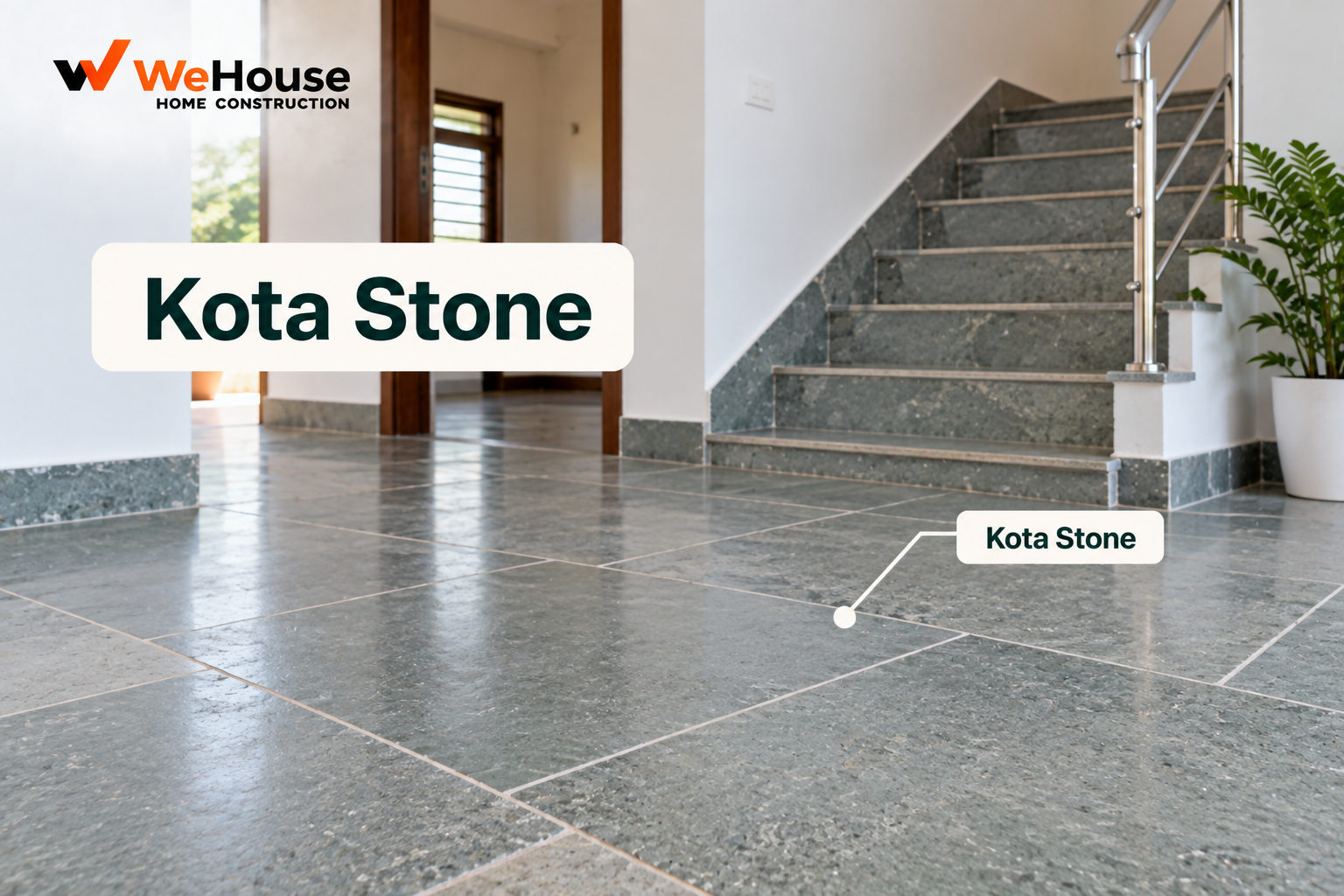
 What is Kota Stone?
Kota Stone is a natural limestone, quarried predominantly from the region around Kota in Rajasthan, valued in Indian construction for a combination of genuine hardness and durability, relatively low water absorption compared to many other natural stones, and a distinctive natural colour range running from green-blue to grey and beige tones, giving each floor a subtly variegated, natural appearance rather than the uniform look of manufactured tile.
Why is Kota Stone so widely used in India?
Its popularity rests on a combination of factors that are somewhat unusual to find together in one material: it is a genuine natural stone, giving it an appearance and durability advantage over many manufactured flooring products, while remaining considerably more affordable than most other natural stone options such as granite or imported marble, largely because it is quarried domestically at scale and does not require the same level of processing as some other stone types. Its low porosity also makes it reasonably resistant to staining and water absorption compared to more porous natural stones, an important practical consideration in India's climate, particularly for verandahs, courtyards and other semi-exposed areas.
Where is Kota Stone commonly used?
| Application | Why it's chosen |
|---|---|
| Residential flooring (living areas, budget projects) | Cost-effective natural stone alternative to tile or more expensive stone |
| Verandahs, courtyards, semi-open areas | Good durability and low water absorption for semi-exposed conditions |
| Office and institutional flooring | Hard-wearing, easy to maintain over high foot traffic |
| Staircases | Durability and slip resistance when properly finished |
| Wall cladding (less common, decorative use) | Natural stone texture and tone for feature walls |
How is Kota Stone flooring laid and finished?
Kota Stone slabs, whether cut to regular tile sizes or supplied as random irregular pieces, are laid on a cement mortar bedding layer over the prepared structural slab or sub-base, with joints filled using cement slurry or grout. Unlike many manufactured tiles that arrive pre-polished, Kota Stone is commonly polished after laying, using progressively finer grit polishing discs (traditionally by hand, now more often with a mechanical floor polishing machine) to achieve the smooth, glossy finish it is typically associated with — a process that also helps level minor unevenness between adjacent slabs from the original laying. A final coat of oxalic acid wash or a stone sealant is sometimes applied to enhance shine and provide some additional stain protection.
What are the trade-offs of Kota Stone versus other flooring options?
- Versus vitrified tile. Kota Stone generally costs less and offers genuine natural stone character, but vitrified tile typically offers more consistent colour and pattern uniformity and, being factory pre-polished, needs less on-site finishing labour.
- Versus marble or granite. Kota Stone is considerably more economical, though marble and granite generally offer a wider colour and pattern range and, in the case of granite, somewhat greater hardness and scratch resistance for very high-traffic areas.
- Versus IPS flooring. Kota Stone offers a more finished, polished appearance suitable for living spaces, while IPS flooring is generally chosen specifically for utility areas where appearance matters less than raw durability and cost.
What quality checks matter when using Kota Stone?
Colour and thickness consistency between slabs from the same batch matters for a uniform finished appearance, since natural stone inherently varies somewhat from piece to piece, and mismatched thickness between adjacent slabs can leave an uneven floor surface if not carefully sorted and laid. Checking that slabs are free of visible cracks or excessive porosity (which affects both staining resistance and long-term durability) before laying, and ensuring adequate curing time for the mortar bedding before the floor is subjected to heavy foot traffic or the polishing process begins, are the main practical quality points worth confirming on site.