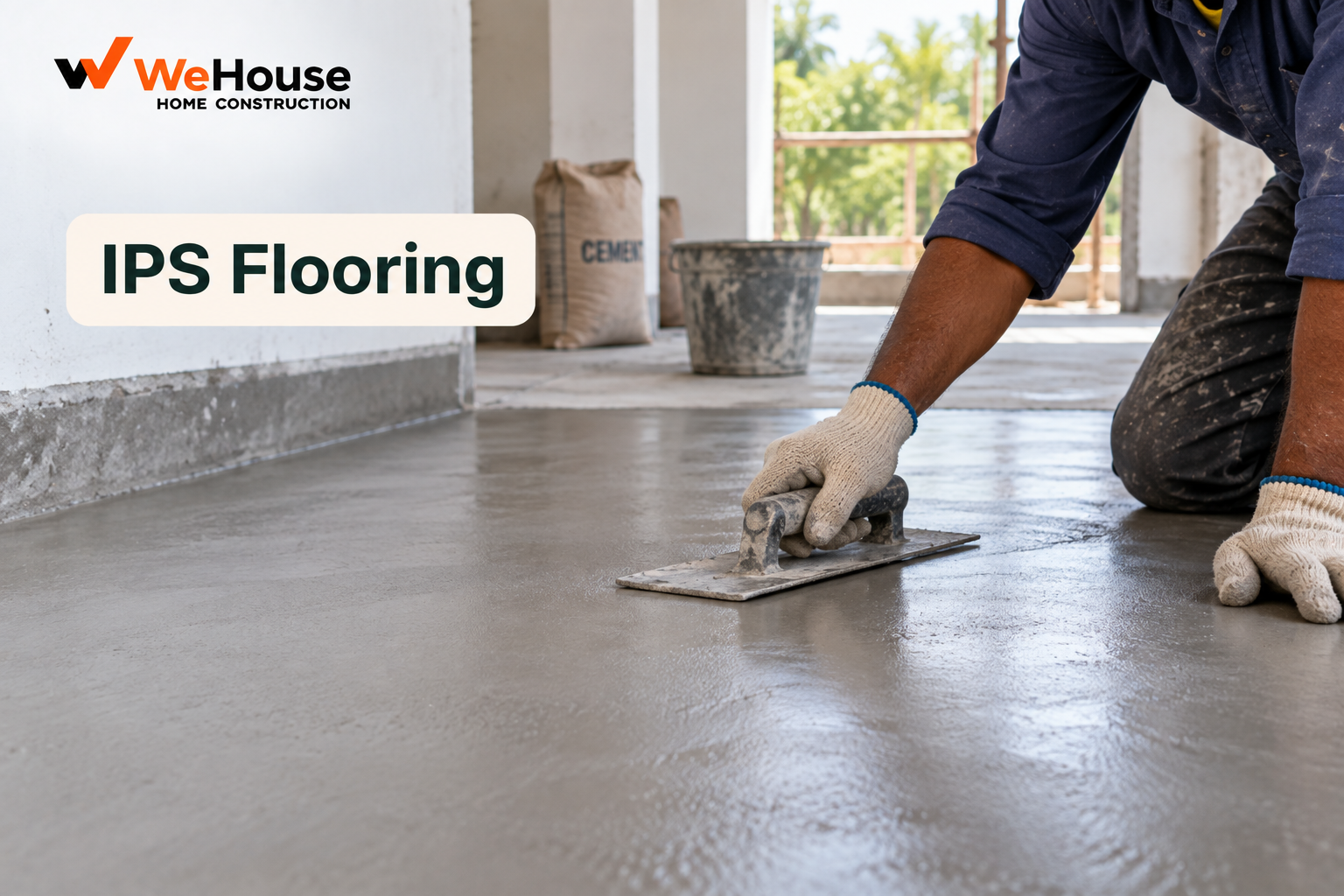
 What is IPS flooring?
IPS, short for Indian Patent Stone, is a cement concrete flooring finish laid directly on a prepared sub-base or structural slab, compacted and finished with a trowel to produce a smooth, hard, durable surface. Despite the name, it is not a natural stone product at all — it is essentially a well-proportioned, carefully finished concrete floor, distinguished from ordinary structural concrete mainly by the deliberate trowel finishing process that gives it a smooth, wearable surface suitable to walk and drive on without a separate tile or stone covering.
Where is IPS flooring typically used?
- Terraces and exposed roof areas. IPS is a very common terrace finish in Indian residential buildings, valued for its durability against sun and rain exposure, though it is typically laid over a proper waterproofing membrane rather than relying on the IPS layer itself to keep water out.
- Garages and driveways. The hard, abrasion-resistant surface tolerates vehicle traffic and oil or fuel spills better than most tile finishes.
- Utility areas and service yards. Wash areas, back-of-house utility spaces, and similar functional areas where a hard-wearing, easily cleaned, water-resistant floor matters more than appearance.
- Staircases (particularly external or service staircases). A durable, slip-resistant (when properly textured) finish suited to heavy foot traffic.
- Industrial and warehouse floors. Often specified with an integral floor hardener for significantly enhanced abrasion resistance under heavy equipment or forklift traffic.
What mix and thickness is used for IPS flooring?
A typical IPS floor uses a 1:2:4 cement-sand-coarse aggregate mix by volume, laid to a thickness of roughly 40-50 mm over the prepared base, though richer mixes and greater thickness are used for higher-traffic or industrial applications. The floor is laid in bays, typically around 1 to 1.5 metres square, separated by joints (either true construction joints or tooled control joints) that allow the concrete to shrink slightly during curing without cracking randomly across the floor — a critical detail, since an IPS floor laid as one large continuous slab without joint control is highly prone to random shrinkage cracking.
How is IPS flooring finished?
| Finish type | Description |
|---|---|
| Plain trowel finish | Smooth, hand or power-trowelled surface, standard for most utility and terrace applications |
| Floor hardener finish | A dry-shake metallic or non-metallic hardener compound trowelled into the surface while still fresh, significantly boosting abrasion resistance for industrial or heavy-traffic floors |
| Textured / broom finish | A lightly textured surface, created by dragging a broom or similar tool across the still-wet surface, improving slip resistance for ramps, staircases and exterior areas |
The finishing process is done while the concrete is still workable but has begun to stiffen, using a steel trowel (by hand for smaller areas, or a power float/trowel machine for larger floors) to compact and smooth the surface, a skill that significantly affects the final floor's density, smoothness and durability — a poorly trowelled IPS floor can be noticeably more porous and prone to dusting than a well-finished one from the same mix.
Does IPS flooring need waterproofing underneath?
Yes, particularly on a terrace or any exposed roof application. IPS flooring itself, being ordinary cement concrete, is not inherently waterproof and can allow some water penetration over time, especially through shrinkage cracks that develop at joints or from wear. A proper waterproofing membrane or treatment should be applied to the structural slab underneath before the IPS layer is laid, with the IPS functioning as a protective and wear-resistant top layer rather than the primary waterproofing barrier — a distinction sometimes lost on budget projects that treat IPS as a substitute for proper waterproofing rather than a complement to it.
What goes wrong with IPS flooring on site?
- No proper joint layout, leading to random, uncontrolled shrinkage cracking across the floor rather than the intended, largely invisible cracking confined to planned joint lines.
- Poor trowel finishing, producing a porous, dusty or uneven surface, particularly common where finishing is rushed or done by inexperienced labour.
- Treating IPS as a substitute for waterproofing on a terrace, rather than laying it over a properly designed and tested waterproofing membrane.
- Inadequate curing, since IPS is cement-based like any other concrete work and needs the same minimum curing period to reach full hardness and durability.